Bosnia: The Emerald of the Balkans
Bosnia: The Emerald of the Balkans

August 2025
Dr. Mufti Abdur-Rahman ibn Yusuf Mangera
Some history
For much of the last three centuries, Bosnia’s Muslim population, primarily Bosniaks, has lived through dramatic shifts in empire, ideology, and identity. In the 18th century, Bosnia was still part of the Ottoman Empire, a realm where Islam was not just a religion but the foundation of law, culture, and daily life. Sarajevo and other cities thrived as centres of Islamic scholarship, sufi mysticism, and trade. Mosques, madrasas, and charitable endowments (waqf) shaped the urban landscape, and the ‘ulama’ held considerable sway. Yet as the Ottoman Empire began to decline, Bosnian Muslims faced growing uncertainty. European powers loomed, and nationalist movements stirred in neighbouring Christian populations, leaving many Muslims anxious about their future.
That anxiety became reality in 1878 when Austria-Hungary occupied Bosnia, later annexing it in 1908. The shift from Islamic governance to a secular, Catholic monarchy was jarring. Islamic law was replaced, religious institutions were sidelined, and many Bosniaks feared cultural erasure. Many chose to emigrate to Ottoman lands, especially Turkey, forming a diaspora that still exists today. Those who stayed worked to preserve their identity, but it was difficult.
After World War I, Bosnia became part of the Kingdom of Yugoslavia. Muslims were not recognized as a distinct nation and were often pressured to identify as either Serbs or Croats. This erasure of identity was compounded by political instability and economic hardship. During World War II, Bosnia became a brutal battleground. Bosniak Muslims found themselves caught between fascist and communist forces, with some joining resistance movements and others suffering atrocities. The war deepened ethnic divisions and left lasting scars.
Following the war, Bosnia entered a new chapter under socialist Yugoslavia. Initially, Muslims were marginalized, but by the 1970s, Bosniaks were officially recognized as a distinct ethnic group. Still, Islam was heavily suppressed. Mosques were closed, religious education banned, and imams monitored. Yet faith endured. Many practiced Islam quietly, in homes and hearts, and sufi orders like the Naqshbandi and Qadiri kept spiritual traditions alive. Sarajevo remained a cultural beacon, and Bosniak intellectuals found ways to celebrate their heritage through literature and art, even under state scrutiny.
The collapse of Yugoslavia brought both hope and horror. After Bosnia declared independence in 1992, it was engulfed in a brutal war. Bosniak Muslims were targeted in a campaign of ethnic cleansing by Serb forces. Some would argue that many Bosniaks had lived secular lives, their Islamic identity faded under communism. It was only when they were violently targeted for their Muslim names—sometimes by their own neighbours—that this dormant identity was shockingly reawakened. The genocide at Srebrenica in 1995, where over 8,000 Muslim men and boys were murdered, became a symbol of the brutality faced by Bosniaks. Mosques were destroyed, communities shattered, and Islamic heritage deliberately erased. Yet even in the face of such horror, faith became a source of resilience. Global Muslim communities rallied in support, sending aid and volunteers, and Bosnia’s suffering became a rallying cry for solidarity.
Since the war’s end, Bosnia has struggled to rebuild. Mosques have been restored, Islamic schools reopened, and the Islamic Community of Bosnia and Herzegovina has emerged as a vital institution. But challenges remain. Political fragmentation, economic hardship, and rising Islamophobia continue to test the community. Still, Bosniak Muslims persist, asserting their identity through education, activism, and interfaith dialogue. The diaspora, especially in Western Europe, plays a crucial role in preserving culture and supporting Bosnia’s future.
The Dayton Peace Agreement
The Dayton Peace Agreement, signed in 1995, ended the Bosnian War but froze the country in a deeply fragmented political structure. It divided Bosnia and Herzegovina into two entities: the Federation of Bosnia and Herzegovina (shared between Bosniaks and Croats) and Republika Srpska (dominated by Serbs). While this arrangement stopped the bloodshed, it entrenched ethnic divisions and created a system where governance is paralyzed by constant vetoes, ethnic quotas, and competing nationalist agendas.
For Bosniak Muslims, the outcome was particularly unjust. Despite being the largest ethnic group and the primary victims of genocide and ethnic cleansing, they were denied a unified political space. Unlike Serbs, who have Serbia, and Croats, who have Croatia, Bosniaks were left with no independent homeland. Instead, they were forced into a power-sharing arrangement with Croats in the Federation, while Republika Srpska was effectively handed to the very forces that had committed atrocities against them.
The Dayton system institutionalised ethnic identity as the basis for political representation. The presidency rotates among a Bosniak, a Croat, and a Serb, and major decisions require consensus across ethnic lines. This has led to chronic gridlock, where nationalist leaders can block reforms simply by appealing to their ethnic constituencies. For Bosniaks, who often push for a more unified and functional state, this structure has been a straitjacket, preventing progress and reinforcing the divisions that Dayton was supposed to heal.
In essence, Dayton ended the war but denied Bosniak Muslims the political dignity of self-determination. It rewarded territorial conquest and ethnic cleansing with autonomy, while forcing the victims into compromise. Nearly three decades later, Bosnia remains stuck—its future hostage to a peace deal that prioritized stability over fairness.
Furthermore, while Serbs and Croats in Bosnia can hold dual citizenship with Serbia and Croatia respectively, benefiting from kin-states that represent their interests, Bosniaks have no such external homeland and are confined to a fragmented state where their political will is diluted by ethnic vetoes and power-sharing arrangements.
Since the end of the war, Bosniaks have continued to migrate abroad in large numbers, driven not only by the trauma of conflict but by the persistent political dysfunction and economic stagnation that followed. Despite living in one of the most naturally beautiful countries in Europe, with rich cultural heritage and deep historical roots, many have felt forced to leave in search of stability, opportunity, and dignity. I’ve met Bosnians in places like Australia, America, Germany, and the UK, and their stories often carry a bittersweet tone: pride in their homeland, sorrow for its broken politics, and hope for a better life elsewhere. Their migration is not a rejection of Bosnia, but a reflection of how hard it has become to thrive there.
One of the Bosnian imams I later spoke to put it like this: Allah has blessed Bosnia with immense natural beauty and abundant resources—rivers, forests, fertile land, and even valuable minerals like lithium. Yet, he lamented that the people haven’t been able to build on these gifts, largely because of the tangled and dysfunctional political system that keeps the country stagnant, among other reasons. Instead of development, there’s confusion, division, and constant interference from external interests who all want a piece of Bosnia’s potential. This lack of clarity and direction has pushed many families to scatter across the world, seeking stability and reassurance they can’t find at home. Bosnia remains rich in what it has, but poor in what it’s allowed to become.
Why Not Just Bosnia? The Meaning of Herzegovina
The name Bosnia and Herzegovina refers to two distinct historical and geographical regions within one nation. Bosnia encompasses the northern and central areas, named after the Bosna River, and was once the core of the medieval Bosnian Kingdom. Herzegovina, the smaller southern region, derives its name from the 15th-century title Herceg (Duke), meaning “the Duchy’s land.”
My Trip to Bosnia
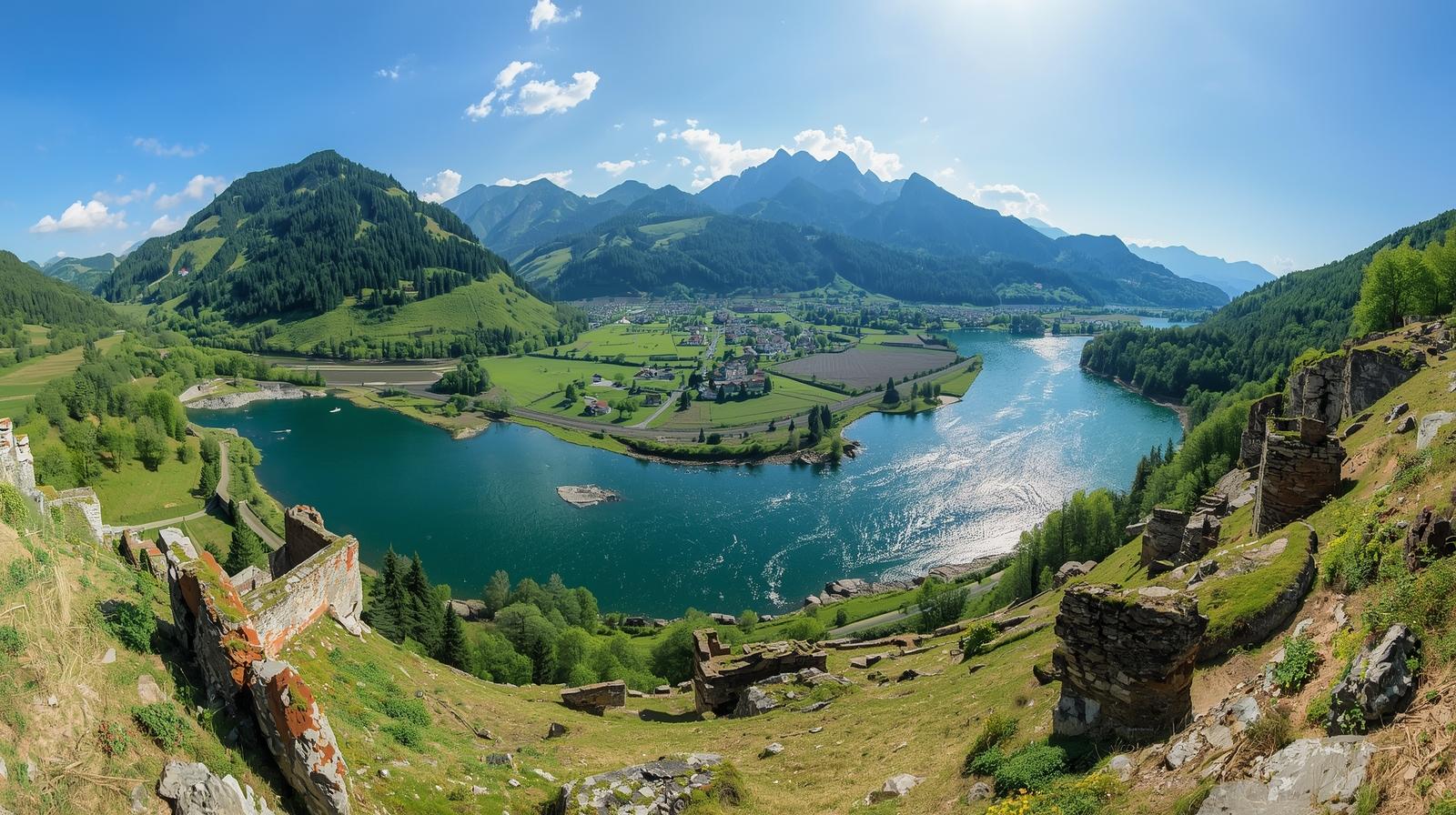
Alhamdulillah, after my youngest two children completed their memorization of the Qur’an, we decided to celebrate with a special trip, finally dedicating time to explore Bosnia, a country I had intentionally saved during my 2022 Balkan tour for its depth and beauty. Despite the complex political backdrop, Bosnia truly feels like a gifted land: welcoming people, breathtaking nature, and a profound sense of history and faith. I refer to it as the “Emerald of the Balkans,” a title earned by its stunning rivers, lush landscapes, and the overwhelming serenity that defines so much of the country. It remains one of the most picturesque and spiritually uplifting places I have visited, with a noticeably strong presence of Islamic scholars compared to other Balkan nations.
For families, renting an apartment proved far more practical and economical than booking hotel rooms. Not only did it offer a private, central living space where we could relax together, but it also allowed us to prepare our own meals, adding both convenience and cultural immersion to our journey.
Flight tickets from London on Wizz Air were around £100 per person, though adding checked baggage increased the cost. Booking early or outside peak seasons can make travel even more affordable.
Renting a car is highly recommended for exploring Bosnia comfortably. While seven-seaters come at a premium, standard five-seat vehicles are reasonably priced. Driving was surprisingly pleasant; roads were well-maintained, clearly marked, and far less congested than British motorways like the M1 or M6. Most routes are single or dual-carriage A-roads, with occasional modern toll segments costing between 1.50 to 5 BAM. Speed limits reach 130 km/h on open highways and drop to 100 km/h in tunnels. I was especially impressed by how clean the roadsides were, free of the litter so often seen elsewhere.
The official currency is the Convertible Mark (BAM), pegged securely to the Euro at 1 EUR = 1.95583 BAM. Banknotes come in 10, 20, 50, 100, and 200 BAM denominations. While many vendors also accept Euros, the exchange rate they apply is often rounded down for simplicity (e.g., treating 1 BAM as half a Euro), so paying in local currency is usually better value.
Thursday 31 July 2025
At immigration, the process was very quick. The officer stamped our passports so fast I don’t think they were even scanned, though they were scanned on our way back.
We picked up our rental car from the airport. Velid, the brother who handled the rental, had us sign all the paperwork. I’d heard online about scams involving cars not showing up or being in poor condition when not booked through well-known companies, but we’d arranged ours through a friend’s contact. It worked out to about 45 euros per day for the seven-seater. Velid also helped us get local SIM cards, which were around 10 GB for just 5 euros.
We drove twenty minutes to our rented apartment in Sarajevo’s Bistrik neighbourhood. Bistrik is an older, largely residential area on the left bank of the Miljačka River, known for its historic charm, cobbled streets, Ottoman-era houses, and walking distance to Baščaršija, the old town. While staying in the old town itself—as we did later in Mostar—has its benefits, it can be very busy and touristy. Our location offered the best of both: a quiet residential area that was still close enough to walk to the old city, though some might find the hilly terrain a bit challenging.
Just as we began unpacking, my phone rang. A man speaking Arabic insisted I hadn’t paid for the rental car. Confused, I explained that not only had I paid in cash, but Velid had given me 10 marks back, which covered the airport parking. The caller grew more persistent, so I asked to speak directly with Velid. To my surprise, he got on the line, in English, and echoed the same claim: we hadn’t paid. My heart sank. Had we been scammed after all?
Then, a moment of clarity. “Which car are you talking about?” I asked. “A VW Sharon,” Velid replied. Relief washed over me. “We have the Renault Grand Scenic.” Apologies followed immediately; he’d mistaken us for another customer. What felt like a tense scam turned out to be a simple case of mistaken identity.
Our apartment turned out to be ideal: three bedrooms, two bathrooms, a generous terrace, and even a private garden. The owner’s parents lived upstairs and offered help whenever needed. Best of all, we had dedicated parking, a lifesaver in a city where ancient streets clashed with modern cars, and every inch of curb was precious.
Friday 1 August 2025
Since it was Friday, we came to the masjid, and by about 11:50 it was already quite packed. We found a spot outside in the courtyard, beneath the shade of a large tree. Mats had been laid out for the overflow of worshippers, and many people were seated there. On the left-hand side was a separate section for women, and quite a few had gathered. There were also women without hijab, looking like ordinary westerners, who stood respectfully at the side listening to the khutbah and du’as.
The programme began with recitation of the Qur’an, followed by several supplications, especially for the person who had built the mosque and the surrounding area. The khutbah itself was in Bosnian and lasted about 15 to 20 minutes. After a short pause, the second khutbah was very brief — just a few lines of du’a — and then the iqama was given.
An older imam appeared to be leading the prayer. His tajwid was fine, though his pronunciation of the letter ṭa (ط) was slightly off. While Bosnians have been heavily influenced by the Ottomans, especially in the style of their mosques and many other things, they don’t share the Turkish way of pronouncing the u sound.
In Turkish, the letter “ü” is a close front rounded vowel, pronounced like the German “ü” in München—similar to an “ee” sound with rounded lips. When some Turkish speakers recite the Qur’an, some vowels are pronounced according to Turkish phonology, which differs from classical Arabic intonation and goes against the rules of tajwīd.
After salat, we met at least ten families from the UK who were also visiting Bosnia on holiday. It was quite something to congregate with so many fellow Britons after the prayer. Over the course of our trip we must have met more than twenty families in total, several of whom I already knew. Bosnia has clearly become a very popular destination of late.
We wanted to go inside the masjid once the main congregation had dispersed. However, we were asked to wait, as a Qur’an completion was underway. Every single day they complete a khatam of the Qur’an for the mosque’s founder, in accordance with his bequest. This may be one of the few places in the world where such a practice continues daily, and it has been done for more than three centuries, even during the war. The khatam takes about 30 minutes, with around 30 people each reciting one juz’, followed by du‘a’ to send the reward to the founder, Ghazi Husrev Beg.
What an honour and blessing for him, that this has continued unbroken for so many centuries. How accepted his works, deeds and investments must have been, that Allah grants him such ongoing reward from this world.
Gazi Husrev Bey
Gazi Husrev Bey was a towering figure of the Ottoman era, remembered not only for his military successes but above all for the legacy he left to Sarajevo. Born in 1484, he was the maternal grandson of Sultan Bayezid II and the great-grandson of Sultan Mehmed Fatih. As the governor of the Sanjak of Bosnia, he led campaigns that pushed Ottoman influence further into Croatia and Hungary. Yet his most enduring achievements were not on the battlefield, but in the heart of the city.
He poured his vast wealth into Sarajevo, transforming it into a flourishing urban centre. With his endowment, he established mosques, schools and libraries — most notably the Gazi Husrev-beg Mosque and its adjoining madrasa and library. He left all his fortune in trust, so that generations after him would continue to benefit. Even today, people speak of his generosity: he gave freely to the poor, set up endowments for the community, and provided interest-free loans, a practice still remembered with gratitude.
In the courtyard of the mosque stands a fountain, its water, they say, is drawn through seven kilometres of stone pipes from the mountains since 1530. The water is clear, cold and wonderfully refreshing, just as it must have been nearly five centuries ago. All around Sarajevo’s old town, similar fountains, known as sabils, or water pathways, offer cool mountain water to passers-by. It reminded me of Prizren in Kosovo, a picturesque hillside town where springs tumble down from the mountains, feeding the streets with fresh water.
During our visit, we met one of the mosque’s imams, Salih Khalilović. By the terms of Husrev Bey’s original endowment, every imam here must be a hafiz of the Qur’an, and Salih fulfils that tradition. He studied at al-Azhar, earned his master’s at Sarajevo University, and is now pursuing his doctorate.
The caretaker of the mosque welcomed us warmly, his gentle manner leaving a deep impression. He took us around the complex, pointing out details we would have easily overlooked, while our friend Samir kindly translated.
From the courtyard of the Gazi Husrev-beg Mosque, one’s eyes are naturally drawn to the Clock Tower.
Standing tall as a proud symbol of Sarajevo’s Ottoman heritage, the Sahat-kula is the highest of Bosnia and Herzegovina’s 21 surviving clock towers. Rising 30 metres above the old town, it was declared a National Monument in 2006.
What sets this tower apart is not just its stature but its timekeeping. Unlike ordinary clocks, it follows the lunar system and uses Eastern Arabic numerals. Most striking of all, its hands are adjusted so that 12 o’clock always coincides with the moment of sunset, marking the time for Maghrib prayer. A dedicated timekeeper, or muwaqqit, maintains this sacred rhythm, carefully setting the mechanism each week.
The tower’s story is woven closely with that of the city. First built in the 16th century by Gazi Husrev-beg himself, it has endured fire, destruction and rebuilding. Prince Eugene of Savoy’s raid in 1697 left it damaged, but it rose again, with major reconstruction in 1762. The current clock mechanism was installed in 1874, crafted by the London firm Gillett & Bland, and restored in 1967 with gilded details that still gleam today.
That Friday, our friend Sameer had driven up from Montenegro with his family, and we met them at Jumu‘a. Sameer has been our companion and guide through much of the Balkans—he hosted us when we travelled through five countries in 2022—and it was good to reunite here.
Before the prayer, we had wandered through parts of the old city, but afterwards, with Sameer leading us, we continued exploring.
Bosnian Masques
Woven into the cobblestone streets of Sarajevo’s old town are its mosques, each carrying the quiet dignity of centuries. Their design follows a recognisably Ottoman pattern: graceful domes, slender minarets and tranquil courtyards that draw people together. There is a rhythm to them, one mosque leading to another, sometimes only 30 or 40 metres apart, so that as you wander the historic quarters, you are never far from the call to prayer.
We were able to visit, or at least pass by, several of these mosques. Among them was the Baščaršija Mosque (Havadža Durak Mosque), built in 1528 and now a national monument at the heart of the bazaar square. Nearby stood the Čekrekčijina Mosque (Čaršijska), the second-oldest domed mosque in Sarajevo, its interior renowned for delicate pastel drawings of floral and vegetal designs. Just beyond the market area, we came to the striking Ali Pasha Mosque, a 16th-century complex of classical Ottoman beauty, its prayer hall framed by a peaceful, garden-like courtyard.
The Mosque Complex
At the centre of each complex lies the mosque itself: a square or slightly rectangular building crowned by a dome of dark grey lead or sometimes vibrant green tiles. Beside it, a slender, pencil-shaped minaret rises skyward, its weathered stone often bearing the marks of time and history.
One never enters these mosques abruptly. First comes the courtyard, a shaded and spacious haven that feels worlds apart from the city’s bustle. An arcade, or galerija, with a sloping roof supported by wooden columns, frames the space. These sheltered walkways sometimes house small offices, shops or cafés, knitting the mosque naturally into the daily life of the neighbourhood.
Within the courtyard, the practical needs of ritual purity are met with fountains or discreetly placed facilities for ablution. From here, the spiritual journey begins, with the covered prayer space flanking the entrance. Open on three sides yet sheltered by the eaves, this area accommodates overflow crowds during Friday prayers and offers worshippers a gentle pause before entering.
Passing through the doorway into the prayer hall feels like stepping into another world. The vast dome overhead creates a sense of serene spaciousness, while light filters through coloured glass to illuminate calligraphy, geometric motifs and the rich hues of kilim carpets spread across the floor. The mihrab (prayer niche) and wooden minbar (pulpit) anchor the room, their simple craftsmanship carrying centuries of devotion.
Beyond the mosques, we continued exploring the old city before and after Jumu‘a, visiting its landmarks, endowments and historic facilities that speak of a community shaped by both faith and daily life.
One of the first sights awaiting a visitor entering from the Latin Bridge is the Sebilj. This elegant, kiosk-shaped fountain is one of Sarajevo’s best-known symbols, though it is the last survivor of the hundreds that once dotted the city. The tradition of such fountains began on the Arabian Peninsula and reached Bosnia during the Ottoman era. Staffed by attendants known as sebiljdžija, they provided free drinking water as a charitable act, funded by the state or through religious endowments.
The Sebilj seen today is not the original. The first, built by Mehmed Pasha Kukavica, stood nearby but was destroyed in a fire. In 1913, during the Austro-Hungarian period, it was replaced by the present structure, designed in a Pseudo-Moorish style by Alexander Wittek. Over the years it has become one of Sarajevo’s most recognisable landmarks, carefully restored both before the 1984 Winter Olympics and again after the Bosnian War.
From there, the path naturally leads into the Baščaršija, the Old Bazaar. More than a district, it is the historic commercial and cultural heart of Sarajevo. One does not simply drift into the old town from here; rather, one enters through it. Its cobbled lanes and wooden-fronted shops funnel visitors deeper into the quarters that surround the city’s mosques, libraries and endowments.
Close by is the Gazi Husrev-beg Bezistan, once an indoor market and still very much alive with trade today. Built in 1555 as part of Husrev-beg’s endowment, it stands beside the remains of his caravanserai and links by an eastern entrance to the mosque, the madrasa and the clock tower. The long, rectangular market stretches for 109 metres, its rows of tiny shops originally cooled by being built below street level — a design meant for storing and selling groceries. Dubrovnik craftsmen were involved in its construction, leaving traces of Adriatic influence in the stonework. Today, the Bezistan hosts boutiques and souvenir stalls, some stocked with trinkets, others with what seemed to be questionable designer goods, all contributing to the lively hum of trade that has endured here for centuries.
When you emerge from the Bezistan, you come across the Tašlihan, or stone inn, a former caravanserai that is now, somewhat oddly, an open-air bar for a nearby hotel. It is a curious sight in the old city, even a mosque nearby sits next to a bar serving alcohol.
Tašlihan is the third stone caravanserai in Sarajevo, built between 1540 and 1543 as an endowment of Gazi Husrev-beg after his death. It originally featured a fountain in its courtyard, with a small mosque resting on its supporting pillars, and upstairs were rooms for travellers. Shops for domestic and foreign merchants lined the ground floor. Evidence suggests that Tašlihan functioned more as a centre of trade than as accommodation for travellers. Unfortunately, a fire in 1879 severely damaged the building, leaving it unusable for its original purpose.
We set out to find somewhere to eat. While many restaurants in the old town claim to be halal, it’s worth noting that some are specifically signposted as halal and do not serve alcohol. In other establishments, alcohol is widely available. It’s still best to ask for certification from the country’s Muslim association. We were informed that chicken tends to be a safer option here than larger animals, which are sometimes not stunned properly unless certified.
Sameer recommended Ćevabdžinica Željo, a kebab shop. It was very busy, but we discovered they have at least three locations throughout the old city, and every one of them was bustling with diners. They are famous for their Ćevapi kebabs, small minced meat kebabs, typically a mix of beef and lamb, grilled and served hot in flatbread, accompanied by chopped onions and optional toppings such as ajvar (a roasted red pepper spread) or kajmak (a type of sour cream). We ordered the kajmak, which proved to be a wonderful accompaniment. I have looked for it since then and have not been able to locate it yet in the UK.
Ćevapi are considered the national dish of Bosnia and Herzegovina, believed to have originated during the Ottoman Empire. They were excellent, and we all agreed that these were the best and cleanest-tasting we had tried anywhere, even though this place was relatively more expensive than others in the vicinity and perpetually busy.
We also noticed a significant number of tourists from Gulf countries, Saudi Arabia, Kuwait, Oman, and others. Their presence seems to have increased over the past four years, especially since COVID, with Arabic signs appearing throughout Sarajevo and other cities. Many of the women among these visitors wore hijabs or even niqabs (face veils). It must be comforting for them to enjoy the beautiful scenery of Europe while feeling at home among a predominantly Muslim population.
We then visited the Gazi Husrev-beg Library, founded in 1537 as part of the larger complex that includes the Gazi Husrev-beg Madrasa. The library houses one of the most significant collections of Islamic manuscripts in Bosnia and Herzegovina, including many originally donated by Gazi Husrev-beg himself. Remarkably, the collection survived the Bosnian War and the Siege of Sarajevo. Today, the library holds around 100,000 items in Arabic, Turkish, Persian, Bosnian and various European languages, including books, journals, newspapers, documents and photographs. After ten years of construction, the new three-storey library reopened on 15 January 2014. Its glass and marble façade gives it an imposing, modern presence, though a fee is required to visit, as with the madrasa next door.
This visit reminded me of the Institute of Oriental Studies in Sarajevo, which I had contacted years earlier about a manuscript for my PhD. It was a copy of Abu ’l-Layth al-Samarqandi’s Kitab al-Nawazil, the first Hanafi fatwa collection, copied in 413/1023. Sadly, it had been destroyed in 1992 along with thousands of other manuscripts. If the catalogue entry was accurate, it had been copied only forty years after the author’s death, likely making it the oldest known copy.
Close by stands the historic Gazi Husrev-beg Madrasa, a cornerstone of the old city directly opposite the mosque. Founded in 1537 as a pious endowment (waqf) by the Ottoman governor, it is the oldest educational institution in Bosnia and Herzegovina and has offered nearly five centuries of continuous education. Built in the style of Istanbul madrasas, it is famously known as Kuršumlija for its distinctive lead-covered roof (kurşun in Turkish). The architecture is striking, with the older section featuring over 24 domes and 12 chimneys. The large, domed central courtyard was once surrounded by student dormitories. Above the entrance, an Arabic inscription dedicates the building “to those in search of knowledge and God’s love.” Initially established in honour of Gazi Husrev-beg’s mother, the madrasa now also hosts a museum and temporary exhibitions, standing as a timeless national monument to Sarajevo’s Ottoman scholarly heritage.
There are several other landmarks in the city that attract tourists. The Eternal Flame (Vječna Vatra), frequently listed as a must-see, was, in our experience, less inspiring than anticipated. Unveiled in 1946 on the first anniversary of Sarajevo’s liberation from World War II, it honours the city’s liberators. The memorial consists of a simple, perpetually burning flame set within a copper wreath of bay leaves, placed against tiles in the blue, white and red colours of the former Yugoslav flag, symbolising eternal remembrance.
Though historically significant, its presentation is understated. For us, it registered primarily as a flame that has been kept alight for decades, lacking the immediate emotional resonance or depth found at some of the city’s more immersive monuments.
The old city also hosts several museums, though we were unable to visit them all. Our visit to the War Childhood Museum, however, was profoundly moving. The experience was hushed and reflective, the weight of personal history palpable. The impact did not come from grand narratives, but from the intimate, ordinary objects on display — a diary, a worn doll, a can of aid food. Each artifact was a portal into a child’s world during the siege, their stories heartbreaking in their simplicity and resilience. Reading of daily fears, tiny acts of courage, and the stark loss of normalcy made the abstract notion of conflict devastatingly personal. It was a powerful reminder of the universal cost of war, most poignantly borne by the innocent, leaving us with a deep and lasting sense of empathy and solemn reflection.
On our way back to Bistrik, we crossed the famous Latin Bridge, an Ottoman-era span over the Miljacka River that we use each time we enter the old city from Bistrik. Nearby is the site where Archduke Franz Ferdinand was assassinated, an event that triggered the First World War.
A little further down the river stands Sarajevo City Hall, locally known as Vijecnica. Built between 1892 and 1894 in a pseudo-Moorish style to honour the Muslim heritage of the Austro-Hungarian territory, its façade was inspired by Cairo’s Mamluk-period architecture. Nestled on the riverbank, the building has served as a city hall, a parliament house, and, during the communist period, the National and University Library of Bosnia and Herzegovina.
During the siege of Sarajevo in 1992, the building was hit by artillery and incendiary bombs, resulting in a devastating fire that destroyed almost the entire library collection, including many 16th-century manuscripts. After extensive restoration, City Hall reopened on 17 July 2014 and now functions as the seat of the Mayor and the Sarajevo City Council, while also hosting two museums: one on the Siege of Sarajevo, and the international contemporary art collection, Ars Aevi. Its elegant main hall, with a hexagonal layout, balconies, and intricate plasterwork in white, yellow, turquoise, and brown Islamic motifs, has made it a favourite with wedding photographers. Its style reminded me of the Islamic architecture of Andalusia, standing in striking contrast to the older Ottoman landmarks we had seen.
On the opposite side of the old city, on our way to Bistrik, one of the most striking architectural landmarks was a green mosque that had always caught my eye.
Rising from the old cobblestone streets, the Emperor’s Mosque is crowned by a dome of luminous green that immediately draws the eye.
Isa-bey Ishakovich-Hranushich built the mosque in 1457, dedicating it to Fatih Sultan Mehmed II, the Conqueror of Constantinople. It was the first mosque in Sarajevo and remains a central landmark. The Emperor’s Mosque (Careva Džamija, Turkish: Hünkâr Camii) is the largest single-subdome mosque in Bosnia and Herzegovina, constructed in the classical Ottoman style of the period.
Considered one of the most beautiful mosques of the Ottoman era in the Balkans, it features a spacious interior and high-quality decorative details, including a finely crafted mihrab. The earliest settlements in Sarajevo developed around the mosque, and the residence of the Sultan’s representative was built next to it. Isa-bey also established a hammam (public bath), a bridge that led directly to the mosque, later disassembled during the Austro-Hungarian period and rebuilt a few metres upstream, and the caravanserai Kolobara-han across the river. To finance these facilities, Isa-bey left a heritage of shops and land properties.
The first mosque was smaller and constructed of wood. A more substantial mosque was built in 1565 to accommodate the growing Muslim population of Sarajevo. This occurred during the reign of Sultan Suleiman the Magnificent (d. 1566), when Mimar Sinan (d. 1588), the renowned Ottoman architect and engineer, served as chief architect. Side rooms were added in 1800 and connected via a door to the central prayer area in 1848. Between 1980 and 1983, the painted interior decorations were carefully conserved and restored, preserving the mosque’s historic character.
Initially, the mosque served modest functions, reflecting its simple form. As Sarajevo grew and its Muslim community expanded, the mosque’s role developed, becoming a centre of worship and community life, a lasting symbol of the city’s Ottoman heritage.
For me, the most breathtaking aspect was the mosque’s masterful and immersive use of green, not merely as an accent but as a complete, enveloping theme. The entire structure is crowned by a magnificent dome, a deep, resonant emerald that seems to drink the sunlight and glow from within. This celestial hue is echoed by the slender minaret, a green needle connecting the earthly realm to the sky.
The harmony truly unfolded within the courtyard. The sacred green of the architecture extended beyond the walls, meeting the living greenery of the surrounding garden. The vibrant jade of the painted pulpit and the intricate leaf-green patterns of the mihrab inside seamlessly conversed with the natural world outside. Ancient trees dappled the stone paving with shifting shadows, while lush grass and climbing vines provided an organic counterpoint to the structured artistry.
It was this profound dialogue between the crafted green of tile and paint and the wild green of nature that impressed me most. The mosque did not merely stand in its garden; it was part of it, a symphony in every possible shade of serenity, making the entire space feel less like a built structure and more like a living, growing piece of paradise.
Beside the Emperor’s Mosque lies the burial ground, containing the graves of viziers, scholars, muftis, sheikhs, mosque employees, and other dignitaries of Sarajevo.
We learned that during the Bosnian war, approximately 700 mosques and other Islamic monuments across the country were destroyed. However, the Muslim community has since been diligent in rebuilding many of them, and more continue to be restored, preserving their cultural and spiritual heritage.
Later that day, I received a message that Shaykh Yusuf Džafić wanted to meet me. He arrived with a Bosnian friend who lives in Germany. Shaykh Yusuf, from the city of Tuzla, is a prolific translator of many books into Bosnian, including the famous Hanafi fiqh text Nur al-Idah, completed around ten years ago. We discussed various translation and publishing projects.
His friend, from Aachen, explained some of his city’s history, including its significance as Charlemagne’s capital and his noteworthy diplomatic engagement with the ‘Abbasid Caliphate. He described how Charlemagne and the renowned Caliph Harun al-Rashid exchanged envoys and gifts, fostering a channel of cultural and intellectual exchange between their empires. This interaction influenced the Carolingian Renaissance, with the geometric precision and architectural sophistication of Aachen’s Palatine Chapel reflecting Abbasid advances.
Centuries later, Aachen also became home to one of Germany’s oldest Bosniak congregation, formed by refugees after the 1990s war in 1979. This blend of historical exchange and modern diaspora makes Aachen a unique witness to enduring connections between European and Islamic civilisations.
Near our apartment in Bistrik, there is a small masjid within a few hundred metres. I tried to visit it after ‘Isha’, as we did not know the time for the congregation, but it was empty apart from three older local women who said we could pray there; they appeared to be the ones locking the masjid up for the night.
Saturday 2 August 2025
We had several places to visit today, organised by our friends Sameer and Shaykh Yusuf Džafić. We left around 11 o’clock and headed to Vrelo Bosne, a charming nature park at the very spring of the Bosna River, just about 15 km southwest of Sarajevo in the Ilidža area, at the foot of Mount Igman. The park spreads over roughly 6 km², with well-tended paths, small waterfalls, wooden bridges, and green lawns lining the water. It was surprisingly busy with families, including many Arab visitors, which felt very welcoming. There is a playground by the car park, keeping the children happy. Entrance costs 6 of the local currency, with half-price tickets for locals, and children are often admitted free, a policy repeated at other sites we visited.
We wandered along the “Velika Aleja” avenue, originally an Austro-Hungarian promenade, passing bubbling streams and shallow pools where it is technically possible to dip your feet into the ice-cold water, although swimming is not permitted in the protected zone. The park is known for its crystal-clear waters, ducks and swans, and serene areas ideal for a picnic or simply relaxing under the trees.
Unexpectedly, our children joined a spontaneous football match with another Saudi family’s children. They met beside one of the grassy lawns near the water and were off in moments, laughing across language barriers. It was one of those magical moments that made the day unforgettable.
By the Ilidža springs, where the Bosna officially begins, there is a historic watermill and outdoor cafés built into the forested surroundings. The site has been carefully preserved as a natural monument since 1995. It feels like a peaceful oasis just a short drive from the city, and the experience is deeply restorative.
We gradually realised just how abundant water is in Bosnia. Nearly every city we visited has a river running through its centre, and even on the highway to Modriča, we crossed the Bosna River several times. Bosnia and Herzegovina possesses a staggering and rare wealth of freshwater. While often celebrated for its rugged mountains and medieval history, it also possesses this hidden, liquid wealth: it is one of Europe’s most water-rich nations. After Finland, it is frequently ranked among the countries with the highest freshwater resources per capita on the continent. This abundance is a direct gift of its dramatic Dinaric Alps geography, which acts as a vast natural reservoir. Countless pristine rivers, such as the emerald Una, the jade Neretva, and the vibrant Drina with its iconic turquoise hue, carve through deep canyons and valleys. These are fed by a network of alpine lakes and spectacular karst springs, where colossal volumes of water surge directly from underground aquifers, so pure and cold they are often drinkable at the source.
Over three decades ago, the Shaykh al-Hadith of Darul Uloom, Bury, UK—my alma mater—visited Bosnia and remarked that, having so often read the Qur’anic descriptions of jannātin tajrī min taḥtihā al-anhār (“gardens beneath which rivers flow,” e.g., Qur’an 2:25; 3:15; 9:72), he finally witnessed a visual realisation of that imagery here in Bosnia. That observation stayed with me until I came here myself, and witnessed it first-hand. It is one of the most picturesque countries I have seen, and this immense hydro-ecological treasure truly defines its landscape. All praise is for Allah.
The capital itself embodies this watery character: the Miljacka River threads through Sarajevo, past its ancient bridges and bustling cafés. Cities such as Konjic and Mostar are built dramatically upon twin riverbanks, their urban centres clinging to steep slopes like stone stairways rising above the water. The bridges that connect them, Sarajevo’s Latin Bridge or Mostar’s Stari Most, are not merely crossings but vital links, their elegant arches mirrored in the flowing currents. The rivers themselves are like chameleons: dazzling turquoise in bright sunlight, shifting to jade or slate grey under clouded skies. The Neretva in particular, a powerful turquoise ribbon, winds through the rocky terrain, defining and sustaining the cities it bisects.
Though I did not visit them all myself, I learned that this aquatic character defines towns and cities across the country. To the north, Banja Luka is cradled by the emerald-green Vrbas River. Jajce offers a natural spectacle where the Pliva and Vrbas meet in the city centre, culminating in a magnificent waterfall. To the west, Bihać is energised by the stunning rapids and cascades of the Una River, while in the east, Foča rests beside the Drina, famed for its opaque, jewel-like waters carving through deep mountain gorges.
This pervasive presence of water confirms that Bosnia’s identity is inseparable from its rivers. Each city, whether Mostar, Konjic, or those I only heard about, is woven into its landscape by these waterways, which are at once the source of its beauty and the timeless arteries of its culture. To travel through the country is to encounter constantly the sight, sound, and serene power of this natural wealth.
We were fortunate to be accompanied by Shaykh Yusuf Džafić, a remarkable guide and companion. He seemed to carry within him an encyclopaedia of Bosnia—its history, geography, culture, and faith all interwoven. Whether pointing out the traces of Ottoman architecture, recalling forgotten episodes of the Austro-Hungarian era, or explaining the unique geography that has shaped the land, his insights gave depth to everything we saw. Conversations with him often transformed a simple view of a river or building into an unfolding lesson about centuries of resilience and faith. It was wonderful to have him with us, and I often wished I could have recorded his explanations, for his words added another layer to Bosnia itself, one that deepened both understanding and appreciation.
Tunnel of Hope Museum
The echoes of the Bosnian War and the genocide of the 1990s, which had profoundly shaped my understanding of the world during my teenage years, were made real through my subsequent meetings with Bosnian scholars and survivors. Their stories provided a human face to the tragedy. After a tranquil morning in one of the city’s parks, this historical weight made the transition to our next destination all the more poignant. It was a sombre and deeply moving experience to finally stand in a place so directly forged by that conflict: the Tunnel of Hope Museum. I tis also referred to as the Tunnel of Salvation among other names. This humble site was my first tangible connection to the siege, a powerful testament to the resilience I had only heard about until then.
During the 1992–1996 Siege of Sarajevo—the longest siege of a capital city in modern history—the city was completely surrounded by Bosnian Serb forces. Cut off from the outside world, Sarajevo faced relentless shelling, sniper attacks, and a severe lack of food, medicine, and electricity. Civilians risked their lives simply crossing open ground, especially the exposed tarmac of Sarajevo Airport (now Sarajevo International Airport, formerly known as Butmir Airport), which was under UN control but heavily monitored and frequently targeted. The death toll from trying to cross the airport alone numbered in the hundreds.
It was in this desperate context that the Bosnian government conceived the idea of a tunnel beneath the airport runway, linking the besieged city to free territory beyond. Dug entirely by hand in just four months in 1993, and under constant threat of discovery, the tunnel stretched around 800 metres, with a cramped height of only 1.6 metres. Workers endured claustrophobic darkness, knee-deep water, scarce oxygen and the ever-present risk of collapse. Yet this passage became Sarajevo’s lifeline: a route for humanitarian aid, fuel, military supplies, personnel, and the escape of desperate civilians.
The Kolar Family’s Role and Legacy
The tunnel’s Sarajevo-side entrance was located in the basement of the Kolar family’s home in Butmir, which we visited. When the military approached Bajro Kolar and his family about using their property, they agreed without hesitation, fully aware of the risks. They remained in the house throughout the war, living just above the entrance of the tunnel, while their basement became one of the most heavily trafficked and strategically vital locations in Sarajevo.
After the war, the Kolars took it upon themselves to preserve the site. Largely without state support, Bajro and his son Edis transformed their home into a private museum—now one of Sarajevo’s most visited historical sites. Their efforts have earned them wide respect both locally and internationally, as their work ensured the tunnel’s history would not be forgotten.
The Tunnel of Hope Museum (Tunel Spasa) is located in the restored Kolar home and is thoughtfully curated to offer visitors a deeply immersive experience. The museum begins with an exhibition space featuring artefacts from the siege: uniforms, personal belongings, tools used in digging, war photographs, and maps. Well-marked plaques and bilingual displays (in Bosnian and English) explain the history of the siege, the necessity of the tunnel, and the lives of those who built and used it.
One of the key features is a screening room where visitors can watch a short but powerful 15-minute documentary. During our visit, we found later that there were several small viewing rooms throughout the museum, so there was no need for everyone to crowd into the same space. The film includes wartime footage, interviews with survivors and engineers, and a visual account of the tunnel’s construction and strategic role in the conflict. It provides crucial context and emotional depth before visiting the tunnel itself.
Visitors are then taken to a preserved section of the original tunnel, which is about twenty metres in length. Though only a small portion remains intact, walking through it leaves a lasting impression. The tunnel is extremely narrow and low (roughly 1.6 metres high and 1 metre wide) forcing many visitors to stoop or slightly crouch the entire way through. This was certainly the case during our visit. The tunnel features a metal track resembling a narrow-gauge railway line, which was used to pull small carriages of supplies along its length. The air inside is cool and damp, and the wooden supports still lining the walls give a strong sense of the urgency and improvisation with which it was built.
The outdoor area includes additional informational boards, a memorial plaque, and views of the airport runway. Although only a short stretch of tunnel remains open to the public, there have been calls to excavate and restore more of its original length, though funding and logistical challenges remain.
While visiting the Tunnel of Hope Museum, we were struck by the realisation that the airport just beyond the site was in fact Sarajevo International Airport—the very same airport we had arrived at just a few days earlier. At first, we hadn’t made the connection, but standing so close to the runway where flights from Saudi Arabia and Kuwait were landing, it became clear. It was surreal to think that during the war, this seemingly ordinary airport had been a deadly no-man’s-land, and that the tunnel beneath it had once been Sarajevo’s only lifeline to the outside world.
Mount Igman Mosque
Leaving the confined, subterranean history of the Tunnel of Hope Museum, we ascended into the dense, forested slopes of Mount Igman. The journey itself felt symbolic, moving from the man-made passage that saved a city to the majestic natural fortress that helped protect it. As we made our way through the steep forest, the mosque came into view, humble, timber-built, and quietly dignified, nestled among tall pines. Its roof was painted a muted green, a deliberate act of camouflage from the war years meant to make it blend into the canopy and escape the notice of enemy bombers. The Igman Mosque was originally constructed during the height of the 1992–1995 Siege of Sarajevo. Mt. Igman itself was a key strategic location during the war, serving as one of the few access points into the besieged city. The terrain was bitterly contested, shelled heavily, and coated in snow for much of the year.
Amid these conditions, Bosnian soldiers and volunteers built this mosque to maintain a sense of spiritual purpose and unity. That it still stands, simple and unadorned, is a testament to resilience and faith under fire.
Today, the mosque continues to function as a place of worship and remembrance. The women’s prayer area is a modest balcony overlooking the main space below. We performed our Zuhr prayer in the mosque. There is another separate hall on the mountain used for gatherings, especially during the annual commemorative service, which draws hundreds. There are a few portable toilets and no other formal infrastructure, but the presence of picnic benches and the regular trickle of visitors each day, often families, show how deeply this site is loved.
When we visited, a handful of families sat together under the trees, some quietly reflecting, others sharing food. The forested surroundings, once echoing with gunfire, now offer a tranquil atmosphere. The contrast is striking. The air feels charged with history. You don’t just see the mosque, you feel what it stood for. It was built in war, under threat, and yet it continues to host peace, prayer, and memory. It took us about 50 minutes to return to Bistrik from here.
Sarajevo Cable Car (Sarajevska žičara)
We had one last, important ritual for our final evening in Sarajevo: a ride on the cable car. Fortunately, the station was just a short walk from our residence, making the journey feel destined. After purchasing our tickets (40 Bam each for adults for a return), we stepped into the glass cabin, and the city began to fall away beneath our feet.
The ride was longer and more serene than any cable car I had experienced recently, granting us a slow, sweeping panorama of the city unfolding below. The dipping sun cast a warm, golden ‘Asr glow over the patchwork of red-tiled roofs, modern buildings, and the gentle curves of the river, making the entire city look like a tranquil diorama. It was a stunning, peaceful perspective, a bird’s-eye view of a world winding down for the day.
At the summit, a path led us down a gentle, forested slope to the famous bobsleigh track. This massive concrete ribbon was once the pride of the 1984 Winter Olympics, built for athletes racing at incredible speeds. Today, it’s no longer used for its original purpose, but it has found a new life. It was strangely beautiful in its decay, its surface a canvas of vibrant graffiti that contrasted with the serene green of the encroaching forest. We walked a short distance along its weathered spine, feeling the cool mountain air on our faces and pondering its transformation from an Olympic venue to this unique, open-air gallery that now draws curious travellers from around the world.
After clambering back up the fragrant pine trail, we were met with a family from the UK, who recognized me, their familiar accents a cheerful echo from home in the Bosnian hills.
As the sky deepened from orange to a soft, indigo blue, we found a quiet clearing near some picnic tables. There, surrounded by the whispering trees and the vast, darkening sky, we made our Maghrib salat. It was a profoundly beautiful place to pray, a perfect, peaceful moment to remember Allah, suspended between the heavens and the twinkling city lights beginning to emerge below. The sense of gratitude was overwhelming.
The cable car descent was a quiet, reflective journey back to earth, the city lights now glittering like a field of stars. We walked back to our place in a contented silence, our hearts full. It was well worth it, a final, breathtaking glimpse of so much of Allah’s magnificent creation.
Sunday 3 August 2025
This was the day of our departure from Sarajevo to Mostar. We left our apartment and first stopped at the impressive King Fahd Mosque in Sarajevo for the Zuhr prayer. Situated beside the Saudi Arabian Embassy, this vast complex is among the largest mosques in the region, a grand gift from the late King Fahd of Saudi Arabia. Its architecture is striking: expansive courtyards, graceful domes, and soaring minarets combine traditional Islamic design with modern elements, making it not only a centre of worship but also a symbol of cultural diplomacy.
A distinctive feature of this mosque is its administrative status. Whereas nearly all mosques in Bosnia and Herzegovina fall under the authority of the national Islamic community, the King Fahd Mosque operates independently under a bilateral agreement between Bosnia and Saudi Arabia. This has allowed it, for the time being, to maintain its own management and religious programming, including inviting speakers of its choice without vetting by the national organisation. After a certain number of years, however, the mosque is due to be handed over to the national organisation for administration.
After praying and spending some time at the mosque, we resumed our journey to Mostar, with Sameer’s car following behind us.
Mostar
The scenic route between Sarajevo and Mostar is one of the most breathtaking drives in all of Europe, a journey where the destination is rivalled by the beauty of the road itself. Leaving Sarajevo, the road almost immediately begins to weave its way into the rugged, mountainous heart of Herzegovina, a journey that feels less like mere travel and more like a passage through a divine exhibition. The landscape transforms from urban to wild, as the route carves through deep river canyons and climbs past forested slopes, offering glimpses of serene, isolated villages tucked into the folds of the hills. Each turn reveals another masterpiece, inspiring a profound reflection on the majesty and artistry of Allah’s creation—from the immense, powerful mountains that speak of His strength to the delicate, perfect flow of the rivers that demonstrate His precise and nurturing order. It is a landscape that humbles the soul and elevates the heart towards gratitude.
The true marvel of this journey is the relentless and dramatic presence of the Neretva River, a flowing testament to the sublime beauty of divine creation. For long stretches, the road clings to the side of steep cliffs, high above the river’s mesmerizing turquoise waters. The colour of the Neretva is a spectacle in itself, shifting from a deep, opaque jade to a brilliant, almost electric emerald depending on the sunlight and depth, each hue a reflection of a magnificent and intricate natural order. This serpentine river is your constant companion, sometimes flowing peacefully beside you, other times roaring far below in a spectacular gorge, its enduring power and grace a silent reminder of the Creator’s artistry.
Passing through Konjic, you encounter the first major town, famously bisected by the Neretva and dominated by its iconic old bridge. We decided to descend into Konjic itself, pulling over near the iconic Stara Ćuprija (Old Bridge). Stepping out of the car, the sound of the river immediately filled the air—a powerful, rushing melody that defined the town. We crossed the graceful arc of the bridge, pausing midway to watch the brilliant turquoise waters of the Neretva churn beneath us. On the other side, we found a charming stone sabil, a public water fountain, where we paused to drink the cold, fresh water, a small tradition that felt both refreshing and deeply connected to the local rhythm.
No stop in a Bosnian town is complete without a sweet pause. We followed the sound of laughter to a small shop near the bridge and bought ice cream for everyone. There, leaning against the ancient stone parapet with the mist from the river gently cooling the air, we enjoyed our simple treat.
From here, the landscape becomes even more dramatic as you approach Jablanica. Here, the mountains seem to close in, and the site of the famous World War II battle and the remnants of the destroyed railway bridge serve as a stark historical landmark against the stunning natural backdrop. The area is also renowned for its delicious roasted lamb, a culinary tradition you’ll see advertised at several restaurants along the road. However, we did not stop here this time.
The final approach to Mostar is the culmination of this visual symphony. The arid, rocky hills of Herzegovina take over, dotted with hardy Mediterranean vegetation, a clear sign you are nearing the southern climes. After navigating the winding road that descends into the Neretva valley, the first sight of Mostar’s iconic Stari Most, spanning the emerald river, feels like a reward for the journey; a perfect harmony of human ingenuity and the raw, majestic beauty of the Bosnian landscape.
After seeing so many beautiful places, you wonder if something can impress you more. This route between Sarajevo and Mostar is certainly very fascinating, proving that the journey itself can be as breathtaking as the destination. It vividly reminded me again of Mawlana Islamul Haq’s poignant observation on the meanings of the verses about Paradise, offering a glimpse into the divine promise of eternal beauty and the boundless grace of the Creator.
In Mostar we had taken an entire apartment right in the heart of the old city, just a few minutes’ walk from the famous bridge. Despite its central location, the thick stone walls and the fact that we entered from the back meant we were shielded from the noise and bustle outside.
The owner was a kind woman, not Muslim, but she went out of her way to be considerate: she covered the wine cabinet in the living room and even draped the nude sculptures in the fireplace. Parking was also arranged for us. Although our space was taken the next day, she quickly found us another and reassured us that if we received a ticket for driving through the mostly pedestrian market road, we should send it to her and she would take care of it.
The apartment itself was comfortable and well equipped, with a kitchen more fully stocked than the one we had in Sarajevo. Its location was ideal, close to a small grocery shop, a bakery (pekara), and other everyday conveniences. We also noticed that prices were far more reasonable here than just 20 or 30 metres further towards the bridge, where souvenirs, ice cream and meals all cost noticeably more.
From our doorstep it was only a short walk into the old bazaar, the lively artery that leads directly to Stari Most, Mostar’s iconic bridge.
The approach to the bridge is an experience that engages all the senses, building anticipation with every step through the bustling old bazaar. The narrow, stone-paved streets are a frenetic yet joyful chaos—a lively river of people flowing in both directions. Visitors from every corner of the globe mingle with locals, weaving between small shops overflowing with copper crafts, vibrant textiles, and traditional souvenirs. The air hums with the energy of commerce and conversation, punctuated by the inviting calls of shopkeepers and the clinking of coffee cups from crowded cafés spilling onto the cobblestones.
As you draw closer to the bridge, the sound of the Neretva River grows from a murmur to a powerful roar, a constant reminder of the natural force flowing below. Then, through the archways and between the buildings, the bridge emerges, not just as a structure, but as a symbol of resilience and beauty, perfectly framed against the sky. From the bridge itself, the view is breathtaking: the brilliant greenish-blue water rushing beneath, the ancient stone buildings clinging to the riverbanks, and the distant hills standing guard over the city. Even amid the crowds and the lively atmosphere, there’s a moment of awe that unites everyone, a shared recognition of standing somewhere truly special.
Stari Most
Stari Most, or “The Old Bridge,” is more than just an architectural marvel; it is the living heart and soul of Mostar. Its elegant, single-span stone arch stretches 28 meters across the turquoise waters of the Neretva River, connecting the two sides of the city in a perfect, graceful curve. Built from local tenelija stone, it appears to change colour with the light, from pale beige under the midday sun to a warm gold at dusk. For centuries, it has stood as a masterpiece of Ottoman engineering, designed by the architect Mimar Hayruddin, who is said to have been so unsure of his work that he prepared for his own funeral on the day the scaffolding was removed, fearing its collapse. Instead, it stood for 427 years.
Commissioned by the Ottoman Sultan Suleiman the Magnificent, the bridge was completed in 1566. It was more than a crossing; it was a vital trade link, connecting the Adriatic coast to the interior of the Balkans and symbolizing the connection between East and West, Christianity and Islam. It transformed Mostar into a major cultural and economic centre, with its very name, Mostar, meaning “bridge keeper.”
However, its deepest significance was forged in tragedy. On November 9, 1993, during the Bosnian War, the bridge was deliberately shelled and destroyed, a devastating act that targeted the city’s central symbol of unity and coexistence. Its collapse into the Neretva River was a moment of profound grief, representing the shattering of the city’s multi-ethnic fabric.
Its meticulous reconstruction, using original techniques and even stone from the original quarry, was an international effort completed in 2004. Today, it is a UNESCO World Heritage Site, not merely as a replica of the old bridge, but as a powerful symbol of reconciliation, the resilience of the human spirit, and the enduring hope for peace. It stands as a permanent reminder of what was lost and what can be rebuilt, both in stone and in community.
Mostar possesses a distinctly different energy from Sarajevo’s old town. While Sarajevo feels nestled within a valley, Mostar is utterly defined by the Neretva River—a stunning, turquoise ribbon that cuts dramatically through the city’s heart, making its presence felt in both its breathtaking beauty and the slightly cooler air that rises from its churning currents. This central waterway is the city’s true focal point, and the region’s Mediterranean climate is immediately apparent, with the summer sun beating down intensely, pushing temperatures to sweltering highs around 37°C (99°F).
The city’s recent history is silently mapped onto its geography. As noted, the iconic Stari Most acts as more than a physical connector; it is a symbolic divide. On the eastern bank, where we spent our time, the call to prayer echoes from the minarets of old Ottoman mosques, and the cobblestone streets of the bazaar are lined with shops and cafes bearing witness to the city’s long Islamic heritage. The atmosphere is vibrant and distinctly oriented towards its historical roots.
What I really liked about both Sarajevo and Mostar was that the street vendors were not pushy. Prices were mostly fixed, and there wasn’t much haggling. Even when walking into a shop, vendors didn’t force a sale or pressure you to buy something. This was a relief compared to our experience in Marrakesh, where it was impossible to avoid constant approaches, and your patience could run thin after being stopped dozens of times walking through the souk.
As we explored further, the contrasts within Mostar became more apparent. Crossing to the west side, the cultural shift was palpable. A very large, tall cross stood prominently on a church, a stark and unmistakable marker of the predominantly Croat Catholic community. This visible demarcation—the minarets on one side, the cross on the other—underscored the lingering tensions and stark ethnic divisions that have persisted since the war. It created a poignant and sometimes uneasy contrast, a silent testament to a city still navigating the delicate path from a fractured past towards a unified future.
Amid these reflections, Shaykh Rayhan from Rožaje, Montenegro, had arrived with his family. I had first met him in his city during our Balkan tour, which I described in that travelogue. Reconnecting in Mostar was a welcome surprise, and together we made plans to visit the famous Blagaj Tekke, the spiritual retreat, the next day.
Monday 4 August 2025
The journey to the Blagaj Tekke is a gradual immersion into serenity. You park in a public lot and begin a gentle stroll alongside the river, following its course as it guides you toward the retreat. Even before the Tekke is in sight, the path sets the tone: the road is lined with rustic restaurants, their terraces spilling energetically toward the water. Each establishment seems to compete for the most inviting view, with wooden decks perched directly over the river’s edge. Beneath the shade of trees, the air carries the rich scent of grilled trout, fresh, smoky, and unmistakable, mingling with the aroma of damp earth and flowing water. It was only later we realized this was the celebrated delicacy of the region, a fact that slipped past us in the late morning light, content as we were with a recent breakfast and the quiet thrill of discovery.
Then, the scene reveals itself in full. The Tekke (or Tekija) is a breathtaking sight, a humble white and brown lodge seemingly grown from the very base of a colossal, sheer cliff face. This isn’t just a hill; it is a mighty karst mountain, solid walls of rock that towers over the entire scene, emanating an aura of ancient, immovable permanence.
But the true heart of it all is the water. From a vast, mysterious cave at the base of the cliff surges the source of the Buna River, a powerful, shockingly cold, and impossibly clear azure torrent that emerges fully formed from the depths of the earth. This vibrant, churning pool and the millpond-green river it instantly creates are the source of the entire valley’s life and tranquillity. The combination of the majestic mountain, the spiritual lodge clinging to its foot, and the mesmerizing, ice-cold water creates a place of profound peace, where the natural world feels both powerful and sacred.
Stepping across the wooden threshold of the Blagaj Tekke is like stepping out of time. The lodge, a humble yet profound structure of weathered wood and whitewashed stone, clings in quiet devotion to the base of the immense cliff. Inside, the air is cool, still, and carries the faint, ancient scent of old timber and damp stone, a sharp contrast to the bright, sun-warmed world outside.
The interior is a serene maze of simple, low-ceilinged rooms connected by narrow, dark wood corridors and small staircases that creak softly underfoot. Each space feels intimate and contemplative. The musafirhana (guest room) and semahana (prayer hall) are sparsely furnished, their floors covered in worn, rich-coloured carpets that muffle all sound, creating a hushed atmosphere of reverence. Small, leaded glass windows frame perfect pictures of the outside world: the turquoise churn of the Buna river surging just meters away, and the towering, majestic rock face that seems to protect the lodge.
The feeling is one of profound peace and humble awe. You are nestled in a space that feels simultaneously fragile and eternally protected, a human sanctuary built in the overwhelming presence of nature’s power and God’s majesty. It is a place that quiets the soul, inviting reflection not through grandeur, but through its powerful simplicity and its harmonious existence with the raw, elemental beauty of the mountain and the river.
The relative quiet of the Tekke allowed for a moment of profound spiritual intimacy. After paying the modest entry fee and wandering through the simple, atmospheric rooms, we found ourselves in the main prayer hall. The space was hushed, cool, and we settled onto the soft, worn carpets to begin a dhikr (remembrance).
I opened the session with the Chishti dhikr, a physical and spiritual affirmation of the formula of tawhid. With each repetition of La ilaha ill Allah, the movement is deliberate and symbolic. On La ilaha (there is no god), we turn our heads gently to the right, a conscious and physical casting away of all falsehood, illusion, and attachment from the mind and the world. Then, on ill Allah (except Allah), we bow our heads down slightly toward the left, aiming those sacred words directly into the heart’s chamber, as if striking the truth into the very core of our being. A hundred times this rhythm continued, a steady, metronomic purification, each repetition carving the declaration deeper into the soul.
The rhythm then shifted inward. We shortened the phrase to just ill Allah, continued with that same gentle, heart-directed nod, each repetition a softer, more focused infusion of divine remembrance. This seamlessly flowed into Allahu Allah, the name becoming a resonant echo within, before settling into the simplest, most primordial rhythm of all: Allah… Allah…, a quiet pulse underlining existence itself.
To conclude, we moved into the Naqshbandi silent meditation, the muraqaba. External sound fell away entirely as we closed our eyes. In the inner darkness, we focused on the heart, visualizing a descending light, a radiant, merciful energy flowing from the Divine, piercing through the ceiling of the lodge, through the layers of the self, to illuminate the heart. In that sacred silence, the heart itself became the tongue, and without a single uttered word, its only rhythm, its only truth, was a silent, ceaseless, pulsating Allah… Allah… Allah…. It was a feeling of immense peace, a tangible connection hoped to be a glimpse of the Divine Presence, where the self feels both utterly dissolved and completely encompassed.
The session closed with a soft, heartfelt du’a for the entire group. As we opened our eyes, slowly returning to the room, we noticed it was no longer empty. A quiet stream of visitors had arrived during our devotion, moving softly through the space, but the profound stillness we had cultivated remained within us, a private peace in the now-busy sanctuary.
The serene atmosphere at the Tekke was gently pierced by the practicalities of time and distance. Sameer, unfortunately, had to take his leave, facing a long road journey southeast to Montenegro. We exchanged warm, heartfelt goodbyes, grateful for the shared moments of peace and remembrance. We also parted ways with Shaykh Rayhan, who, drawn by the call of the river, decided to take one of the small wooden boats into the mysterious, water-issuing cave next to the lodge. On the leisurely walk back to the carpark, the path was lined with small, inviting stalls selling local produce. We paused to buy a basket of fresh, soft green figs, splitting with ripe sweetness. When we asked the vendor if we needed to wash them, he smiled and said it had rained that morning and they had been picked right there afterwards. We also bought a jar of golden local thyme??? honey, its fragrance rich with the scent of wild herbs and blossoms.
Left to decide our next move, we stopped at the small mosque near the parking area. In its quiet shade, we contemplated our options: return to the familiar energy of Mostar, just thirty minutes away, or delve deeper into the unknown treasures of the region. A quick inquiry revealed a tantalizing possibility: the ruins of a medieval castle, Blagaj Fort (Stjepan-grad), perched high on the cliffs overlooking the entire valley. Intrigued by the promise of history and panoramic views, we made our decision. Turning away from the road to Mostar, we instead pointed our car toward the hilltop fortress, eager to see the valley from the eagle’s nest perspective and add another layer of discovery to our day.
We parked the car at the base of the hill and looked up at the formidable hight of the mountain, as the Blagaj Fort (Stjepan-grad) was not visible. The ascent began immediately, splitting our group in two: one of my sons, eager and bold, chose to scramble directly up the steep, rocky incline, while the rest of us opted for the longer, zigzagging path that wound more gently up the mountainside. As we climbed, we called his name repeatedly, our voices echoing across the sun-drenched slope, met each time with a distant but reassuring reply. He later admitted the direct route grew surprisingly steep and difficult at times, causing him moments of worry, but his youthful determination carried him through with the protection of Allah.
When we finally converged at the summit, we were greeted not by crowds, but by history and silence. The fortress, largely in ruins, felt like our own private discovery. Only one or two other couples were there; one was already leaving, while another wandered quietly through the ancient stone remnants, their whispers lost to the wind.
The castle itself is a testament to medieval power and persistence. Originally built in the 9th or 10th century and expanded over generations, most significantly by the powerful Herzegovinian duke Stjepan Vukčić Kosača in the 15th century, it served as a key strategic stronghold overseeing the entire Neretva valley. Its weathered stone walls, fractured arches, and crumbling battlements spoke of centuries of sieges, occupations, and abandonments, now standing as a silent monument to the region’s layered past.
But it is the view that truly steals one’s breath. From this eagle’s nest perspective, the entire world unfolds below. Although the Blagaj Tekke was hidden from view, nestled deep within the folds of the cliff face beneath us, the panoramic vista was no less magnificent. The emerald ribbon of the Buna River was clearly visible, emerging from the hidden source and snaking through the lush valley. Red-roofed villages dotted the landscape, and the distant hills rolled toward the horizon in soft blue waves. It was a sweeping vision of natural and human history intertwined, a perfect reward for the challenging climb, and a moment of triumph and tranquillity high above the world.
There was an initial reluctance to begin the climb, as the fatigue from days of continuous travel and exploration weighed heavily upon us. Yet, spurred by a shared sense of adventure, we resolved to ascend. In the end, we thanked Allah for granting us the himma, the spiritual energy and motivation, to undertake the climb, for it proved not only to be invigorating exercise but also a soul-refreshing escape into nature and history. With muscles tired but hearts uplifted, we made our way back down the winding path, returned to the car, and began the short drive back to our apartment in Mostar, grateful for the day’s journey and ready for a restful evening.
While it is often said that most meat in these Muslim-populated areas is halal by default, we were particularly careful to seek out establishments that explicitly confirmed it. We were pleased to find several restaurants displaying clear ‘halal” signage and maintaining an alcohol-free environment, such as Restoran Zeman, Aščinica Misal, and Aščinica Saray. At one of these, we tried the iconic Bey’s Soup (Begova Čorba), a rich and creamy chicken and vegetable stew, along with other traditional Bosnian dishes like ćevapi. The soup was velvety and comforting, with a delicate aroma of root vegetables and herbs. For baked goods, the burek from Pekara Stari Most and another bakery near the Apoteka Jasmina were excellent. We had heard from other Asian travellers that they found the local cuisine somewhat bland compared to the intense spices of our native dishes, but for us, the hearty and savoury flavours were a satisfying taste of the region’s culinary heritage and were thoroughly enjoyable for our stay.
The old city of Mostar is adorned with historic mosques that echo its Ottoman heritage. Among them, the Koski Mehmed-Pasha Mosque stands out not only for its elegant architecture but also for the breathtaking panoramic views it offers. For a small fee, visitors can ascend its very narrow minaret and be rewarded with a stunning perspective of Stari Most and the old city along the Neretva River. Unlike Turkey, where charging for entry into a mosque is generally not permitted, here it is an accepted practice. At times, the mosque closes after prayers and reopens for visitors purchasing tickets. Outside of congregation hours, prayer mats are sometimes laid out in adjoining courtyards for those who wish to pray.
Other significant mosques include the Karađoz Bey Mosque, a 16th-century masterpiece linked to the celebrated architect Mimar Sinan, and the Sinan Pasha Mosque, another classical Ottoman structure commissioned during the reign of Suleyman the Magnificent. The Čejvan-Ćehajina Mosque, one of the oldest in the city, lends a quieter and more understated dignity to its neighbourhood.
Not all mosques are open for every prayer. The Koski Mehmed-Pasha Mosque, for example, opens only for Zuhr and ‘Asr. We discovered this the following morning when we tried to pray Fajr. The two mosques we visited were closed, and only later did we learn that one nearby had in fact been open. Our disappointment was softened by the sudden morning rain, which gave the city an unexpected calm. Despite such limitations, these mosques remain enduring symbols of Mostar’s resilience and deep-rooted spiritual heritage.
As our stay in Mostar came to an end, we had two free days left in our itinerary. This time we let the children choose our next destination. Their wish was simple: a house with a swimming pool. A quick search revealed a villa in Konjic with a large private pool, available for around 100 euros. It was a bargain, since similar villas often cost twice as much. We booked it immediately. The children’s excitement carried us eagerly into the next stage of our journey.
Tuesday 5 August 2025
Konjic
Before leaving Mostar, we carefully cleaned the apartment we were staying in as a gesture of gratitude. When we contacted the owner, she informed us she had to go to the hospital unexpectedly and asked if we would simply leave the rental payment and keys on the table and lock the door behind us. We were genuinely surprised and touched by her immense trust in us, and of course, we did exactly as she requested, leaving everything orderly and secure before setting off for our new destination and that very large pool in Konjic.
Along the scenic route, we made a purposeful stop near Jablanica at one of the region’s famous roasted lamb establishments, known as the Lamb House. I believe it is the first of several such restaurants in the area on the highway. In fact, we passed a few of them before deciding to turn back and choose this specific one, as it had been highly recommended online by a source we felt we could trust.
When the lamb arrived at the table, it was actually quite nice. The meat was tender, and infused with a delicate, smoky flavour from the coals. It is typically served with minimal seasoning, perhaps just a touch of salt and local herbs, allowing the pure, rich flavour of the meat to truly shine. The setting also enhanced the experience; we sat at a table perched on the side of the steep Neretva River valley, with the dramatic landscape unfolding below us. The combination of exceptional food and the breathtaking view made it a profoundly memorable and highly recommended stop on our journey, filling our hearts with gratitude to Allah for His countless blessings. In that moment of serenity and abundance, the divine words regarding the people of Saba’ emphasizing both the physical and spiritual grace bestowed upon them echoed gently in my mind:
لَقَدْ كَانَ لِسَبَإٍ فِي مَسْكَنِهِمْ آيَةٌ ۖ جَنَّتَانِ عَن يَمِينٍ وَشِمَالٍ ۖ كُلُوا مِن رِّزْقِ رَبِّكُمْ وَاشْكُرُوا لَهُ ۚ بَلْدَةٌ طَيِّبَةٌ وَرَبٌّ غَفُورٌ
There was for [the people of] Saba’ in their dwelling place a sign: two gardens on the right and on the left. [They were told], “Eat from the provisions of your Lord and be grateful to Him. A good land [have you], and a forgiving Lord” (Saba’, 34:15).
When we finally arrived at the house in Konjic, it was beautifully positioned on the opposite side of the mountain, nestled in an area of remarkable seclusion with hardly any other buildings dotting the rugged slopes in front. The owner, a kind and gracious elderly Muslim couple, were waiting to welcome us as we pulled into the driveway. We made our way down the driveway, anticipation building, and turned into the backyard.
It was then that the reality dawned on us: there was no large, permanent swimming pool. Instead, we were met with a sizable temporary tub, constructed from a thick, blue fabric—ample for playful splashing, but certainly not the in-ground pool we had imagined for proper swimming. The children’s faces fell with visible disappointment. The owners had taken pictures using some special lenses to show the pool as a very large one with the mountain in the distance.
Yet, the genuine warmth of the elderly hosts and the undeniable charm of the house itself soon softened the surprise. The home was lovely, thoughtfully equipped, and comfortably furnished, even offering a gaming console that quickly became a welcome consolation for the younger ones, along with a football for the garden. They had even left some drinks and snacks for us on the table. Though the Neretva River flowed through the valley below, its presence was felt more than seen from the property, a hidden jewel in the dramatic landscape. In the end, the combination of heartfelt hospitality and peaceful isolation turned potential let-down into a uniquely serene and memorable stay.
Wednesday 6 August 2025
The next morning, we decided to try the rafting experience on the Neretva River, for which Konjic is well-known. There are at least twenty companies offering this service, and we chose one that had been recommended by a friend. When I called to inquire, the manager avoided giving a clear price, saying only that he would “do me a deal” since we had come through a contact.
We arrived at their facility in the morning, and I again asked for the price. This time, he replied with a Bosnian proverb: “You only pay if you have a smile on your face after the experience.” We were fitted with heavy wetsuits, special water shoes, helmets, and life vests. Then, just as we were fully changed and about to be driven to the launch point about 7 km away, he finally showed me the price list. He mentioned that the standard 5-hour trip usually costs €60 per person, but since we had opted for the shorter 2-hour version and wouldn’t be having the included meal, he offered it for €40 per person.
I found this approach somewhat uncouth. He had repeatedly avoided naming a price earlier, promising a “good deal,” only to present one after we were already committed and dressed for the activity. Moreover, he quoted the price of the longer trip even though we had made it clear we were short on time. We needed to reach Modriča, several hours away, before Maghrib and also wanted to make stops along the way. I decided to discuss the matter on the return.
There are around twenty registered rafting companies in the area, and even more unregistered ones, most of which are Muslim-owned.
We were taken to the starting point, launched the raft, and began our journey. Because we had a baby with us, we skipped the high-adrenaline route, which covers a longer distance with more intense rapids.
The Neretva River is renowned as one of the cleanest and purest rivers in the world. Its waters are classified at the highest level of purity, so pristine that it is essentially 100% drinkable directly from the source. As you raft along, you witness this purity first-hand: the water is strikingly clear, revealing every stone and pebble beneath the surface, and there is not a single piece of litter in sight. The river’s exceptional quality comes from its source high in the Dinaric Alps, where melting snow and natural springs feed into it. Along the journey, you can see water dripping and streaming down the steep mountainsides, countless small trails and miniature waterfalls cascading over moss-covered rocks, continuously replenishing the river with fresh, cold, and untouched water. This constant infusion from the mountain springs maintains the Neretva’s temperature at a near-constant 7°C, making it one of the coldest rivers on earth, and its quality so exceptional that it feels like moving through natural, living mineral water.
We stopped at one calm section to swim. Though the water was quite cold, the outside temperature was around 27°C, making the dip tolerable.
Our skipper, a young man around twenty years old, was knowledgeable and explained everything clearly. He shared that rafting isn’t offered in winter due to high, dangerous water levels. The experience itself was excellent, and we only wished we’d had time for the longer, more thrilling route with faster rapids.
When we returned, the manager was not there. His daughter asked for €40 per person. I reminded her that her father had hinted at a discount, but she said he hadn’t mentioned anything. In all honesty, €40 was reasonable for the trip, but it was the principle that bothered me: he deliberately withheld the price until we were already prepared, preventing us from easily backing out, and also implied a discount that never materialised. The fair price for the shorter trip should have been around €30.
In Islamic commercial ethics (fiqh), it is makruh (discouraged) to leave prices vague before a transaction. I had encountered this before and should have insisted on clarity, but sometimes, out of embarrassment or the flow of business talk, one lets it slide. This experience reminded me of the importance of always seeking clear agreement beforehand, even if it requires polite persistence.
Returning to the house after rafting, the couple had kindly approved a late checkout for us, allowing us to depart around 2 p.m. As we prepared to leave, they warmly asked if we would provide a good review, explaining that their property was newly listed. This helped us understand why the discrepancy about the pool had not been caught earlier. There were no existing reviews to clarify its actual size or temporary nature.
We politely but honestly explained that we had expected a permanent, in-ground swimming pool based on the photos, and that future guests might also feel disappointed if the listing wasn’t clearer. We assured them we would leave a positive review highlighting their kindness, the cleanliness of the house, and the beautiful location, but that we would also gently mention that the pool was a temporary structure rather than a built-in feature, so future visitors could make a fully informed choice. They appreciated our feedback, and we parted on good terms.
Visoko
Our route today took us northwest 30km past Sarajevo to Visoko. Located in the heart of the country, Visoko is a town steeped in history, mystery, and natural beauty. It is most famous for the Visočica Hill, often referred to as the “Bosnian Pyramid of the Sun” (Bosanska Piramida Sunca), which has sparked international interest and debate. Whether viewed as an ancient man-made structure or a natural geological formation, its symmetrical shape and intriguing tunnels, such as the Ravne Tunnels, draw curious visitors and researchers from around the world. These underground labyrinths are known for their alleged energy properties and ancient ceramic megaliths.
Beyond the pyramids, Visoko is also home to the historic Old Town of Visoki, perched on a hill overlooking the modern town. This medieval fortress was once the seat of Bosnian kings and offers panoramic views of the valley below. The town itself retains a traditional charm with its cobblestone streets, Ottoman-era architecture, and bustling bazaar.
Another significant site is the Husein-Begova Džamija (Husein-Bey Mosque), an elegant 16th-century Ottoman mosque that stands as a testament to the region’s rich Islamic heritage.
Since we needed to perform ‘Asr prayer and find a bite to eat, our time in Visoko was brief. We didn’t do much more than stroll through the old town centre, observing the gentle flow of the Bosna River. The town had a noticeably devout atmosphere; we saw many local women wearing hijab and bearded men who offered warm “salam” as they passed. One man even engaged me in conversation. When I mentioned we were heading to Modriča, he asked, with slight concern, why we were going to “the Serb area.” I explained we were visiting a friend, and when he inquired if our friend was Muslim, I confirmed yes.
We had initially hoped to visit nearby Travnik and its famous waterfalls, but time was now too short. We continued our journey, driving through the countryside. As we passed through various towns, the familiar pencil-shaped minarets punctuating the skyline served as comforting signs of Muslim communities along the way. We drove through Zenica, and after passing Doboj, we officially entered the entity of Republika Srpska. Even there, we still occasionally saw minarets lining the horizon.
Our navigation system guided us onto the R465 country road, a slightly shorter route through the countryside rather than a motorway. After all the travelling we had done, the drive felt slightly more tedious here, as the area seemed less exciting and the scenery a little dull in comparison. We finally reached Haji Ibrahim’s house in Modriča just as the Maghrib adhan was about to begin, completing our journey in time for the evening prayer.
Modrica
Modriča is a town and municipality located in the northeastern part of Bosnia and Herzegovina, within the Republika Srpska entity. It lies in the fertile valley of the Bosut River, a tributary of the Sava, which has historically made the area suitable for agriculture. This is not a town that tourists visit; it is a place of quiet, local life, a 3.5-hour drive from the well-trodden paths of Mostar. We had been pulled here not by guidebooks, but by brotherly love.
We had come to visit Haji Ibrahim, a dear friend who had also lived in Australia and had twice performed i’tikaf (Ramadan spiritual retreat) with me in Perth. Now in his eighties, he is remarkably able and healthy, living a life of devotion directly in front of one of the town’s main mosques, which he looks after with great dedication. His home is a haven of generosity and peace, complete with a large swimming pool, a thriving fruit orchard, and a spacious plot of land—all of which the boys loved instantly. Both he and his wife welcomed us with overwhelming warmth.
His wife, a convert to Islam originally from Croatia, became an immediate lesson in gratitude and resourcefulness. As my wife helped her prepare eggs, she was about to wash the bowl when our hostess stopped her. Instead, she took a spatula and meticulously scraped every bit of egg stuck to the sides back into the meal. She did the same with breadcrumbs on the counter, gathering them into the stew. Even fallen or slightly damaged fruit from their trees were never wasted; she would clean them and turn them into compote. This profound respect for sustenance, born of experience and faith, was humbling to witness.
Over the meal, she shared their harrowing story from the war. She had been stranded in Croatia with the children, with no knowledge of her husband’s whereabouts. Haji Ibrahim had been taken captive, forced to work on a farm, and was nearly executed. In fact, as he was about to be executed along with other prisoners, one of the Serb paramilitaries suddenly intervened and said, “Leave him; I will finish him later.” He then kept Haji Ibrahim on the farm to work, an act for which Haji Ibrahim remained deeply grateful to Allah. Their house in Modriča had been occupied by others and badly damaged, with its basement used as a shelter. It was only years later that they managed to reclaim and renovate it. Haji Ibrahim, who prefers not to speak of those times, now spends his days in prayer and caring for the mosque, only travelling to Australia to visit his children. He has not missed a prayer since he was 14 or 15, nor a Jumu’ah. On occasion, he has even travelled over 100 km to attend Friday prayer.
Seeing him now, safe, joyful, and surrounded by family, made the earlier stories of hardship all the more poignant. It was moving to witness the man who, during i’tikaf in Perth, had led our exercise sessions with more energy than any of us, despite being the eldest by far, now in his element, overflowing with joy at our visit. He repeated again and again, “I cannot believe you have come to visit us. Thank you so much. You must come and stay much longer.”
We felt completely at home. The children adored the pool and the attentive care of their “aunty,” and we all agreed we could have spent many more days there. Even my morning walk into the town centre felt peaceful and welcoming, without a single unusual or curious look.
Thursday 7 August 2025
Our final day
It was now time to leave at about 1:30 pm. With heartfelt farewells and warm embraces, we said our goodbyes to Haji Ibrahim and his wife, whose generosity had made us feel like family. We then began our journey back, opting for the larger E73 motorway toward Doboj, a smoother, faster route that made for an easier drive.
Alhamdulillah, we reached Sarajevo Airport with plenty of time before our evening flight. Since we had some time to spare, we asked our car rental agent, Walid, to suggest a place to pick up some snacks for the return journey. He recommended a bakery called Pekara Gold on Aleja Bosne Srebrene, assuring us it was one of the best in the area and very close to the airport. We followed his advice and picked up some delicious, freshly baked burek from there, which was indeed very tasty. As we navigated the area, we also discovered that the impressive King Fahd Mosque was located very nearby, a testament to how built-up and integrated the airport area is with the city, unlike many remote international airports. After our quick detour, we reached the airport and returned the car to Walid, who conducted a quick inspection for any damages, of which, Alhamdulillah, there were none.
At the airport, we met several families who had arrived on the same flight as us a week earlier and were now returning on our evening flight. Sarajevo Airport is small and manageable, without the overwhelming crowds of larger international hubs, making check-in and security a calm and straightforward process.
Alhamdulillah, our return flight with Wizz Air departed on time. Though the seats, like those in other low-cost airlines such as Ryanair, do not recline, their fixed posture felt surprisingly comfortable. A small pocket in front of each seat also offered convenient storage for personal items during the flight.
It was the end of an eventful, enriching journey, a trip filled with natural beauty, profound history, and cherished connections. With gratitude in our hearts and memories to last a lifetime, we touched down smoothly at Luton Airport, thankful for a safe and wonderful flight home.
General Notes on Bosnia
Bosnia left a deep impression on us, not just for its scenery but for the warmth of its people. Every host we encountered during our stay was genuinely pleasant and welcoming. Tourism has only really taken off in the last five years, with a noticeable influx of visitors from the Gulf and Turkey. Yet despite this growing interest, the country retains a quiet charm and authenticity. Locals were consistently kind and patient, even when we paused in the middle of the road to decide directions, not a single person beeped or showed frustration. On one occasion, we mistakenly drove on the left-hand side, and the oncoming driver gently corrected us with a smile.
The roads throughout Bosnia are impressively well-paved, and the infrastructure feels solid and well-maintained. Buildings are refined and finished with care. There’s a noticeable absence of rough edges or neglected homes. Most houses appear well-kept, and we didn’t come across any shanty towns or areas in disrepair, unless they were clearly abandoned. It’s striking that, despite Bosnia being one of the poorer countries in Europe and relatively low average salaries, Bosnians seem to maintain a decent standard of living. Even the cars are in good condition, many are new or well-maintained, and we rarely saw any old, run-down vehicles.
Religious life in Bosnia carries a quiet dignity. All the imams we saw wore turbans and long gowns (jubbas) when leading prayer, even if they didn’t have prominent beards. The minbars (pulpits) in Bosnian masjids follow Ottoman tradition, positioned tall and to the right-hand side of the front wall. Most mosques in Bosnia operate under the Bosnian Muslim Organization, which provides oversight and ensures certain standards are maintained.
When it comes to publishing Islamic books, authors must seek approval from a panel of muftis if they wish their works to be distributed through these mosques. This process can be lengthy, so some authors choose to publish through universities or affiliated institutions, which are also recognised and allow their works to be distributed in mosques and other religious spaces.
Bosnians often ask where you’re originally from when you say you’re visiting from the UK. Like in other Balkan countries, most people dress in Western clothing, and many women do not wear a hijab or dress as modestly as might be expected in predominantly Muslim countries. We learned that prior to the war, many Bosnians weren’t practicing and didn’t strongly identify as Muslim. But when the war began, they were shocked to see people they knew turn against them. This painful awakening reshaped their sense of identity. During Austro-Hungarian rule, Islam was portrayed as strange or backward, and after World War I, a fatwa encouraged hijra, prompting many devout Muslims to leave. Under communist rule, religion was suppressed, though not as aggressively as in Albania or Uzbekistan. Nearby Albania, under Enver Hoxha, was particularly harsh and Muslims were even forced to drink alcohol. In Bosnia, the suppression was more subtle, with religion portrayed as outdated and regressive.
In recent years, however, there has been a quiet but visible religious awakening. Walking through the cities and meeting scholars and families, it is clear that hearts are turning back to Allah, seeking guidance and renewal. We pray that this continues, that the people grow in sincere devotion, and that the ‘ulama shoulder their immense responsibility with wisdom and care, nurturing a faith that can flourish even amid the challenges of modern life. There is a sense of cautious hope in the air, a feeling that the resilience of Bosnia’s people is matched by their determination to live with both spiritual and communal integrity.
Nature in Bosnia is breathtaking, not just in isolated spots, but spread generously across the land. There are countless waterfalls and scenic locations we hope to explore next time. Jajce, with its famous waterfall, Travnik, Teslić, Una National Park, and Bihać (which was highly recommended by locals) are all on our list for a future visit. For those short on time, two days in Sarajevo and one day in Mostar offer a satisfying glimpse into the country’s beauty and history.
We regret not making it to Srebrenica, which is about 2.5 hours from Sarajevo and lies outside the usual tourist routes. Visiting Srebrenica offers a deeply moving experience: it is a place to reflect on the 1995 genocide, where over 8,000 Bosniak men and boys were tragically killed. Today, the memorial and cemetery provide a space for remembrance, prayer, and reflection. Travelers come not only to honour the victims but also to bear witness to history, to understand the weight of human loss, and to appreciate the resilience of survivors and the community’s ongoing efforts toward reconciliation. Insha’ Allah, we’ll visit it next time.
Even weeks after returning, Bosnia stayed with me. It remains one of the most beautiful places I’ve ever seen—not just for a few standout sights, but for the consistent, quiet beauty that fills its rivers, towns, and hearts.
Abdur-Rahman Mangera
10 September 2025