Iceland: Land of Ice, Fire and the Northern Lights
Iceland: Land of Ice, Fire
and the Northern Lights
A Journey in October 2026 in the Company of
Shaykh al-Islam Mufti Muhammad Taqi Usmani,
Distinguished Scholars and Other Esteemed Companions
Iceland October 2026 With Mufti Taqi Usmani
By Abdur-Rahman Mangera
White Thread Press
www.zamzamacademy.com
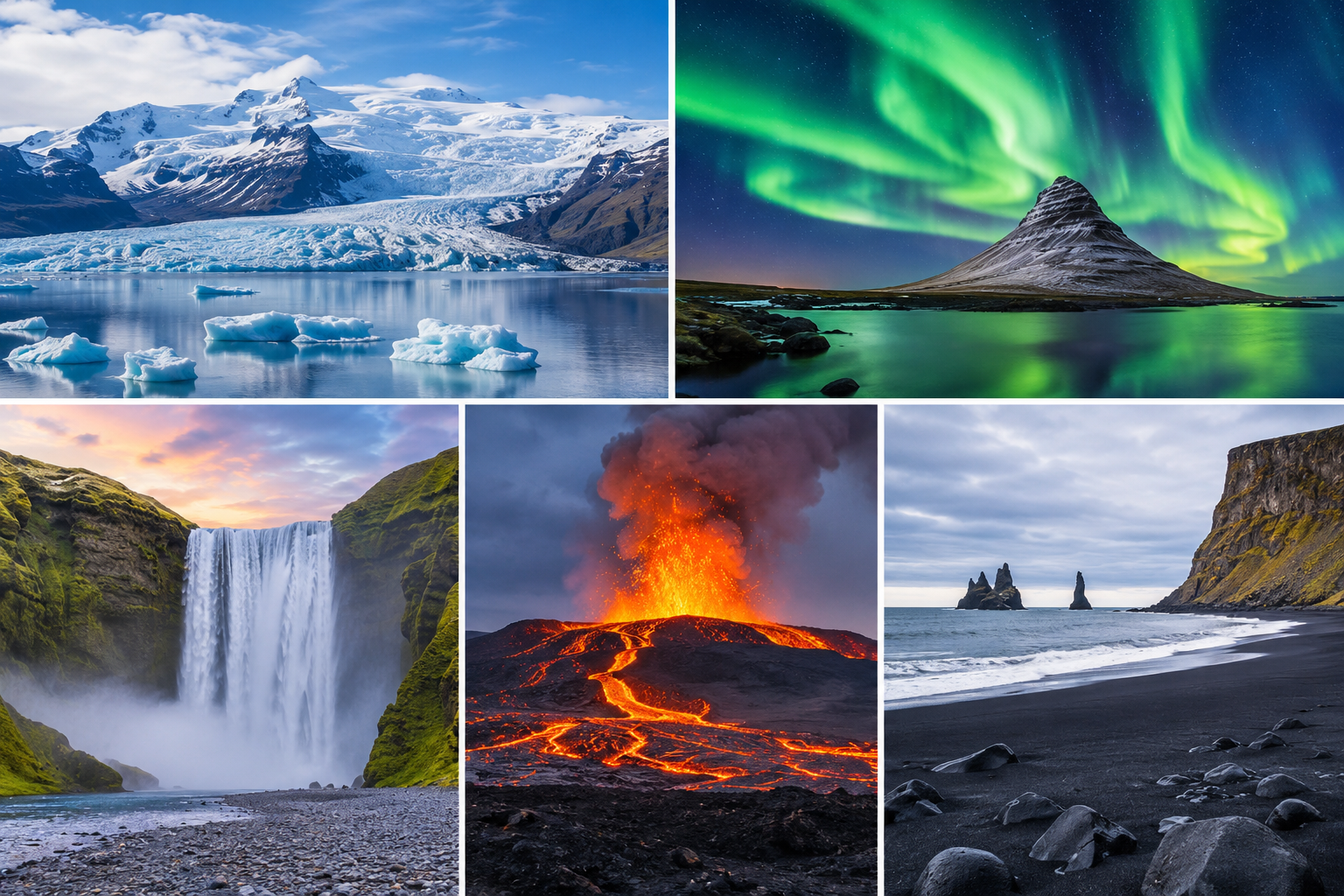
Iceland is an island nation in the North Atlantic, lying between Greenland and Norway, close to the Arctic Circle. Its very name might suggest a land buried beneath ice, but the reality is far more varied. Glaciers and snow-covered mountains stand alongside volcanoes, vast lava fields, waterfalls, lakes and steaming geothermal springs. Along its extensive coastline, black sand beaches bear witness to the extraordinary forces that have shaped the island over countless ages.
In terms of land area, Iceland is comparable in size to England, yet its population is smaller than that of many British towns, with fewer than 400,000 inhabitants. A substantial proportion live in and around the capital, Reykjavík, while much of the interior remains sparsely populated or entirely uninhabited. Travelling through Iceland, one can drive for considerable distances through immense, open landscapes without encountering a settlement. There is a sense of space and solitude that is increasingly difficult to find in much of Europe.
What makes Iceland particularly remarkable is its geological position. It lies astride the Mid-Atlantic Ridge, where the North American and Eurasian tectonic plates are gradually moving apart, at a rate of roughly two centimetres a year. At the same time, a plume of unusually hot material rises from deep within the Earth’s mantle beneath the island. The combination of these forces has made Iceland one of the world’s most volcanically active regions, continually reshaping its surface through eruptions, earthquakes and the movement of molten rock.
Much of the island is formed from volcanic rock, particularly basalt, while other formations bear witness to eruptions beneath glaciers and beneath the sea. Glaciers cover approximately a tenth of Iceland, with Vatnajökull, the largest, dominating a vast area in the south-east. Over time, these glaciers have carved valleys and reshaped the terrain, while volcanic activity has created lava fields, caves and other extraordinary formations. Even the black sand beaches reveal something of this geological history, their dark sands originating largely from volcanic material.
Yet the thought that particularly struck me was that Iceland’s very existence above the ocean is a remarkable manifestation of the Earth’s hidden forces. Beneath the sea lies an immense world of ridges, mountains and volcanic formations, most of which remains unseen. Here, through a combination of geological processes, part of that submerged world rises above the waves to form an island of extraordinary diversity. What we see on the surface is only a small part of a much greater reality hidden beneath our feet and beneath the ocean.
For me, this invites reflection on the qudra of Allah, His absolute power. How much of His creation remains concealed from us, beyond the reach of our senses and understanding? We see the mountains, the glaciers and the rocks, but the forces working deep beneath them are largely invisible. Allah brings forth what He wills, and the hidden can become visible before our very eyes. Standing in a land shaped by such immense forces, one cannot help but feel a sense of humility before the Creator whose power encompasses both the seen and the unseen.
When the Earth Awakens
Iceland’s volcanic activity is not simply a matter of ancient geological history. It is an ongoing reality. The island contains more than a hundred volcanoes and numerous volcanic systems, several of which remain active. The Reykjanes Peninsula in the south-west, near Reykjavík, provides a particularly striking example. After roughly eight centuries without a major eruptive period, the region entered a new phase of volcanic activity in 2021, with repeated earthquakes and eruptions since then.
These eruptions differ from the explosive eruption of Eyjafjallajökull in 2010, which sent ash high into the atmosphere and disrupted air travel across Europe. On the Reykjanes Peninsula, eruptions have often occurred along long fissures in the ground, sending fountains of lava into the air before the molten rock spreads across the surrounding terrain. The sight of such activity attracts visitors eager to witness the Earth at work, although the same lava flows can threaten roads, buildings and entire communities.
Scientists closely monitor earthquakes, ground deformation and other signs of magma moving beneath the surface. Their observations help them assess the likelihood of an eruption and give authorities valuable time to warn residents and prepare evacuations. Meanwhile, engineers and local crews have constructed substantial earthen barriers and trenches in an effort to divert lava away from vulnerable settlements and critical infrastructure. These measures demonstrate considerable ingenuity and determination in the face of forces that human beings can neither create nor fully control.
It is remarkable to see how people have learned to live with this uncertainty, using their knowledge and skills to protect their communities. Yet scientific understanding, impressive as it is, has its limits. We can study the movement of magma, identify warning signs and develop ways to reduce the danger, but we cannot command the Earth to remain still. The ground beneath us, which we ordinarily take for granted as something solid and dependable, can suddenly begin to tremble and change.
For a traveller, this adds another dimension to the experience of Iceland. The landscape is not simply a collection of spectacular sights to be photographed and admired. It is a living, changing environment whose power demands respect. A peaceful stretch of countryside may conceal immense forces beneath the surface, reminding us how little we can see of what is happening around us.
And here, too, my thoughts return to Allah. Human knowledge and ingenuity are blessings, enabling us to understand something of His creation and protect ourselves from its dangers. Yet the more we learn, the more clearly we may recognise the limits of our knowledge. The same Earth that sustains us can shake beneath our feet; the same forces that create new land can destroy what human beings have built upon it. There is a profound humility in recognising both the gifts we have been given and our dependence upon the One who created them.
Iceland’s people have responded to this reality with resilience and resourcefulness. Their barriers and protective structures stand as evidence of what human beings can accomplish when knowledge is put to practical use. But they also reveal an important distinction: we may learn to anticipate natural forces and mitigate their effects, yet we remain part of a creation whose ultimate power lies beyond us. For me, this is one of the most compelling aspects of Iceland, a place where the majesty of Allah’s creation is written into the very ground beneath one’s feet.
A Brief History of the Nation
Iceland’s human history has also been shaped by its geographical position, lying apart from the European mainland yet connected to the wider North Atlantic world. It came under Norwegian rule and subsequently Danish rule, gradually gaining greater autonomy over the centuries. In 1918, it became a sovereign state in union with Denmark, before finally establishing itself as an independent republic on 17 June 1944.
Today, Iceland is a member of the European Economic Area and the Schengen Area, although it is not a member of the European Union. Iceland is also a member of NATO but does not maintain a standing army of its own. Its modern identity has developed within this distinctive combination of geographical isolation, historical connections and a landscape that continues to shape the lives of its people.
The Icelandic Language and People’s Names
The national language is Icelandic (íslenska), a North Germanic language descended from the Old Norse spoken by the Scandinavian settlers. Despite the passage of more than a thousand years, Icelandic has retained many features of its ancient form. It is a language with a long memory, even if visitors may struggle to remember how to pronounce some of its words!
Iceland also has an unusual naming tradition, although the idea of identifying someone through their parents is found in other cultures too. Rather than inheriting a family surname, Icelanders traditionally form their surname from their father’s first name, adding -son for a son and -dóttir for a daughter. For example, if their father is called Einar, his son Jón becomes Jón Einarsson, while his daughter Sara becomes Sara Einarsdóttir. They have the same father, but their surnames differ because one means ‘son of Einar’ and the other ‘daughter of Einar.’ So, unlike in Britain, even siblings do not necessarily share the same surname!
A similar idea exists in Arab naming traditions, where ibn or bin means ‘son of’ and bint means ‘daughter of’. The difference is that Icelanders commonly use these forms in place of a hereditary family surname, while Arab names may incorporate parentage as one element of a longer name.
The Icelandic alphabet has two distinctive letters: þ (thorn) and ð (eth). Their sounds are similar to the ‘th’ in thing and this respectively, corresponding roughly to the Arabic letters thā’ (ث) and dhāl (ذ). You will encounter them frequently in Icelandic words and place names. They may look unfamiliar, but at least they save Icelanders from having to write ‘th’ every time. After our trip, my son remarked to someone that ð looked like an ‘o’ with an aeroplane flying out of it.
Once you begin exploring the country, two words are particularly useful to recognise. Foss means ‘waterfall’, which explains the names of famous falls such as Skógafoss and Gullfoss. Jökull means ‘glacier’ and appears in names such as Langjökull and Eyjafjallajökull. Icelandic place names often describe the landscape itself. Learning a few of these words helps, although pronouncing the names correctly is another matter entirely!
Fortunately, English is widely spoken, especially in Reykjavík and tourist areas, so communicating as a visitor is generally straightforward. You may not master Icelandic, but you can at least learn to recognise a waterfall when you see foss on a sign.
The Muslim Community in Iceland
Iceland has a population of around 400,000, of whom approximately 300,000 are Icelandic, with the remainder coming from overseas. The Muslim community is estimated to number between 10,000 and 12,000, many of whom have arrived in recent years. The largest groups are said to include Syrians and Iraqis, followed by Somalis, Turks and Pakistanis. Many of them have come as refugees.
The community has established organised religious institutions, including the Association of Muslims in Iceland. There are now three masjids or musallas in Reykjavík and one in Akureyri, in the north of the country.
There are also about eight Muslim-owned restaurants and takeaways. Finding suitable food and somewhere to pray is therefore possible, although it requires a little more planning than in Britain, where halal options can be found on almost every high street.
One particularly important consideration is Iceland’s extraordinary variation in daylight. In summer, the nights become extremely short, while in winter daylight is limited. This can make the timings of salat, particularly Fajr and ʿIshāʾ, more complicated than usual. In summer, the sun seems reluctant to go to bed; in winter, it barely seems to get up! Neither arrangement makes prayer times quite as straightforward as they are at home.
Muslims travelling to Iceland need to consult appropriate prayer-time guidance for the season and location, rather than relying uncritically on ordinary timetables. I have discussed how to work out prayer times in such circumstances in my Norway travelogue, available at www.zamzamacademy.com.
How I Came to Join the Esteemed Caravan
A friend mentioned that Mawlana Haneef Dudhwala of Muslim Welfare Institute (MWI) was organising a trip to Iceland in October with our Shaykh, Mufti Taqi Usmani Sahib, and asked whether I would like to join them. MWI was established in 1992 under the guidance of our late Shaykh, Hazrat Mawlana Yusuf Motala Sahib. Nine of its members are graduates of Darul Uloom Bury. The organisation is currently active in Albania, Bosnia, Macedonia, Bangladesh, India, West Bengal and the UK.
Initially, I hesitated. I had already committed myself to several projects that needed to be completed, so I decided not to go. However, when I later spoke directly with Mawlana Haneef, his enthusiasm, passion and generosity won me over, and I agreed to take part.
Mawlana Haneef had previously arranged visits for Mufti Sahib to numerous countries, including Albania, Macedonia, Montenegro, Kosovo, Bosnia, Bulgaria, Malta, Hungary, Greece and Sicily. Iceland was the latest destination in this remarkable series of journeys. I had been fortunate to travel with Mufti Sahib to Uzbekistan several years earlier and had also accompanied him at conferences in Jordan and elsewhere, so I already knew how beneficial these occasions could be.
Looking back, I am particularly glad that I changed my mind. I felt this could prove to be a landmark journey with Mufti Sahib, one that might be remembered for years to come and would be filled with benefits and blessings, in shāʾ Allāh. My wife and two of my children accompanied me, making it a special family experience as well. The journey was also among the first of its kind involving Mufti Sahib in Iceland, which made the prospect all the more significant.
We were privileged to travel in the company of Mufti Muhammad Taqi Usmani Sahib, his wife and son, Mawlana Hassan, alongside a distinguished group of scholars, friends and fellow travellers. From the UK, these included Mawlana Haneef Dudhwala, Mufti Muhammad ibn Adam al-Kawthari, Mawlana Yunus Dudhwala and his son, Hafiz Ibrahim; Mufti Sarfraz Muhammad and his son, Yusuf; Mawlana Ibrahim Madari; Mufti Asmar Akram; Mufti Amir Isap; Mufti Ibrahim Gora; Mawlana Usama Surti; Mawlana Umar Farooq Pandor; Mawlana Zakariya Muhammad; Mawlana Huzaifah and Mawlana Muhammad Nadat; Ml Mohammad Umar; Hafiz Jabir Seth and his wife; Haji Salim Adam and his wife; Haji Yusuf Zabou; Haji Munaf Mirawala; Haji Khalid Munshi; Haji Mushtaq Dawood; Haji Yunus Patel; Haji Asad Mohamed; Haji Tameem Shafi; Haji Sarfaraz Dudhwala; Haji Shafiq Garda and his wife; and Haji Ahmed Timol.
From Canada, we were joined by Mufti Husayn Madani, Mawlana Imranullah, Mawlana Abdul Mannan Mulla, Mufti Aman and Mufti Owais; from Norway, Waqas Mustafa; from Denmark, Mufti Imtiyaz; from India, Haji Afzal Memon; and from the USA, Mawlana Faizan. My wife and our two sons, Hafiz Yusuf and Hafiz Saalim, were also part of the group.
Our caravan numbered 47 people, although it grew to 50 for one day when Mufti Yusuf Shabbir, his brother, Mawlana Muhammad, and their mother joined us. Most UK members departed from Manchester, while others travelled from Birmingham, as I did with my family. It was a sizable and well-organised gathering. May Allah reward Mawlana Haneef and all those who worked so hard to arrange this journey, and bless them abundantly for their efforts.
My wife was able to assist Mufti Sahib’s wife, alongside the other wives who had accompanied their husbands. This added another dimension to the journey, allowing the women to share in the experience and support one another as we embarked on what promised to be a memorable visit. I have included my wife’s reflections at the end of this account.
Monday 19 October 2026
Arrival in Iceland
Our Jet2 flight from Birmingham departed as scheduled at 8.45 am, in fact, a few minutes early. I had chosen Birmingham rather than London because flying from London would have cost around £200 extra per person.
The flight took approximately two hours and forty-five minutes and was perfectly decent. Immigration was remarkably straightforward: the officer simply asked how many days we intended to stay. Within minutes, we were through and reunited with the rest of our group, who had arrived from Manchester at around the same time.
We then boarded our bus, driven by Gohar Sahib, who is of Pakistani origin. He took us first to a restaurant just five to ten minutes from the airport.
Flights from Britain arrive at Keflavík International Airport, rather than Reykjavík itself, which is around 45 minutes away by road. This is worth bearing in mind when planning a visit.
Our First Meal: Halal Food in Iceland
Our first stop was Nan Den, a Muslim-owned restaurant in Keflavík, near another establishment called Biryani Kebab. The food was a pleasant surprise. They served delicious Italian-style thin-crust pizzas, alongside shawarma, chips and various other dishes. Everyone enjoyed the meal, and we sampled a few smaller dishes as well.
The restaurants import their meat from Denmark. We avoided the chicken, as finding halal chicken that has been hand-slaughtered can be particularly difficult. Iceland has its own excellent lamb, and the local Muslim community arranges for Icelandic lamb to be made available for sale at the mosque on Fridays.
A Land of Changing Weather and Volcanic Landscapes
There is a famous Icelandic saying: “If you don’t like the weather, just wait five minutes.” The weather can change remarkably quickly, and the wind can be fierce. We were extremely fortunate, however, to enjoy mostly sunny conditions throughout our four days there.
As we travelled towards Reykjavík, we could see extensive tracts of black lava beside the highway, stark reminders of Iceland’s volcanic activity in recent years. The landscape gave us a first-hand glimpse of how dramatically the forces beneath the earth continue to shape this island.
We also passed the area around Grindavík, a fishing town that has suffered serious disruption from repeated volcanic eruptions and earthquakes. In November 2023, its residents were evacuated after the ground began to crack and shift, and subsequent lava flows and damage to infrastructure made life there extremely difficult. Many residents were forced to leave their homes. It was sobering to see a landscape where the threat from beneath the earth is not merely a matter of geological history but a reality affecting people’s lives.
The roads were excellent, and the surrounding landscape, with its dramatic open spaces, reminded me in many ways of Norway. The maximum speed limit on paved rural roads is generally 90 km/h, falling to 80 km/h on gravel roads. Drivers must also adjust their speed to the conditions, as weather and road surfaces can change quickly.
Although Iceland is an island surrounded by the sea, swimming in the ocean is not generally an option because of the extremely cold water, except at certain places and under suitable conditions. The sea may be beautiful to look at, but it is not particularly inviting for a casual dip!
Industry, Geothermal Springs and International Brands
Along the way, we passed large aluminium plants, some with their own port facilities. Aluminium is an important part of Iceland’s economy. Raw materials are brought in from other countries and processed using the country’s abundant electricity.
We also passed the famous Blue Lagoon, a remarkable geothermal spa. Its warm, mineral-rich waters and distinctive surroundings have made it one of Iceland’s best-known attractions. A visit can be expensive, according to the driver.
Yet geothermal activity is found throughout the country, and many towns have their own public geothermal swimming pools. These are generally much more affordable and offer residents and visitors alike the opportunity to enjoy Iceland’s naturally heated waters.
One thing we noticed was the limited presence of international brands. There is no McDonald’s in Iceland, but the reason is more specific than simply the country’s small population. The chain left Iceland in 2009 following the financial crisis, when the collapse of the Icelandic currency made imported ingredients and supplies prohibitively expensive for its local operator. The restaurants were replaced by a local chain.
Surprisingly, the country does have a Costco, despite its relatively small population. In a country of only a few hundred thousand people, it seemed remarkable that a large warehouse retailer could sustain its operations.
As we approached Reykjavík, we passed what appeared to be the presidential residence, a group of white buildings with red roofs across the water. This is Bessastaðir, the official residence of Iceland’s president, situated on the Álftanes peninsula across the Skerjafjörður fjord from Reykjavík. It looked remarkably modest for a presidential residence, more like a large country house than an imposing state building.
We then entered the older part of Reykjavík. Some of the buildings date back around 200 years, yet they do not necessarily look their age. Many have been renovated and carefully maintained, giving the area a surprisingly modern appearance. A large hospital was also under construction nearby.
Reykjavík
Reykjavík is the capital and largest city of Iceland, although by international standards it remains a relatively small capital. It is the world’s northernmost national capital, situated at approximately 64° north latitude. Its name means ‘Smoky Bay,’ traditionally associated with the steam rising from the area’s hot springs.
For centuries, the area’s settlement remained largely rural. Its transformation into a town began in the eighteenth century, particularly through the industrial initiatives of Skúli Magnússon, often remembered as the ‘Father of Reykjavík.’
Hótel Óðinsvé
We were nearly all accommodated at Hótel Óðinsvé, a modest four-storey hotel in central Reykjavík. Hotel location
The hotel has operated since 1984 and is situated on Þórsgata, near Týsgata. The surrounding streets take their names from figures in Norse mythology: Óðinn (Odin), regarded as the chief god, Þór (Thor) and Týr, another Norse deity. These names preserve traces of the beliefs that once shaped Icelandic culture.
For a Muslim, they also prompt reflection on the nature of the Divine. Allah is not one deity among many, nor a being within the universe, but the One who created and sustains all things. The mountains, the oceans and the forces of nature are not gods, but signs of His power. The names of the old gods may remain embedded in Iceland’s streets, but the landscape itself points beyond them to the One Creator.
The hotel is within walking distance of Hallgrímskirkja, Laugavegur and several other central attractions, making it a convenient base for exploring the city.
Since we needed around twenty-five rooms for our group, this seemed to be the most suitable mid-sized hotel at a reasonable price. The next level of accommodation would have cost a few thousand pounds more.
Because the hotel was in the town centre, our bus could not enter the narrow streets around it. We were therefore dropped off in a parking area beside Hallgrímskirkja, Reykjavík’s most striking landmark, and a church. Its towering structure, inspired by Iceland’s volcanic basalt columns, is visible from many parts of the city, making it an excellent point of reference when finding one’s way around. Its sheer scale and distinctive architecture make an impressive sight, and the parking area beside it is particularly convenient for coaches. From there, it was about a five-minute walk to our hotel.
The hotel rooms were on the small side, but comfortable enough for our needs. After checking in, we rested for an hour or so. The bus then returned to collect Mufti Taqi Sahib and several other members of the group who were arriving at around 5 pm.
Waqas Mustafa, an old acquaintance of mine, who is from Norway and was accompanying Mufti Sahib, who was also arriving from Norway. Other members of the group, including Mufti Muhammad, had travelled from the UK to Norway to accompany Mufti Sahib and were arriving with him on the same flight too.
We took a short walk to find a local grocery shop to buy some milk. Fortunately, there was a Krónan supermarket just down the road, which was very convenient.
After praying ‘Asr, we waited for Mufti Sahib and the others to arrive and welcomed them to the hotel. Mufti Sahib greeted us all warmly. At around 7.45 pm, we set off for the mosque for ‘Isha’ prayer and dinner.
The Grand Mosque of Iceland
We visited the Grand Mosque of Iceland. Compared with the large mosques found in some Western countries, it would be considered medium-sized, but it appeared well suited to the needs of Iceland’s relatively small Muslim community.
The building was modern, clean and well maintained. A mezzanine section ran along the back and sides of the upper level, which functioned as the women’s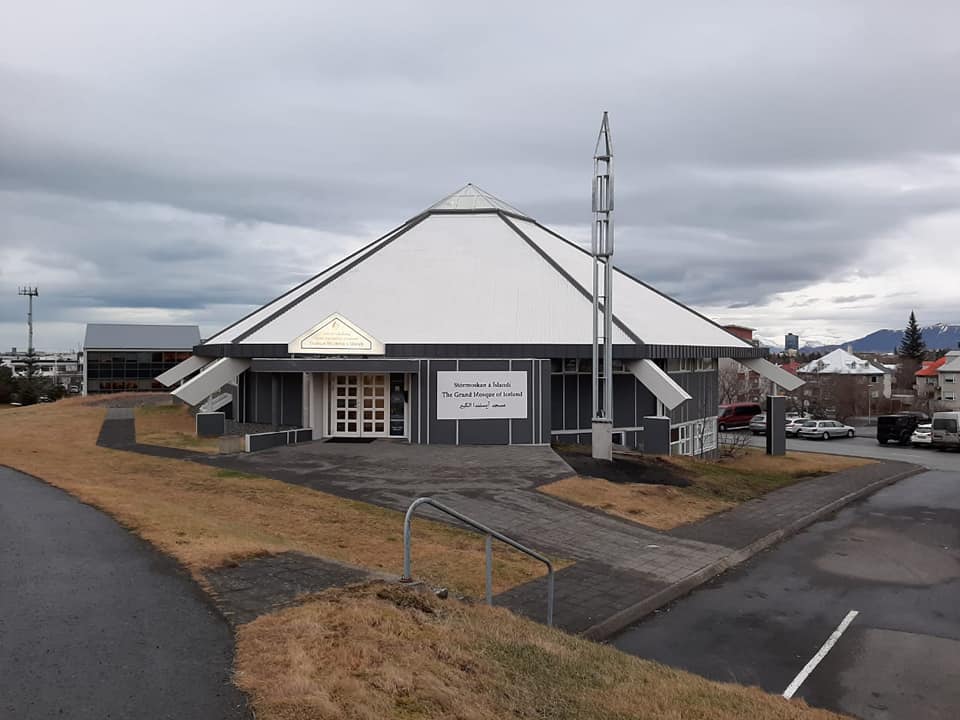 prayer area. There was also a modest library at the back. One of the things I particularly appreciated was the literature displayed near the entrance. There was a good selection of material on a table for Muslims to read and benefit from, as well as leaflets and brochures introducing Islam to non-Muslim visitors who might come to the mosque seeking information.
The local congregation had already performed ‘Isha’, so we prayed separately with our group. Our Norwegian colleagues explained that, according to the prayer timetable they were following, the time for ‘Isha’ had only just entered, so we waited until 8.10 pm. This was another reminder of the challenges of determining prayer times in places where daylight hours vary so dramatically throughout the year.
Dinner at the Mosque
The local brother who owned the restaurant in Keflavík had kindly arranged catering for our evening meal, which was served at the mosque. The meal consisted of salmon and a vegetarian dish.
The imam, Shaykh Usman Hijazi, was a welcoming and hospitable man. He had been living in Iceland for a few years and, as I understood it, had roots in the Hijaz while identifying himself with Libya and perhaps also having Moroccan connections. He struck me as a hardworking man who was genuinely concerned about the community and its needs. May Allah reward him for his service.
Mufti Taqi Sahib did not join us for dinner, as he remained at the hotel to rest after his journey.
A Safe Island and Dark Icelandic Humour
During the morning journey, we had wondered whether we should leave our luggage on the bus. Our driver, Gohar Sahib, reassured us that there was no need to worry. His reasoning was memorable: if somebody stole something, where would they go afterwards? They were surrounded by water on all sides on this island!
It was an amusing way of looking at things, although, of course, being an island does not mean that theft is impossible. Still, his confidence gave us a little reassurance and provided a good talking point.
Later, we spoke to the hotel’s night attendant, an Icelandic man with a particularly lively sense of humour. He explained that Icelanders often know a great deal about one another’s families because their family histories can be traced back over many generations. He joked that people had married within the same interconnected families for centuries, so he had decided to marry into an ‘Oriental’ family instead.
He also suggested that the long periods of gloom, rain and darkness had contributed to the Icelanders’ distinctive sense of humour. It was, he explained, often very dark indeed. He certainly seemed to embody that description himself.
We did not encourage him too much to share his darker jokes, which, he informed us, usually emerged during the final two hours of his night shift. We thought it best not to discover what might happen to a person’s sense of humour after spending too many winter nights in Iceland!
A Gathering of Scholars and Friends
I took some time to look around the esteemed caravan and get to know those I had not met before. Although I already knew some of the people travelling with us, others were new acquaintances.
Our group of forty-seven included scholars from several countries, predominantly the UK, alongside people from Canada, India, Pakistan, Norway and Denmark. There were also businessmen present.
One of the great benefits of a journey like this is the opportunity it creates for people who might otherwise rarely spend extended periods together. Travelling, sharing meals and sitting together in the evenings provide natural opportunities to exchange ideas, discuss religious and contemporary issues, learn from one another’s experiences and develop friendships.
The value of such a trip therefore extends well beyond the places visited. One might arrive expecting to see a new country, but also return having gained fresh perspectives from the people with whom one travelled. In the company of scholars and people with different experiences, even an ordinary conversation over dinner can become an opportunity to learn.
Our First Impressions of Icelanders
So far, everyone we had encountered in Iceland had been polite, accommodating and friendly. Perhaps this was partly because the country receives so many visitors and its people are accustomed to welcoming tourists. Whatever the reason, our early encounters had been very pleasant.
There is something reassuring about arriving in an unfamiliar country and finding people willing to help, answer questions and make visitors feel at ease. These small encounters often shape one’s impressions of a place just as much as its famous landmarks. Reykjavík had already offered us a mixture of natural beauty, a distinctive cultural heritage, a welcoming Muslim community and the beginnings of many interesting conversations.
Tuesday 20 October 2026
The Honour and Trial of Recognition
We began the day with breakfast in the hotel. Mufti Taqi Usmani Sahib was in a particularly good mood and, after the meal, several of us gathered around his table to listen to his advice and benefit from his company.
Someone asked him how many countries he had visited, and he mentioned that he had travelled to more than ninety. The conversation then turned to the respect and affection people show him wherever he goes.
Mufti Sahib related how someone had once written to him saying that, if he had two days to spare, he would spend one making du‘ā’ for Mufti Sahib and the other praying that Allah would raise others after him who would continue to pray for him. Mufti Sahib remarked that many people had expressed similar sentiments towards him.
Yet, rather than dwelling on such expressions of affection, he drew our attention to the spiritual dangers that can accompany them. He recited a couplet that captures the uncertainty of being surrounded by admirers:
میرے پیچھے ہر آن یہ خلقت کا ہجوم
اب خدا جانے یہ عزت ہے یا رسوائیBehind me, at every moment, crowds of people gather;
Only Allah knows whether this is an honour or a disgrace.
The couplet conveys a profound truth: the attention and admiration of people may appear to be an honour, but only Allah knows what it ultimately means for a person’s standing with Him. What seems like respect and recognition can become a spiritual trial if it feeds the ego or gives rise to pride.
Mufti Sahib was drawing our attention to ḥubb-i jāh (the love of status) and ḥubb-i shuhra (the love of fame). When people gather around us, admire us and show us respect, the heart can quietly begin to take pleasure in its own importance. The danger is not necessarily in receiving people’s affection, but in becoming attached to it and allowing it to alter our relationship with Allah. Recognition can be a blessing, but it can also become a means of spiritual ruin.
He then mentioned the following hadith of the Prophet ﷺ:
مَا ذِئْبَانِ جَائِعَانِ أُرْسِلَا فِي غَنَمٍ بِأَفْسَدَ لَهَا مِنْ حِرْصِ الْمَرْءِ عَلَى الْمَالِ وَالشَّرَفِ لِدِينِهِ
Two hungry wolves let loose among a flock of sheep do not cause more damage to it
than a person’s greed for wealth and status causes to his religion (Tirmidhī).
The comparison is striking. Two hungry wolves can devastate a flock, and the desire for wealth and status can similarly devastate a person’s spiritual life. The danger is particularly subtle because the desire for recognition can hide behind apparently worthy things: serving others, teaching, leading or being respected for one’s religious work. The question is whether these things bring us closer to Allah or quietly make us more attached to ourselves.
Mufti Sahib also spoke of Madinah, his favourite place, and how difficult it had become for him to enjoy private time there because so many people recognised him and gathered around him. On one occasion, the security personnel at the mosque had even taken him aside because they were curious about the identity of the man attracting such a large crowd.
There was something poignant about this. A place he loved for its peace and spiritual significance had become difficult to enjoy in solitude because of the very recognition that many people might regard as a privilege. His experience brought the lesson home: even the affection of well-meaning people can become a trial when it deprives someone of the privacy and quietness they need for their relationship with Allah. Ultimately, what matters is their standing with Allah, who alone knows the condition of the heart. May Allah protect us from insincerity.
Departing for our Tour
We set off on our tour at around 10.50 am. Alhamdulillah, the sun was out, the sky was blue and the day looked promising. As we headed south, we could see ranges of mountains capped with snow and ice. Their tops appeared almost flat, with a light dusting of white that became increasingly intense as we approached the higher elevations.
The temperature was lower than the previous day, but it was a pleasant, crisp cold. As long as one was dressed appropriately, it was easy to enjoy. I have come to feel that one must learn to embrace the weather, whatever it may be, rather than allow it to spoil one’s experience. I had learnt this lesson on an earlier trip to Scotland, when the forecast had promised rain for practically the entire visit. If we spend our time complaining about conditions we cannot control, we can make ourselves miserable. Accept them instead, and we may discover that there is still much to enjoy.
Before setting off, we recited the Prophetic du‘ā’ for travelling, asking Allah to protect us and grant us a safe and blessed journey. I also encouraged the group to recite Sura Yasin at the beginning of the day, recalling the narration concerning its recitation and the needs of the day being taken care of. During the journey, we encouraged everyone to perform a few rak‘as of the mid-morning prayer, salat al-duha, even while seated in their seats. The Prophet ﷺ would perform voluntary prayers while riding during travel outside city limits, facing the direction in which his mount was heading. Our travelling need not interrupt our connection with Allah. We could enjoy the beauty of His creation while also observing the Prophetic practices and keeping our hearts occupied with His remembrance.
As we travelled, we noticed a small wooden structure displaying two damaged cars. It appeared to have been placed there as a warning to motorists about the consequences of reckless driving and speeding.
We also began to see plumes of steam rising from the ground in various places. These were reminders of Iceland’s geothermal activity, with heat from beneath the earth finding its way to the surface. It was fascinating to see how close this hidden energy was to the world above.
Along the way, we passed some of Iceland’s distinctive horses. They are compact, hardy animals, well suited to the country’s harsh climate. Iceland has strict rules protecting its horse population from disease: once an Icelandic horse is exported, it is never permitted to return. This helps preserve the health of a breed that has remained isolated for centuries.
Kerið Volcanic Crater
We finally reached our first destination, Kerið (pronounced roughly KEH-rith), a volcanic crater in southern Iceland. It is known for the striking contrast between its reddish volcanic rock and the blue-green lake at its centre. The crater forms part of a group of volcanic hills known as Tjarnarhólar, in the Grímsnes area. It is approximately 55 metres deep and around 270 metres across at its widest point, giving it the appearance of a vast natural amphitheatre.
Kerið is commonly estimated to be around 3,000 years old, although some sources give different estimates. It is believed to have formed through volcanic activity, followed by the collapse of the volcanic structure. Water subsequently accumulated in the depression, creating the lake we see today. The reddish slopes and the changing shades of the water make it a particularly striking sight.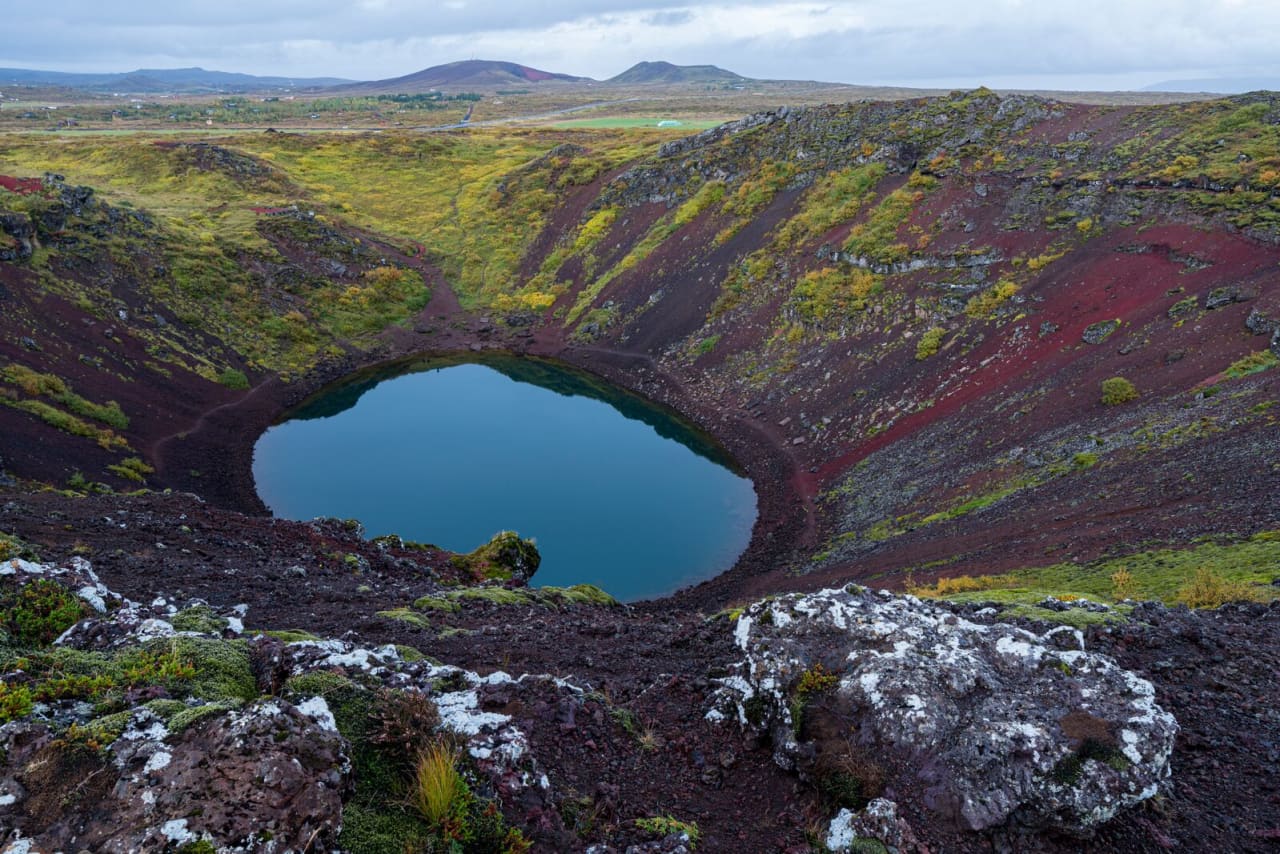
Standing at the rim, one can see the layers of rock exposed along the sides and the steep slopes descending towards the water. What looks like a carefully designed natural bowl is, in fact, the result of powerful geological processes. For a believer, such places offer an opportunity to reflect on the immense forces Allah has placed within the earth and the remarkable forms through which His creation is displayed. The earth beneath our feet may appear still and permanent, yet its landscape has been shaped by tremendous forces over thousands of years. Kerið is not merely a beautiful view; it is also an invitation to contemplate the power and wisdom of Allah, and the extraordinary variety of His creation.
We stayed at the crater for a short while, waiting for Mufti Sahib’s car to arrive. In the meantime, my wife and I walked around the entire rim before making our way down towards the water. After sitting on the bus for so long, it was refreshing to stretch our legs and enjoy a brisk walk.
From above, the lake appeared blue-green, but when we descended, the water looked much greener. The contrast between the reddish soil and rock and the green water was particularly striking. Despite its volcanic origins, the water was not hot; it was simply a beautiful lake nestled at the bottom of the crater. It was well worth the walk down.
A Stop for Zuhr Prayer
We then continued our journey, stopping at a service station at around 1.15 pm to perform Zuhr prayer. We also had a short session with Mufti Sahib, while others took the opportunity to use the toilets and buy refreshments.
The local people were very accommodating. They had no objection to our praying and allowed us to use a corner of the café, where we arranged ourselves and performed our prayer. The facilities were clean and well maintained, and everyone was able to attend to their needs before we set off again.
As we continued south, we passed fields where sheep and Icelandic horses grazed, with long mountain ranges stretching across the landscape. Offshore, we could see the Westman Islands, known locally as Vestmannaeyjar. This volcanic island group is particularly famous for its seabird colonies, including its many puffins. Even from a distance, the islands added another distinctive feature to the already impressive Icelandic scenery.
Seljalandsfoss
We reached our next major attraction, Seljalandsfoss, at around 2.20 pm. Standing approximately 60 metres high on Iceland’s south coast, it is one of the country’s best-known waterfalls. What makes it particularly unusual is the path that allows visitors to walk behind the falling water, into a large recess in the cliff. Most waterfalls are admired from the front or from a viewpoint nearby, but here one can experience the cascade from behind, with the landscape visible through the curtain of water.
The waterfall is set against the dramatic landscape of southern Iceland, in the region associated with Eyjafjallajökull, the glacier-covered volcano that became famous around the world following its 2010 eruption. The ash released into the atmosphere caused widespread disruption to European air travel. This part of Iceland is a remarkable meeting point of glaciers, volcanic rock, rivers and waterfalls, all contributing to the distinctive character of the landscape.
From a distance, the falling water looks like a delicate curtain. Up close, however, the experience is rather different: the spray and mist can leave visitors thoroughly soaked. Some members of our group had come prepared with waterproof clothing and footwear. Mufti Sahib was clad in a blue plastic waterproof anorak, which was certainly appropriate for the occasion!
A path had been made behind the waterfall, leading into the large hollow in the cliff. I went ahead with another member of the group to assess the route. The ground was uneven and rocky in places, and the path was wet and slippery. After having a look, I returned to tell the others that it should be manageable, including for Mufti Sahib.
Mufti Sahib was keen to experience the waterfall for himself. Despite the difficulties, he was courageous and determined to make the effort. We proceeded slowly, taking turns to hold one of his hands while he used his walking stick with the other. It was not an easy path, but we managed it together.
It was well worth the effort. Once we were behind the waterfall, the experience was quite different from viewing it from the front. The sheer volume of water, the spray and the unusual perspective made it memorable. Most importantly, Mufti Sahib was delighted to have made it there. He was so pleased that he recited a couplet beneath the waterfall:
انہی پتھروں پہ چل کر اگر آ سکو تو آؤ
میرے گھر کے راستے میں کہیں کہکشاں نہیں ہےIf you can make your way over these very stones, then come;
There is no galaxy along the path to my home.
The couplet captures the idea that reaching a place of spiritual or personal significance may require effort: the path is not necessarily easy, nor is it paved with extraordinary comforts. One must be willing to negotiate the stones along the way.
There was another waterfall nearby, Gljúfrabúi, partly concealed within a narrow gorge and only a short walk away. My son had particularly wanted to visit it, having researched it beforehand. Unfortunately, we had already spent so much time at Seljalandsfoss that we could not fit it into our schedule. It was a pity to miss it, especially as he had been looking forward to seeing it, but the time spent helping Mufti Sahib experience the waterfall had been worthwhile.
Mufti Amir Isap’s Drone Footage
Seljalandsfoss also became the setting for some remarkable aerial footage captured by Mufti Amir Isap, affectionately known among the group as Mufti Drone. His drone revealed the group and the surrounding landscape from a perspective that would otherwise have been impossible to appreciate. The footage was received with considerable astonishment and admiration by the companions. It was a wonderful way to capture not only the beauty of the location but also the group’s shared experience.
Skógafoss: A Mighty Waterfall and a Persian Couplet
We then arrived at Skógafoss, a much larger and more imposing waterfall on Iceland’s south coast. Standing about 60 metres high and 25 metres wide, it plunges over the cliff in a broad, powerful curtain of water. Unlike Seljalandsfoss, whose appeal lies partly in the opportunity to walk behind it, Skógafoss is particularly impressive when viewed from the front. The sheer volume of water, the thunderous sound and the mist rising from below make it a spectacular sight. In sunshine, the spray can produce beautiful rainbows.
The cliff itself has an interesting history. It was once part of Iceland’s coastline, but the sea has since retreated, leaving the former coastal escarpment inland. The landscape is a reminder of the enormous changes brought about by erosion and the island’s geological forces. The Skógá River, fed by water from the mountainous interior and nearby glaciers, now pours over this ancient cliff.
Steps beside the waterfall lead to a viewing platform above the falls, from where visitors can look down at the water and follow the river inland. The route also opens onto longer walks along the Skógá River towards the Fimmvörðuháls pass. Unfortunately, we did not have enough time to explore the area fully and had to be content with admiring the waterfall from below.
One detail that caught my attention was the black soil along the paths. The dark volcanic landscape was a striking reminder of Iceland’s fiery geological origins, even in a place dominated by water.
It was here that Mufti Sahib recalled a Persian couplet traditionally associated with the Moghul Ruler Shah Jahan and his wife, Mumtaz Mahal. The story is said to originate from a moment when the royal couple were in Kashmir, admiring its flowing waters. Shah Jahan is said to have remarked:
آب از ہوای روی تو می آید از فرسنگ ها
The water travels miles, drawn by the longing to behold your face;
Mumtaz Mahal is said to have replied:وز ہیبت شاہ جہاں سر می زند بر سنگ ها
In awe of Shah Jahan, it leaps and strikes the rocks.
The imagery is charming: the water travels from afar, captivated by the beloved’s beauty, while its force against the rocks is likened to its awe of the emperor. Nevertheless, hearing Mufti Sahib recite it beside this magnificent waterfall gave the verses a special resonance. The setting could hardly have been more fitting, with water cascading over the rocks before us.
We also needed to attend to our prayers, which we prayed outside the café in a clearing we found. From Skógafoss, Mufti Sahib set off by car for Reykjavík.
Reynisfjara: Iceland’s Extraordinary Black Sand Beach
We then boarded the bus and travelled towards Reynisfjara, the famous black sand beach on Iceland’s south coast. It turned out to be well worth the effort.
The beach was absolutely stunning, unlike anything I had seen before. The contrast between the brilliant white foam of the Atlantic waves and the almost jet-black pebbles was extraordinary. As each wave rolled in and broke upon the shore, the foam spread across the dark surface, creating a striking pattern of black and white.
I was fascinated by how the texture of the beach changed as we moved away from the water. Closest to the sea were smooth, shiny black pebbles, polished by the relentless movement of the waves. Further inland, these gave way to smaller stones, gradually becoming finer until they formed the distinctive black sand. It was as though we could see the sea at work, slowly grinding volcanic rock into ever smaller fragments.
At one end stood a remarkable wall of naturally formed basalt columns beside a sea cave known as Hálsanefshellir. The columns, formed as ancient lava cooled and fractured, were so regular that they looked almost artificial, like a vast structure carved by a master craftsman. Nearby, the Atlantic had gradually eroded the rock to create the cave. Between them, the formations revealed two very different forces at work: the fiery origins of the rock and the patient power of the sea.
The whole scene was mesmerising: black rock, white foam, the restless ocean and extraordinary formations rising beside the shore. There was something stark and almost otherworldly about its beauty. Photographs might capture the scenery, but they could never quite convey the feeling of standing there, watching the waves sweep across the black pebbles.
It was a pity Mufti Sahib had not been able to join us. I felt he would have appreciated the uniqueness of this place as much as we did.
From here, we faced a journey of about two and a half hours back to our hotel. It had been a long day, but Reynisfjara had made the detour thoroughly worthwhile.
Reflections on the Road
After leaving Reynisfjara, we stopped at a clearing near the café, where we prayed Maghrib and had some tea before boarding the bus for the journey back to our hotel.
During the journey, one of the senior members of the group, who had been sitting towards the back of the coach, asked me if I could give at least half an hour of tafsir of the Qur’an. He had been listening to the 30 Juz’ in 30 Days Ramadan tafsir programme I had conducted in 2020, and he wanted to hear more.
I was sitting at the front, directly behind the driver. Since Mawlana Haneef was travelling separately by car, he had asked us to help manage the arrangements on the coach. I had invited Mufti Asmar to sit in the front seats on the opposite side and so now asked him to coordinate the announcements and invite different scholars to come forward to share some reflections with the group. Why not give the scholars, including the younger ones, an opportunity to benefit us all.
Mawlana Yunus Dudhwala, our senior, spoke first, reflecting on the verse:
يَا أَيُّهَا الَّذِينَ آمَنُوا ادْخُلُوا فِي السِّلْمِ كَافَّةً
O you who believe, enter into Islam wholeheartedly (Baqara, 2:208).
Mufti Ibrahim Peerbhai then shared some advice, followed by my son Hafiz Yusuf, who recited several verses of the Qur’an. Mufti Sarfraz shared a few anecdotes from Mufti Taqi Sahib’s life, illustrating his remarkable ability to take an ordinary worldly conversation and turn it towards Allah and the Hereafter. It was a quality that left a lasting impression on those who knew him.
Mufti Husayn Madni from Canada reflected on the dangers of pride, the human ego and the desire for recognition. These were important reminders, particularly in an age when people can become so concerned with how others perceive them that they lose sight of the One before whom they will ultimately stand.
Throughout the journey, Mufti Asmar proved to be an excellent host and master of ceremonies. He kept the programme moving, shared anecdotes of his own and brought a welcome touch of humour, not least through his commanding Scottish accent, to the proceedings without detracting from the seriousness of the discussions. The combination made the journey both spiritually enriching and enjoyable.
One anecdote concerned our grand teacher, Shaykh Zakariyya Kandhlawi, who, while hundreds of people were coming forward to shake his hand in Karachi, was reported to have been reciting the following words:
الْحَمْدُ لِله الَّذِي أَظْهَرَ الْجَمِيلَ وَسَتَرَ عَلَيَّ الْقَبِيحَ
All praise belongs to Allah, who has made my good qualities apparent and concealed my faults.
The words offer a beautiful lesson in humility. Even when people are showing us respect and admiring our qualities, we should remember that Allah knows our shortcomings, many of which remain hidden from others. Whatever goodness people see in us is a favour from Allah, while His concealment of our faults is itself a tremendous mercy. Rather than becoming proud of the praise we receive, we should turn to Allah with gratitude and a recognition of our own deficiencies.
By the time we arrived back, the coach journey had become much more than a means of getting from one place to another. It had provided an opportunity for Qur’anic reflection, advice, personal recollections and fellowship among the scholars and other members of the group.
We went directly to the masjid, where we prayed salah before sitting down to eat. The meal included Icelandic lamb, along with other dishes.
Later, two local brothers approached me to discuss some matters privately. They spoke of their concerns about the recent rise of far-right sentiment in Iceland and the atmosphere this had created for Muslims. They felt that some Muslims were experiencing discrimination, including difficulties when seeking employment. They also referred to issues within the Muslim community that had appeared in the media and, in their view, had contributed to a more negative perception of Muslims.
I also spoke with Imam Usama, who kindly reminded me that he was still waiting for a copy of my book on marriage, Handbook of a Healthy Muslim Marriage. From our conversation, I gained the impression that marriage and family life presented many of the same challenges in Iceland as they do elsewhere. These are not problems confined to one country or culture.
I told him that I had brought a copy of the book specifically to give him, but I would need to find it among my luggage. I hoped to get it to him before our time in Iceland came to an end.
Seeking the Northern Lights
After the dinner, we set off in search of the Northern Lights, heading away from the city towards an area with less light pollution. Almost as soon as we left the mosque, we caught sight of a streak of light in the sky, which raised our hopes. We then drove for about forty-five minutes, but by the time we reached our destination, clouds had gathered and obscured the sky and snow had started to fall.
As we travelled, we discussed which du‘ās we might recite in the hope of seeing this extraordinary phenomenon. I suggested reciting Āyat al-Nūr, the Verse of Light (Nur, 24:35). I then asked Mufti Asmar to lead everyone in the Du‘ā’ of Light, which he graciously did. We hoped that Allah would grant us the opportunity to witness the Northern Lights, but it was not written for us that night. Disappointed, we eventually turned back.
It was an exceptionally cold evening, with temperatures seemingly around freezing point and a little snow falling. We had travelled out of the city specifically to escape the artificial lights, yet, in a curious twist, Mufti Sahib and those accompanying him managed to catch a glimpse of the Northern Lights in Reykjavík itself. We had gone in search of them in the darkness beyond the city, only for others to see them amid the city lights. What an interesting turn of events! I had briefly witnessed the Northern Lights in Finland a few years earlier, so I knew how fascinating they could be, but it would still have been a pleasure to see them again in Iceland.
The Northern Lights, scientifically known as the aurora borealis, are among the natural phenomena for which Iceland is famous. They occur when charged particles from the Sun interact with the Earth’s magnetic field and collide with gases high in the atmosphere, releasing energy in the form of light. Oxygen produces the familiar green glow, while other atmospheric interactions can create red, blue and purple hues. The lights may appear as arcs, curtains or rippling bands, shifting and changing shape across the night sky.
Yet, as we discovered that evening, seeing them is never guaranteed. Three conditions are particularly important: darkness, clear skies and sufficient auroral activity. Even when the Northern Lights are active, cloud cover can hide them completely. Autumn and winter offer long hours of darkness in Iceland, making this a favourable time of year to look for them, but the weather remains beyond our control. Getting away from Reykjavík’s bright lights had not helped us that night; the clouds had thwarted our plans.
There is a particular pleasure in understanding the science behind such a phenomenon while still appreciating its beauty. The Northern Lights arise from physical processes involving the Sun, the Earth’s magnetic field and the atmosphere, yet the thought of these vast forces at work can leave a person filled with wonder. From an Islamic perspective, such sights invite reflection on the vastness of Allah’s creation and the intricate order of the natural world. Scientific understanding need not diminish our sense of awe; it can deepen our appreciation of the complexity of creation.
Wednesday 21 October 2026
After breakfast, we listened to a brief piece of advice from Mufti Sahib before setting off at around 11 am. We were leaving a little later than usual, and our first destination of the day was Gullfoss Waterfall, where we arrived at about 11.45 am.
Gullfoss Waterfall
Gullfoss means ‘Golden Falls’ and is one of Iceland’s most celebrated waterfalls. It lies on the Hvítá River, whose waters are largely fed by meltwater from the Langjökull glacier region. Unlike a waterfall that plunges in a single uninterrupted drop, Gullfoss descends in two main stages: the upper falls drop approximately 11 metres, follo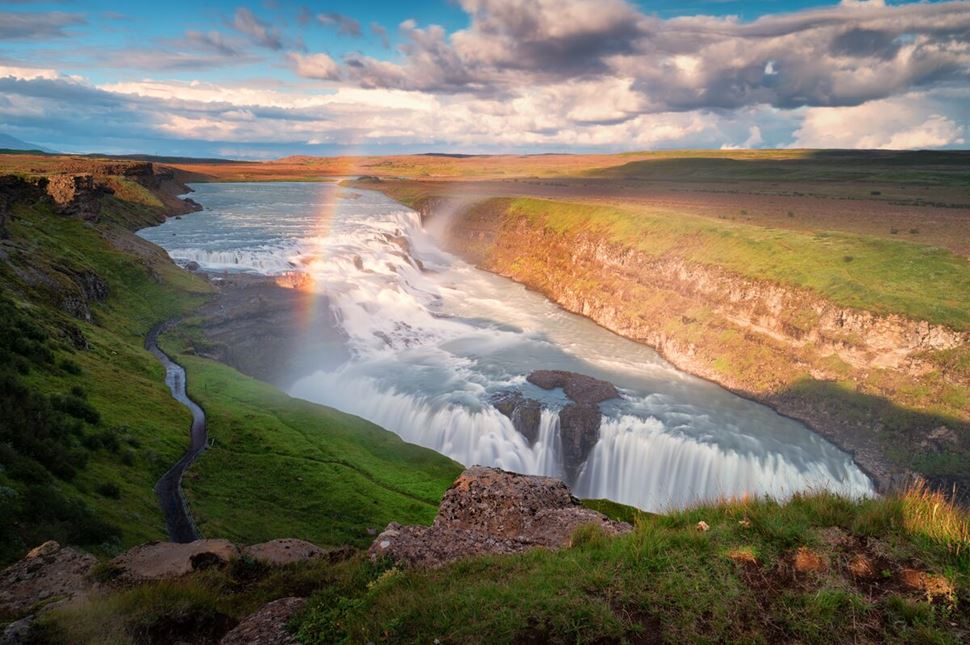 wed by a lower cascade of around 20 metres. The water then disappears into the deep Gullfossgljúfur canyon, creating the extraordinary impression of a river being swallowed by the earth.
I found Gullfoss particularly impressive, especially in terms of its sheer size and the volume of water cascading through the gorge. Of all the waterfalls I had visited, Victoria Falls remained my favourite. I had found it more mysterious, wild and intriguing than Niagara Falls, and Gullfoss brought back some of that sense of awe, albeit in a very different setting.
One of the things I particularly appreciated about Victoria Falls was the variety of vantage points from which to view it, both from the Zimbabwean and Zambian sides. Gullfoss offered fewer such perspectives, but its distinctive formation more than made up for this. The river first tumbles down a series of rocky steps before plunging into the canyon in two dramatic cascades. Watching the immense volume of water surge over the rock and disappear into the depths below was an impressive sight.
The name ‘Golden Falls’ is sometimes associated with a golden shimmer in the water under certain lighting conditions, although the precise origin of the name is not entirely certain. On this cold, overcast day, there was little sign of gold. Instead, the waterfall had a silvery-white appearance, with the water shimmering as it rushed over the rocks. It was beautiful in its own way, though perhaps less golden than its name suggested.
As we stood there contemplating the sheer power and force of the waterfall, a thought occurred to me. I turned to Mufti Sahib and asked:
هذا من جمال الله أو من جلال الله؟
Is this a manifestation of Allah’s Beauty, or of His Majesty?
Mufti Sahib pondered the question for a few moments before replying:
هذا جمال الله يهدي إلى جلال الله
This is Allah’s Beauty, which leads to Allah’s Majesty.
We found his response profound. The beauty of creation can itself be a means of drawing us towards recognition of the Creator. We may initially be captivated by a waterfall’s appearance, the play of light upon the water or the magnificence of the surrounding landscape. But as we contemplate the immense forces at work, the sheer scale of the natural world and the power displayed before us, our thoughts can move beyond what we see towards the majesty of Allah, who created it all.
In this sense, beauty is not merely something to admire; it can be a path to deeper spiritual awareness. The جمال (jamāl, beauty) we witness in creation can guide the heart towards جلال (jalāl, majesty). Mufti Sahib had expressed this beautifully in just a few words.
While many of us remained with Mufti Sahib, the rest of my family and some other members of the group made their way down towards the bottom of the falls. They later told me how fascinating it had been to experience the waterfall from below. Gullfoss had offered us not only a magnificent natural spectacle but also a moment of reflection that made the visit particularly memorable.
Geysir Geothermal Area
Our next stop was the Geysir Geothermal Area, in the Haukadalur valley, where we arrived at approximately 1.45 pm. It is one of Iceland’s most distinctive natural attractions and the source of the word geyser, now used in many languages. The name comes from the Great Geysir itself, derived from the Icelandic verb geysa, meaning to gush or surge.
Although the Great Geysir has been largely inactive for long periods, the area remains very much alive with geothermal activity. The main attraction today is Strokkur, which erupts every few minutes, sending a column of hot water high into the air, sometimes reaching 20–30 metres. Before an eruption, the water can form a striking blue dome at the surface as pressure builds beneath it, although I did not witness this particular feature.
The companions watched as hot water and steam emerged from the ground. Some witnessed smaller bursts, while others were fortunate enough to see a much more powerful eruption, with hot water shooting high into the air. The eruptions happen quickly, so it is worth keeping one’s eyes on the water rather than looking away between them.
The surrounding landscape was fascinating in its own right. Hot springs, steaming vents and bubbling pools were scattered across the area, revealing the heat simmering beneath Iceland’s surface. Barriers and marked boardwalks kept visitors at a safe distance, for the water and the ground around the springs can be dangerously hot. One or two of our companions dipped their fingers into a pool that was not at boiling point, but caution was clearly essential.
The science behind these eruptions is remarkable. Water seeps underground, where it is heated by geothermal energy. In the right conditions, pressure builds within the underground channels until steam forces the water upwards in an eruption. The system then refills and the process begins again. Not every hot spring erupts like a geyser; the underground channels and pressure conditions must be just right. Here, we could see how Iceland’s volcanic heat continues to shape the landscape, even without a volcano visibly erupting.
The experience reminded me of the bubbling sand we had seen in Rotorua, New Zealand, where geothermal activity had filled the air with the pungent smell of eggs and sulphur. The smell here was much less pronounced, though we could still detect a faint whiff of sulphur. The two places shared that distinctive sense of witnessing the earth at work beneath our feet.
We also took the opportunity to pray our Zuhr ṣalāh. Afterwards, some of our Canadian companions went to get fish and chips, having first made enquiries about how the fish was prepared and fried. It was good to see them taking care over what they ate, and the staff were very pleasant.
Another special moment was meeting Mufti Yusuf and Mawlana Muhammad, the sons of our teacher, Mufti Shabbir Patel Sahib. Their mother had also come to Iceland, albeit for just one day, so it was a pleasure to meet them all here. Amid the geysers, steam and bubbling pools, this family reunion added a personal touch to what had already been an interesting stop on our journey.
Þingvellir National Park
We stopped briefly at Þingvellir National Park to walk among the fissures that split the ground apart. It was a bright, sunny day, although the air was still quite cold, and we were glad to have our jackets on. The sunshine illuminated the rugged rock faces and uneven ground, revealing a landscape that was both beautiful and unsettling.
What makes this place so extraordinary is that we were walking through a rift zone associated with the separation of two immense sections of the Earth’s crust: the North American and Eurasian tectonic plates. Iceland lies on the Mid-Atlantic Ridge, where these plates are slowly moving away from one another at an average rate of roughly two centimetres a year. Over thousands of years, this movement has opened great fissures, exposed sheer walls of rock and caused parts of the landscape to sink. Here, the movement of the Earth is not merely something to read about in a book; its effects are laid bare before you.
The cracks seemed to run through the ground almost randomly, as though the Earth had been torn open. Walking between the towering rock walls gave me an unsettling sense of vulnerability. The ground beneath our feet, which we ordinarily take for granted as solid and dependable, suddenly seemed fragile, shaped by forces on a scale we could scarcely comprehend.
We only had time for a short walk among the fissures and did not make it down to the water. Nevertheless, even this brief visit left a lasting impression on me: a reminder of the immense power of Allah and the precariousness of the landscape we inhabit. What appears so solid beneath our feet is, on a geological timescale, continually changing.
More Reflections and Reminders Along the Journey
As we continued our return journey, the discussions in the vehicle provided another opportunity to reflect, learn and benefit from the company of the scholars travelling with us. Not everyone had been given the opportunity to speak.
I spoke about dedicating every aspect of our lives to Allah, drawing upon the Qur’anic verse:
قُلْ إِنَّ صَلَاتِي وَنُسُكِي وَمَحْيَايَ وَمَمَاتِي لِلَّهِ رَبِّ الْعَالَمِينَ
Say: Indeed, my prayer, my sacrifice, my living and
my dying are for Allah, Lord of all the worlds. (Anʿām, 6:162)
I emphasised that devotion to Allah should extend beyond formal worship. Our work, family life, marriage and everyday decisions should all be for His sake. Ultimately, even our dying should be for Allah. But how can we hope to die thinking of Him if we have not learnt to live for Him? This means making even sleeping, eating, studying, working and choosing where we live part of our devotion. It is not easy to bring every aspect of life under this intention, but we must begin somewhere and keep trying to see how far we can get.
Earlier, I had also discussed the meanings of the various du‘as we recite at the beginning of a journey and when riding a vehicle or other means of transport.
Both Mawlana Muhammad and Mawlana Huzayfah Nadāt shared a short talk. Mufti Amir Isap continued with a reflective discussion (tadabbur) on the same Qur’anic verse I had used, exploring its message of dedicating our lives to Allah. It was beneficial to approach this central theme from different perspectives, allowing the message to settle more deeply.
Mufti Imtiaz shared a particularly interesting account of his own journey from professional cricket to Islamic scholarship. He described how the guidance of the ‘ulamā’, his studies at Darul Uloom Karachi and the encouragement of Mufti Taqi Usmani Sahib helped shape his path. His journey eventually led him to serve a Muslim community in Denmark.
Mufti Imranullah then gave a particularly engaging account of his religious work in Cuba. He spoke about the growing number of people embracing Islam and the opening of several masjids. He also described the people he had encountered with considerable warmth, noting that, despite their poverty, they were clean, gracious and pleasant. His account offered a glimpse into Muslim life in a part of the world that many of us know little about.
Having so many scholars together was itself a great benefit. Some of the most rewarding moments of the journey were during our time together. The bus journeys became opportunities for stimulating discussions on fiqh, society, scholarship and spirituality, enriched by the depth of knowledge among those present.
On one occasion, we even found ourselves debating a complex end-of-life scenario involving artificial respiration and human volition. The discussion continued in the hotel lobby as we tried to work through the questions it raised. Mawlana Yunus Sahib jokingly suggested that this might be the beginning of an international scholars’ forum!
Back in Reykjavik and the evening program
We returned to the hotel with a little time to spare before heading back to the masjid for the ‘Isha’ prayer at 7.30 pm. Mufti Sahib’s special talk at the masjid was scheduled to take place after the prayer, but he was expected to arrive only after 8.30 pm. Mufti Muhammad ibn Adam had therefore called me and asked if I could fill the gap by giving a talk until Mufti Sahib arrived.
After the prayer, the imam introduced me. I asked whether we should first perform our sunna prayers, but he suggested that we begin straight away. I asked my son, Hafiz Yusuf, to recite some Qur’an, and then began speaking about the importance of recognising what the heart is passionate about and directing that passion towards Allah, above all for the preservation of our faith. I also emphasised the responsibility of those who form the first generation of Muslims in Iceland. They would need to make sacrifices and lay firm foundations so that future generations could inherit an established Muslim community.
A few Arab brothers sitting at the back said that they did not understand English and asked me to speak in Arabic. However, as most of the congregation did not appear to be Arabic-speaking, I told them in Arabic that I would come and explain the talk to them afterwards.
Mufti Sahib had still not arrived, so I took a few questions from the congregation. When he began his talk, I went over to the Arab brothers, who were from Homs in Syria, and translated his talk into Arabic for them.
Mufti Sahib’s Talk
Mufti Sahib delivered his talk in Urdu, as much of the congregation that evening was Urdu-speaking, with Mufti Muhammad translating into English.
Mufti Sahib gave a profound reminder that Islam must be embraced in its entirety. It extends far beyond the outward observance of prayer and fasting to encompass our beliefs, financial dealings, relationships, conduct and character. Referring to Allah’s command to enter into Islam completely (Baqara, 2:208), he emphasised that every aspect of our lives must be brought into conformity with its teachings.
This reformation, however, must begin with ourselves. As the Qur’an reminds us (Ma’ida, 5:105), we must not become so preoccupied with the shortcomings of others that we neglect our own. Instead, we should examine our intentions, actions and relationship with Allah. Remembering death and the Hereafter should continually shape our priorities, reminding us that this worldly life is temporary and that we will ultimately stand before Allah to account for how we have lived.
Mufti Sahib also stressed the importance of taqwa (God-consciousness), sincerity and keeping the company of those who strengthen our faith. Spiritual progress requires more than good intentions; it demands sustained effort and a willingness to overcome our weaknesses. Allah promises that those who strive for His sake will be guided to His ways (‘Ankabut, 29:69).
He offered a practical way of putting this into effect: begin each morning by repenting for past shortcomings and asking Allah to help us live according to His commands throughout the day. Then, before retiring at night, review how we have spent our time, acknowledge our failings and seek forgiveness. He recommended maintaining this discipline consistently for forty days, helping to establish a habit of regular self-examination.
He also emphasised the importance of making religious learning a regular feature of family life. Even fifteen minutes of daily family ta‘līm, preferably after dinner, could bring considerable benefit through reading and discussing Islamic teachings. He recommended books such as Uswa-i Rasul Akram by Dr ‘Abd al-Hayy ‘Arifi and Riyad al-Salihin by Imam Nawawi.
The upbringing of children was another important theme. They need a sound Islamic education through suitable religious institutions and learning arrangements, but religious instruction alone is not enough. Children also require love, affection, attention and appropriate opportunities for recreation. Parents must nurture their religious development alongside their emotional well-being.
The central message was that a meaningful religious life rests upon three interconnected responsibilities: reforming ourselves, acquiring and imparting religious knowledge, and raising our children upon the teachings of Islam. Din must not remain confined to particular acts of worship or designated moments in our lives; it must shape our character, guide our decisions and govern our relationships. The reformation of society begins with the reformation of the individual, while the preservation of faith across generations depends upon both what we teach our children and the example we set for them. Above all, we must live with an awareness of our return to Allah, striving each day to become better servants of Him.
After the programme, we had dinner at the masjid, as we had done on previous evenings. I was later told that a gathering of more than forty people, including such a large group of scholars, was probably unprecedented in Iceland, particularly at the Grand Mosque. It was heartening to think that our visit might represent a significant occasion for the local Muslim community.
During Mufti Sahib’s talk, a woman in the women’s section said that the Northern Lights were visible outside. Some of the women went out and were fortunate enough to enjoy a good display. The rest of us tried to catch sight of them after the programme, but by then they had largely disappeared.
However, after returning to the hotel, some of us decided to walk down to the seafront near the Sun Voyager, the striking sculpture overlooking Reykjavík’s bay. The sky appeared clearer there, so we hoped for one last chance to see the lights. We scanned the heavens, looking for the faintest sign, but once again our hopes were only partly rewarded. There seemed to be a few faint streaks, though nothing like the vivid displays we had hoped to witness. At times, the Northern Lights can be more apparent in photographs taken on a mobile phone than to the naked eye, as the camera can capture light that is difficult to discern in the darkness.
Sunrise at this time of year was around 8.40 am, which meant that the mornings began late and we could enjoy a decent night’s rest after our busy days.
Thursday, 22 October 2026
Today’s programme was lighter, with a local tour and some shopping planned. As we were not due to leave until later, I took the opportunity to enjoy another short walk into the town centre with my wife. There was a good mixture of local shops and a few international brands.
One item that Iceland guides recommend is the lopapeysa, the traditional Icelandic woollen jumper, recognisable by the distinctive circular pattern around its shoulders. Iceland has a long history of sheep farming, and wool has traditionally been essential for clothing in a cold and changeable climate. Icelandic wool is unusual in having an outer layer that helps repel moisture and a softer inner layer that provides insulation. These jumpers are beautiful, although they come at a price: a typical one can cost around £150. We purchased some Icelandic chocolate and some special volcanic salt.
Afterwards, we made our way to the bus stop and boarded the coach. Our first stop was the Sun Voyager, Reykjavík’s striking sculpture overlooking the sea.
The group decided not to visit the opera house, so we moved on to FlyOver Iceland, a 4D experience that simulates flying over the country’s dramatic landscapes. With the group discount, the cost was approximately £35 per person, provided everyone paid together.
Another option was the Perlan Museum’s Wonders of Iceland exhibition. Although more expensive, it offered a wider range of attractions, including a lava show, an ice tunnel, an aurora experience and other displays exploring Iceland’s natural wonders. The group opted for the museum.
Perlan Museum
The Volcano Experience
Perlan was an impressive experience, and its outstanding highlight was undoubtedly the volcanic show. It brought Iceland’s raw geological power vividly to life, transporting us into a world of fire, molten rock and spectacular eruptions.
The presentation drew on the 2021 eruption at Geldingadalir, near Fagradalsfjall, when lava burst through the earth after the area had remained volcanically quiet for more than 800 years. Through dramatic aerial footage and immersive sound, we watched the landscape being transformed by glowing rivers of lava, pouring across the dark terrain like rivers of fire.
There was something mesmerising about watching the molten rock advance, its brilliant orange glow illuminating the surrounding landscape. The show was exceptionally well produced and gave us a vivid sense of the immense forces at work beneath Iceland’s surface. It was a powerful reminder that this land of glaciers and snow is also a place where the earth remains very much alive. For many of us, this was the most worthwhile attraction of the day.
The Ice Cave and Brother Mushtaq Dawood
From the world of fire, we moved into a world of ice. Perlan’s indoor ice cave recreates the experience of entering a glacial environment, with a tunnel stretching approximately 100 metres and constructed from more than 350 tonnes of snow gathered from Iceland’s mountains.
The contrast with the volcanic show was striking.
Our visit to the ice cave became memorable for a rather different reason, however. Brother Muhstaq Dawood from Bolton took his place on the ice chair there and delivered a humorous short talk, imitating Maulana Sulayman Katani of South Africa. His unexpected performance brought plenty of amusement to the companions along with a humble exhortation. It was a reminder that, alongside the natural wonders and impressive exhibits, some of the happiest memories of a group outing come from the spontaneous moments of fellowship and humour.
The Northern Lights Show
The companions also attended Áróra, Perlan’s Northern Lights planetarium show, a roughly twenty-minute presentation combining science, art and ancient stories about the aurora. Using impressive 8K projections and surround sound, it recreated the mysterious lights dancing across Iceland’s night sky before taking viewers on a journey into space.
Despite the sophisticated presentation, it did not quite captivate us in the same way as the volcanic show. The darkened dome and eerie atmosphere felt a little spooky, while the gently reclined seats, designed for viewing the screen overhead, were exceedingly comfortable. By this stage, many of the companions were tired, and some struggled to keep their eyes open. A few appeared to drift off beneath the simulated Northern Lights! It was an interesting experience, but the volcano show had undoubtedly left the stronger impression.
The Glacier Exhibition and Global Warming
One of the museum’s most informative displays explored the effects of global warming on Iceland’s glaciers. Through interactive exhibits and a striking visual timeline, we could see how these vast masses of ice have been shrinking and consider what their continued retreat might mean for Iceland’s landscape and future.
It was a sobering reminder that climate change is not merely a distant possibility but an ongoing process that is visibly reshaping the natural world.
The Observation Deck
After exploring the indoor exhibitions, we stepped out onto Perlan’s observation deck, which encircles the building and offers a magnificent 360-degree panorama of Reykjavík and its surroundings.
The weather was clear, with scattered clouds overhead and a slight chill in the air. We could take in the city from every direction, tracing its rooftops towards the coastline and distant mountains. The cool breeze added to the feeling of being out in the open, while the sweeping views provided a fitting conclusion to our visit. Having learnt so much about Iceland’s natural forces inside the museum, it was a pleasure to stand above the city and appreciate the landscape for ourselves.
One of the brothers remarked that perhaps we should have visited Perlan at the beginning of our trip. It was only now, after seeing the exhibitions and learning more about Iceland’s geology, glaciers and natural wonders, that we were beginning to appreciate just how much the country had to offer. We had concentrated largely on the south-western part of Iceland, yet there were so many other places and landscapes still waiting to be explored.
One experience we had missed was taking a dip in one of Iceland’s natural thermal springs. That would have been another wonderful way to experience the country’s geothermal character. Insha Allah, perhaps there will be another opportunity to return and discover more of this remarkable land.
Return from the Museum
We then returned to the hotel and went to a local fish and chips restaurant called Reykjavík Street Food. Each portion cost around £20, nearly twice what one might pay in the UK. The sauces were particularly nice, though, and we enjoyed our meal.
Afterwards, we returned to the hotel for a rest before gathering for a special farewell programme with Mufti Sahib at the masjid following Maghrib. Mufti Sahib himself led the prayer.
During the salat, he performed the salam after two rak‘as and began to conclude the prayer. When some members of the congregation alerted him by saying Subḥān Allāh and Allāhu Akbar, he stood up to complete the remaining rak‘a and then performed sajdat al-sahw (the prostrations of forgetfulness) before completing the prayer.
A brother sitting near me remarked afterwards that it was good to see even someone as knowledgeable as Mufti Sahib make such a mistake. It gave the rest of us a practical lesson in what to do when something like this happens during prayer. His comment struck me as a useful reminder that knowledge does not make a person infallible, and that even an unexpected moment can become an opportunity for others to learn the right thing to do in such situations.
Mufti Sahib’s Farewell Message
The programme began with Mawlana Usama Surti singing an Urdu naat. Following the fard prayer and sunna prayers, Mufti Sahib addressed the visiting ‘ulamā’ and companions.
He began by apologising for not having been able to spend personal time with each of the travelling companions. He then shared some profound reminders about our relationship with Allah and how we should make the most of the time He has granted us.
Mufti Sahib emphasised that the purpose of all our efforts should be to bring us closer to Allah. Although Allah tells us in the Qur’an that He is nearer to us than our jugular vein, we frequently fall into heedlessness and forget to turn towards Him. He encouraged us to cultivate ruju‘ ilā Allāh, constantly turning to Allah in every situation. He compared this to a young child who instinctively turns to its mother for help, whether the matter is great or small. In the same way, a believer should develop the habit of turning to Allah throughout the day, seeking His assistance in every matter.
Two practices were particularly important: du‘ā’ and shukr, supplication and gratitude. We should ask Allah for everything, no matter how insignificant it might seem, whether it is a broken sandal strap, leaving the house, embarking on a journey or experiencing a change in the weather. The purpose is to develop an intimate relationship with Allah in which nothing is too small to bring before Him.
Alongside this, gratitude should become a constant habit. Our food, comfort, health, companionship, a pleasant breeze and the ordinary conveniences of daily life are all blessings that we so easily take for granted. Mufti Sahib drew attention to the profound lesson of Surat al-Fatiha, which combines the praise of Allah with supplication to Him, teaching us to acknowledge His greatness, recognise our dependence upon Him and seek His guidance.
He also reminded us that Shaytan seeks to make us ungrateful and heedless of Allah’s blessings. Consciously recognising these blessings and expressing gratitude protects us from such heedlessness. He encouraged the frequent recitation of Subḥān Allāh, Alḥamdulillāh and Lā ilāha illā Allāh. These words can be recited while walking, sitting, travelling or going about our ordinary activities, filling our days with the remembrance of Allah.
Mufti Sahib also expressed his appreciation for the religious efforts being undertaken in Muslim minority communities. He acknowledged the sacrifices of those establishing masjids, teaching children, producing ḥuffaz and ‘ulamā’, and striving to preserve the dīn for future generations. Such work, he reminded us, lays foundations whose benefits may continue long after those who established them have passed away.
The most poignant part of his address came when he reflected on the uncertainty of life and his desire to devote whatever time remained to earning Allah’s pleasure. He explained that Allah had granted him far more than he could ever have imagined and that, in a sense, he had had his fill of this world. His concern now was to use his remaining time meaningfully, rather than waste it on anything futile. This was something he had also mentioned during the trip. Speaking in his hotel room, he explained that these journeys provided him with an opportunity to review and complete some of his written works, for which he might not otherwise find the time.
He asked for prayers that Allah enable him to complete three important works: the “Mudawwana Project,” a comprehensive collection of hadiths that accompanies him on his travels; an “Islamic Legal Code,” setting out a framework for the practical implementation of Islamic law in the modern world, including its legal systems and constitution; and an accessible commentary on the Qur’an (tafsir).
His words brought home a profound truth: life is finite, time is precious, and our greatest success lies in using whatever remains to earn the pleasure of Allah.
This part of the gathering was particularly poignant for me. It brought me face to face with my own mortality and made me reflect on how much time I might have left in this world, and whether I was making the best use of what Allah had granted me. I found myself praying that Allah allow me to complete my own projects, use my time wisely and spend the remainder of my life in work that pleases Him. May Allah grant us all the tawfīq to make the most of our time, and leave this world having made our lives a means of goodness for others. Amin.
The Feelings of Visiting Madinah
During the gathering, Mufti Sahib was asked about the feelings one experiences upon visiting Madinah Munawwarah. He explained that the experience differs in character from that of Makkah Mukarramah. In Makkah, a person may weep before Allah, perform sajda and express devotion with complete humility. In Madinah, standing before the blessed resting place of Allah’s Messenger ﷺ evokes a distinct sense of awe, reverence and personal accountability.
Mufti Sahib highlighted two particular concerns. The first is the need to ensure that our love and reverence for Allah’s Messenger ﷺ remain firmly within the boundaries of tawḥīd. The second is the fear of having displeased Allah’s Messenger ﷺ through our shortcomings and sins, and of appearing before him with a record of which we feel ashamed.
He expressed this feeling in a deeply moving phrase:
آپ کے سامنے میں کس منہ سے جاؤں؟
With what face can I appear before him?
He then recited these Persian verses attributed to Allama Iqbal:
تو غنی از هر دو عالم، من فقیر
روزِ محشر عذرهای من پذیر
ور حسابم را تو بینی ناگزیر
از نگاهِ مصطفی ﷺ پنهان بگیرTu ghani az har do aalam, man faqir
Roz-i-mahshar uzr-hā-ye man pazīr
War hisābam rā tu bīnī nā-guzīr
Az nigāh-i-Muṣṭafā ﷺ pinhān begīrYou are self-sufficient, possessing both worlds, while I am a beggar in need.
On the Day of Resurrection, accept my excuses.
And if You must inevitably take account of my deeds,
Then conceal me from the gaze of Mustafa ﷺ.
The verses express a profound sense of humility, longing and apprehension before Allah, together with the desire not to face the Messenger of Allah ﷺ in a state of shame. It was a particularly moving moment in the gathering, and one that brought the discussion back to the importance of living a life worthy of the love and reverence we profess.
Following the question-and-answer session, Mufti Sahib took time to greet the members of the group personally. He had intended to depart before ‘Ishā’, but the adhan was called while he was still there, so he remained to perform the prayer. The imam humbly apologised for leading the prayer in Mufti Sahib’s presence. The two then exchanged du‘as, bringing the gathering to a gracious and spiritually uplifting close.
An Unexpected Farewell Gift
After dinner, when we stepped outside, we were finally greeted by a display of the Northern Lights.
After our earlier unsuccessful attempts to see them, this was the perfect ending to our Icelandic journey. We had searched for them, driven into the darkness, watched the clouds gather and returned disappointed. Yet here they were, appearing as our time in Iceland was drawing to a close.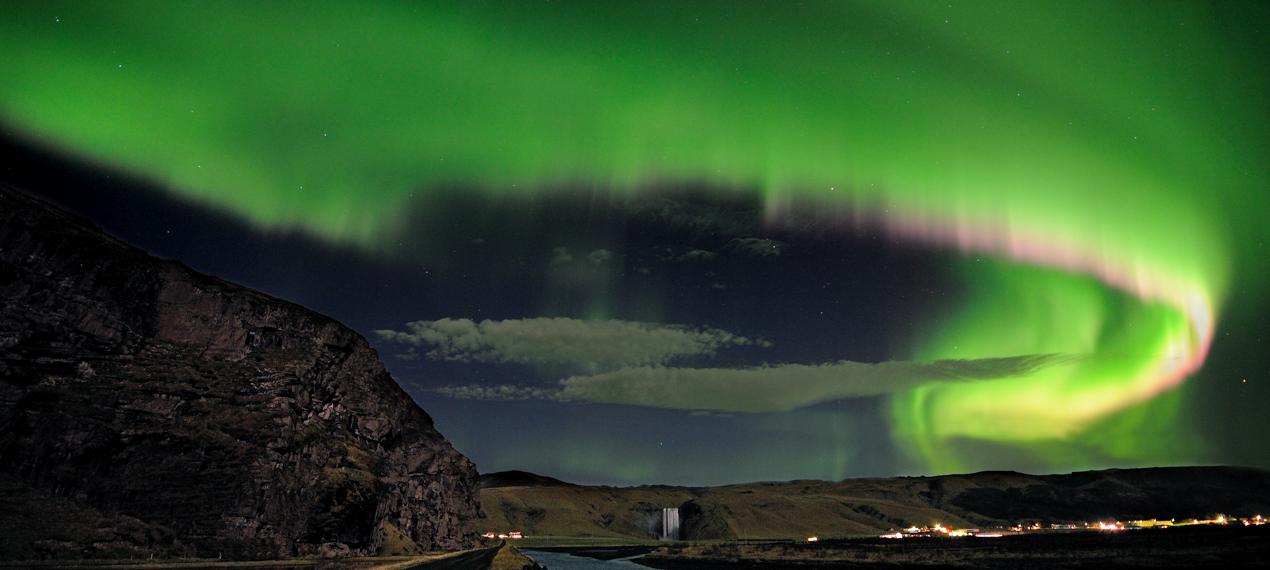
It felt like the icing on the cake, a final gift after a journey filled with remarkable sights, beneficial company and spiritual reminders. All praise belongs to Allah, who allowed us to witness this extraordinary spectacle before we departed.
Friday 23 October
A Farewell Filled with Gratitude
The next morning, Mufti Sahib departed for Karachi at about 5.30 am, while most of us were due to leave around 8.00 am for our 11.30 am flight. My flight to London was an hour earlier, at 10.35 am, so we left at 7.30 am with Brother Ermir, an Albanian brother who had lived in Iceland for many years. May Allah reward him for his hospitality.
Alhamdulillah, we returned home with many wonderful memories, but also with the feeling that there was still so much more to see in Iceland. Yet this is true of so many places in the world: there is always more to explore. At the same time, life has other priorities.
It would be an omission not to pay tribute to our driver, Gohar Bhai. Originally from Pakistan, he had lived in Italy before coming to work in Iceland, where he had been based for around three years. Throughout our journey, he took care of our transport and practical needs, while sharing useful observations about Iceland, its landscape and its people. A man of great character and discipline, he managed the challenges of transporting a large group with firmness and respect, patiently accommodating those who occasionally arrived late. His helpfulness, patience and thoughtful consideration towards the ‘ulamā’ were greatly appreciated. May Allah reward him abundantly and grant him success in all his endeavours.
Alhamdulillah, Gohar Bhai later remarked that no one had fallen seriously ill or sustained any injuries. Having taken many groups on tours, he said there was usually someone who suffered an injury along the way. We were grateful that our journey had been free of such mishaps. More generally, everyone had got along well, and the trip had proceeded smoothly, without arguments or disagreements. Even the restaurant manager had remarked to one of our group members on how such a large gathering remained so well-behaved, respectful and dignified. It was pleasing to see the group leave such a positive impression.
Above all, I feel I must express my heartfelt gratitude to Mufti Taqi Sahib (May Allah preserve him) for giving us the opportunity to accompany him on this journey. To spend these days in his company, listen to his words of advice, benefit from his reflections and share these experiences with him was a privilege for which I am deeply grateful to Allah. Particularly at his age, the opportunity to travel alongside him and benefit from his company in this way is something I will always treasure.
I often reflected on how fortunate we were. There must be hundreds of thousands of people who would dearly love to have such an opportunity: to travel with Mufti Sahib, sit in his company and benefit from him, even if only for a short while. Yet Allah had granted us the blessing of spending this time with him throughout the journey. The more I reflect on it, the more I realise what a precious opportunity it was. I pray that Allah allows me to appreciate it fully, and that the memories, advice and lessons of this journey remain with me long after the trip itself has ended.
May Allah preserve Mufti Sahib, grant him continued health and strength, accept his lifelong service to the dīn, and allow us to benefit from his knowledge, wisdom and company for many years to come. Amin.
I must also mention my dear, long-standing friend Yahya Batha of Turath Publishing, who had hoped to join us but unfortunately had to withdraw at the last minute. His absence was felt, and I had very much wished to share this memorable journey with him. May Allah grant us another opportunity to travel together. Amin.
I must also acknowledge a truly distinguished sister, whose encouragement and efforts played an important part in making it possible for my wife (and my sons) to accompany me. May Allah reward her kindness. Amin.
Finally, my thanks go to Mawlana Haneef Sahib, Mufti Yusuf, Mufti Muhammad and Mawlana Ibrahim, whose efforts in organising the trip and making all the necessary arrangements enabled us to enjoy this precious opportunity to accompany Mufti Sahib. I am also grateful to Haji ‘Abdul ‘Aziz Saheb for introducing me to this trip, and the members of the esteemed caravan for sharing their notes and photographs, from which I have greatly benefited, particularly the notes of Mawlana Yunus Dudhwala. Such a journey requires considerable time, effort and care, and I am grateful to everyone who contributed. May Allah reward them abundantly, accept their efforts and place barakah in their lives and work. Amin.
Iceland Beyond the Itinerary
Nature’s Gifts and the Icelandic Way of Life
One of the things that struck me about Iceland was how generously Allah has provided the country with natural resources, and how successfully its people have learnt to harness them. Geothermal energy, in particular, plays an important part in everyday life.
Much of the hot water used in homes and apartments comes from geothermal sources beneath the ground. I was told that in some places, hot water can be found relatively close to the surface and then supplied to buildings through distribution systems. Cold water comes from separate sources, including natural springs and groundwater.
One person told me that household bills for water, electricity and fuel could be as little as £20–30 a month.
Geothermal energy is also used to heat swimming pools and other facilities. Allah has not only provided these resources but also granted human beings the knowledge and expertise to benefit from them.
Swimming in a Cold Country
Iceland’s summers are generally cool, and a temperature of around 18°C is often considered a pleasant summer’s day, although warmer weather is possible. Swimming in the sea is therefore not particularly appealing to many people. Instead, heated swimming pools, many of which use geothermal energy, have become an important part of everyday life.
People visit these pools regularly to swim, relax and socialise. Some use geothermal water mixed with cooler water to achieve a comfortable temperature.
We did not manage to visit any of the geothermal pools ourselves, which was a pity, as it would have been a lovely experience. It is another reason to leave something for a future visit, in shā’ Allāh.
Exceptionally Clean Water
Iceland’s cold tap water is exceptionally clean and fresh, with much of it originating from groundwater and springs naturally filtered through volcanic rock. It is safe to drink, so there is little need to buy bottled water.
The hot water is different. Much of it comes from geothermal sources and can have a sulphurous smell, rather like rotten eggs. This is normal in many geothermal systems, although the smell varies from place to place.
After drinking Icelandic water for several days, I found that London’s water took some getting used to.
Living with the Elements
Iceland’s dramatic scenery comes with the challenges of living in a landscape shaped by volcanic activity and exposed to powerful weather. Earthquakes are relatively common in some parts of the country because of its position on the Mid-Atlantic Ridge and the associated geological activity. Buildings and infrastructure must take the risk of earthquakes into account, I heard that buildings were required to withstand earthquakes of high magnitudes.
The greater everyday concern for many people is often the wind. I was told that winds can become so strong that even buses have been overturned. This helps explain why driving requires particular care, especially in exposed areas. I also heard that one of Iceland’s islands is among the windiest places on Earth, although I could not establish which island was meant.
People, Livelihoods and Opportunity
I found the Icelandic people to have very good character. The country is also far from poor, enjoying a prosperous economy despite its small population and remote location. During the trip, I heard and observed several things that gave me an insight into how people from different backgrounds have made their lives there.
One particularly interesting story was about a Palestinian man who had started a car-washing business. Within a few years, he had expanded it to employ eight people and was doing well. His experience illustrated how someone prepared to work hard, recognise an opportunity and develop a business could build a successful livelihood in a new country.
The Pakistani community also appeared to be doing well. From what I was told, many Pakistanis had established themselves comfortably and built good lives in Iceland. It was encouraging to see people from different backgrounds making a contribution to the country while maintaining their own identities and communities.
Iceland’s relative prosperity reflects a combination of natural resources, skilled labour and industries developed around its environment. Fishing remains important, while aluminium smelting and silicon production make use of the country’s abundant electricity. Tourism has also become a major source of income.
Iceland has attracted data centres, partly because of its cool climate and access to electricity. However, such facilities do not necessarily create large numbers of jobs once established, despite their substantial energy requirements. Their wider environmental impact also depends on how the electricity is generated and how the facilities are operated.
The country’s prosperity does not mean that life is easy or inexpensive. Salaries are relatively high, but so are living costs, and housing in particular can be a considerable burden. These pressures are worth bearing in mind when considering how Iceland’s economy works in practice.
An Expensive Country
Iceland is an expensive destination, and we certainly noticed this during our travels. Its small population, remote location and reliance on imported goods all contribute to the cost of living. Transport is expensive, labour costs are high, and tourism adds further pressure, particularly on accommodation, where visitors compete with residents for places to stay.
The prices we encountered brought this home. A basic fish and chips meal cost us around £20, a scoop of ice cream about £6, and a bar of local chocolate £5. Even ordinary purchases can quickly add up, so travelling around Iceland requires careful budgeting.
Accommodation can be particularly costly. I was given figures of around £2,500 a month to rent a two-bedroom apartment in Reykjavík, with a purchase price of approximately £550,000. These were indicative figures rather than verified averages, but they give a sense of the housing costs that residents may face.
One surprise was that some products seemed considerably cheaper at Keflavík Airport than in Reykjavík. We noticed Icelandic chocolate and clothing from the local brand 66°North selling for around 20–25% less in the airport shops. It is worth checking airport prices, even on your way into the country, before buying souvenirs or branded clothing in the city.
Making Your Money Go Further
Despite the high costs, there are ways to enjoy Iceland without spending a fortune. Many of its greatest attractions, including waterfalls, black sand beaches and hiking trails, are free. A large part of the country’s appeal lies in its natural scenery, so some of the most memorable experiences need not cost anything at all.
Food is another major expense. Eating out for every meal can be costly, so choosing accommodation with a kitchen and shopping at budget supermarkets such as Bónus or Krónan can make a real difference. Iceland’s cold tap water is safe to drink, so there is no need to spend money on bottled water. Simply fill a reusable bottle.
The weather is unpredictable, but there is no need to buy an entirely new wardrobe for the trip. A good waterproof and windproof jacket, a warm mid-layer, gloves and a scarf are far more useful than lots of bulky clothing. Iceland’s wind and rain can make even a relatively mild day feel bitterly cold.
Visitors may also be eligible for a VAT refund on qualifying purchases. The minimum purchase threshold is generally ISK 12,000 on a single receipt, subject to the applicable conditions. It is worth asking for the necessary tax-free documentation when shopping and checking the refund procedure before departure. Travelling outside the summer peak may also help reduce the cost of flights and accommodation.
The scene of Da‘wa
One of the more encouraging things I heard during the trip was that interest in Islam among Icelanders had increased in recent years. I was told that events in Palestine and other issues affecting the Muslim world had prompted some people to investigate the religion more closely. One anecdote I heard was particularly interesting.
A young woman had visited a mosque seeking the truth. One of the sisters explained Islam to her according to its main framework, but the woman then asked to hear about the real Islam, raising familiar criticisms encountered in the media, particularly concerning the perceived subjugation of women. The sister patiently addressed her concerns and explained the Islamic perspective. The young woman subsequently embraced Islam.
The Cold Climate and Controlling the Gaze
A local Muslim brother made another interesting observation. He felt that Iceland’s cold climate made it easier to manage one’s gaze and avoid looking at things one should not be looking at. It was an appreciated and thought-provoking point.
Appreciating Allah’s Provision
For me, Iceland offered a reminder that Allah’s provision is not always immediately obvious. Sometimes it lies beneath the ground, in water heated by the Earth’s internal forces. Sometimes it takes the form of knowledge and expertise, enabling people to turn natural resources into warmth, comfort and opportunity. At other times, it appears in the opportunities available to those who move to a new country and build a livelihood there.
The Qur’an repeatedly invites us to look at the earth, the mountains and the heavens as signs of Allah’s power and wisdom. During our visits to Iceland’s waterfalls, geothermal areas, glaciers and volcanic landscapes, there were many opportunities to reflect on the forces that have shaped the land over thousands of years, long before modern Icelandic society came into being.
Such observations can naturally lead to gratitude to Allah for the diversity and order of His creation. They also encourage humility. Human beings can study the mechanisms of the natural world and learn to make use of its resources, but we remain dependent upon conditions far beyond our control.
Ultimately, the journey was not only an opportunity to see extraordinary landscapes or learn about another country. It was also an opportunity to reflect on the blessings we often take for granted, the abilities Allah has given us, and our dependence upon Him in every aspect of life.
Alḥamdulillāh for the opportunity to witness such beauty and learn from the experience. And through Allah is all enablement: wa bi ’Llāhi ’l-tawfīq.
Abdur-Rahman Mangera
White Thread Press
October 2026
The following reflections are offered by my wife and the three other women who accompanied us on the journey to Iceland and supported Khala Jaan, the wife of Hazrat Mufti Taqi Usmani Sahib, during the trip.
Moments in Iceland with Khala Jaan
Personal Reflections from Four Sisters
When the four of us travelled to Iceland with our husbands in the company of Khala Jaan and Mufti Taqi Usmani Sahib, we expected to take in the breathtaking waterfalls, glaciers, and mountain landscapes. What we didn’t fully anticipate was how much deeper the journey would go. Beyond the scenery, those days spent by Khala Jaan’s side became a quiet masterclass in faith, resilience, and genuine devotion. Sitting with her, walking alongside her, and listening to her stories left an imprint on our hearts that we will carry for the rest of our lives.
One of the most moving parts of our time together was listening to Khala Jaan talk about her early married life. When she and Mufti Sahib got married, he was a young ‘alim just starting out. She consciously took on every detail of the household—his meals, his clothes, and every domestic responsibility—so that he could devote his mind completely to his research, writing, and service to the Umma. As she shared her life story, we were deeply moved by her inner strength. She spoke openly about the painful trials she endured, including miscarriages and losing children. Yet even in those moments of physical and emotional heartbreak, she refused to burden Mufti Sahib, returning home from the hospital independently and carrying her grief quietly so his work would never be interrupted. Her sacrifice showed us what true, selfless support looks like.
Her counsel to us on spiritual connection was simple, practical, and incredibly profound. She urged us to keep dhikr on our tongues throughout the entire day, explaining that when you remember Allah constantly during quiet, normal moments, your voice becomes familiar in the heavens. When hard times hit and you call out in du‘a’, you are calling out with a voice Allah already knows so well. She also reminded us that du‘a’ doesn’t always require formal moments with raised hands after prayer. You can—and should—ask Allah for every single task, big or small, wherever you are. Whether walking, cooking, or resting, your heart can keep an unbroken, informal conversation open with Him throughout the day.
Khala Jaan also showed us that spiritual mindfulness isn’t just about ritual; it is woven into how you treat people, food, and the world around you. She had a deep dislike for israf (waste). At breakfast, she gently made sure all five of us helped finish up the leftover muesli so nothing was thrown away, and when large plates of food were served at dinner, she encouraged us all to share from the same dishes. She accepted every gift presented to her with genuine warmth, never turning anything down. Even though walking was physically tough for her, she paused along a path to clear a loose stone out of the way, reminding us of the immense reward in removing a simple hardship from someone else’s path.
Throughout our outings, Khala Jaan naturally shared practical spiritual remedies with us. She reminded us of the four specific du‘as to recite after finishing a meal as an act of gratitude. She also told us about a rare booklet on protection against nazr (evil eye) and hasad (envy) that she had personally benefited from during a time of hardship and physical discomfort. Because the book was out of print and hard to find, she was genuinely concerned that others couldn’t access it, expressing a strong desire to see it republished so more people could heal from it. On a separate occasion, when we asked her about specific Qur’anic verses for protection against nazr, she recommended holding onto the following verses of Surat al-Mulk and the final verses of Surat al-Qalam:
فَارْجِعِ الْبَصَرَ هَلْ تَرَىٰ مِنْ فُطُورٍ ﴿٣﴾ ثُمَّ ارْجِعِ الْبَصَرَ كَرَّتَيْنِ يَنْقَلِبْ إِلَيْكَ الْبَصَرُ خَاسِئًا وَهُوَ حَسِير
Farjiʿi ’l-baṣara hal tarā min fuṭūr. Thumma ’rji‘i ’l-baṣara
karratayni yanqalib ilayka ’l-baṣaru khāsi’aw wa huwa ḥasīr (Mulk, 67:3–4).وَإِنْ يَكَادُ الَّذِينَ كَفَرُوا لَيُزْلِقُونَكَ بِأَبْصَارِهِمْ لَمَّا سَمِعُوا الذِّكْرَ
وَيَقُولُونَ إِنَّهُ لَمَجْنُونٌ ﴿٥١﴾ وَمَا هُوَ إِلَّا ذِكْرٌ لِلْعَالَمِينَWa-in yakādu’lladhīna kafarū la-yuzliqūnaka
bi-abṣārihim lammā samiʿū ’dh-dhikra
wa yaqūlūna innahu la-majnūn. Wa mā huwa
illā dhikrun li-’l-ʿālamīn (Qalam, 68:51–52.).
We also had the honour of meeting with Mufti Taqi Usmani Sahib during the trip, who took time to listen attentively to concerns raised by some of the sisters, giving each person thoughtful guidance and specific du‘as.
Some of our favourite memories were the light-hearted, joyful moments we shared in the middle of Iceland’s wilderness. When we reached a massive waterfall, Khala Jaan walked with us all the way to the viewing deck despite the difficulty. She stood right in front of the rushing water, taking in the cool spray on her face, completely immersed in praising Allah’s creation and quietly reciting tasbihat. When we got back to the car, a sweet moment unfolded between her and Mufti Sahib. He playfully teased that he had beaten us to the car first, subtly referencing the sunna of racing. Khala Jaan didn’t skip a beat—she wittily fired back that she only turned around because her husband commanded her to, so she didn’t get a fair chance to win! Later, when one of his students joked that it was because the sisters’ team was weak, Khala Jaan immediately jumped to our defence, telling them ‘No!’ and reminding them that we only turned back because we were called.
As four sisters watching them together, witnessing the mutual love and respect between Mufti Taqi Usmani Sahib and Khala Jaan was one of the most uplifting parts of the trip. Even when the paths were icy and slippery, Mufti Sahib never discouraged her from joining the excursions. He would sit patiently in the car waiting for her to return without a single hint of rushing, and he personally kept track of her health, gently checking if she had taken her medications on time. He modelled what an ideal, caring husband looks like in practice. Before the trip ended, Mufti Sahib personally thanked us sisters for taking care of Khala Jaan, telling us in his own words that seeing us look after her gave him true rahat (comfort of the heart).
Traveling across Iceland with Khala Jaan felt less like a holiday and more like an unexpected gift. Watching her constant remembrance of Allah, her quiet resilience, her care for others, and the gentle dynamic between her and Mufti Sahib gave us a practical model of how to live our faith. We came home not just with photos of waterfalls, but with lessons in character and devotion that we will cherish forever.
V.1.1
November 2026
Iceland October 2026 With Mufti Taqi Usmani