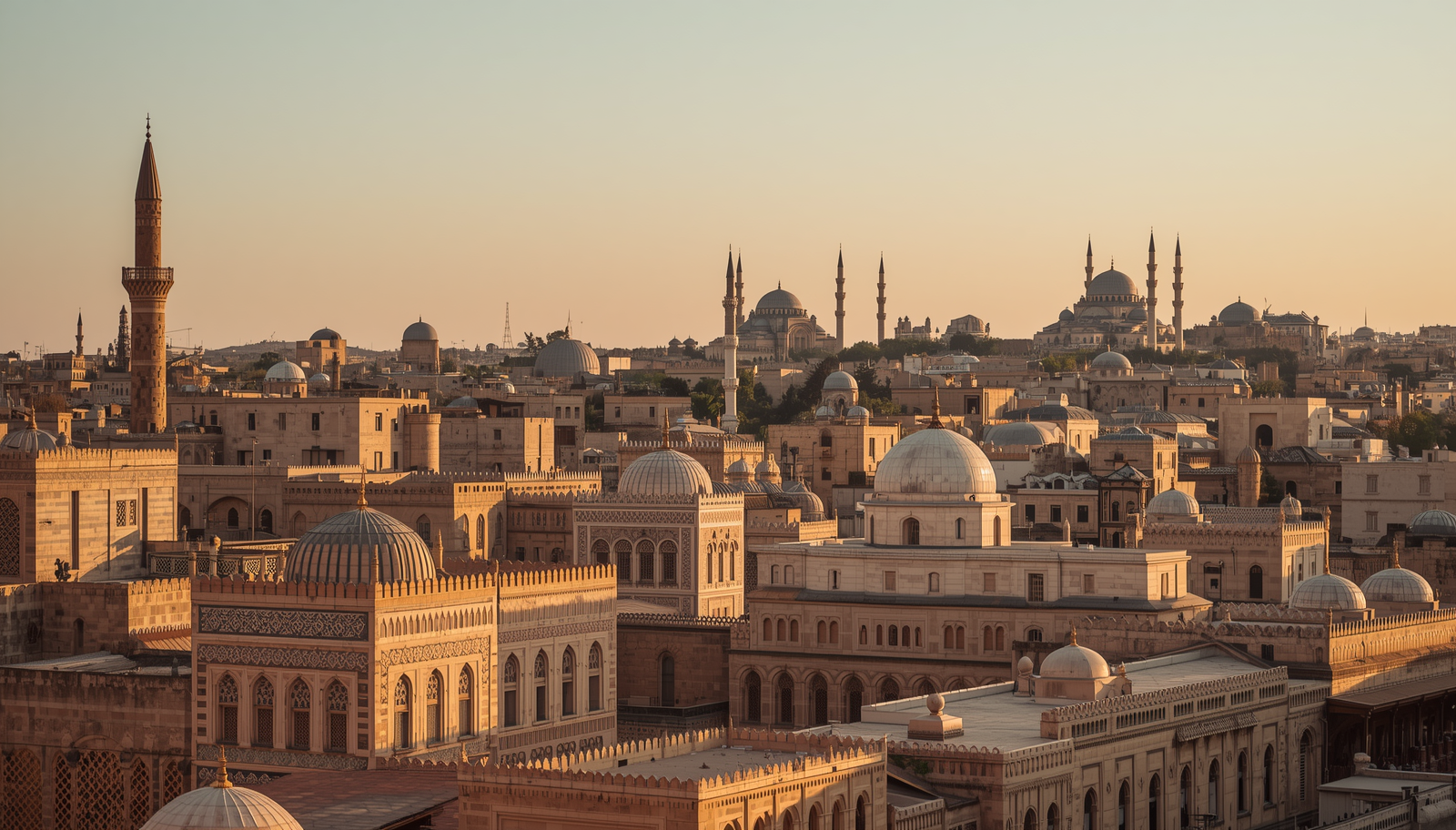
Back to Syria: The Beating Heart of the Levant
Back to Syria: The Beating Heart of the Levant
10 to 18 August 2025
Syria is a land where history does not sit silently in museums or behind plaques, but breathes through streets, courtyards, mosques, and markets. One does not merely visit Syria; one moves through it, layer by layer, civilisation by civilisation. It is among the oldest continuously inhabited regions on earth, a place where the past has never fully receded, but remains present in stone, sound, scent, and rhythm. Cities such as Damascus and Aleppo feel ancient not because they are worn or crumbling, but because they are deep, carrying centuries with a quiet, unforced dignity.
Geographically and culturally, Syria has always stood at the crossroads of the world. Situated between the Arab heartlands, Anatolia, Persia, and the Mediterranean, it has for millennia been a meeting point rather than a margin. Trade routes, armies, pilgrims, and scholars passed through its cities, leaving behind ideas, customs, and knowledge that shaped not only Syria, but the wider region beyond it. Damascus, often described as the oldest continuously inhabited capital in the world, was never merely an administrative centre. It was a living city of governance, commerce, worship, and learning, where the sacred and the ordinary coexisted naturally.
For Muslims in particular, Syria occupies a special and enduring place. It has long been a land of scholars, saints, and seekers, producing generations of learning rooted in balance, depth, and spiritual refinement. The mosques, madrasas, and zāwiyas of Syria were not simply institutions, but living spaces of transmission. Knowledge was taught alongside adab, and spirituality was embodied rather than performed. The scholarly tradition of Syria was marked by continuity and restraint, by chains of learning passed quietly from teacher to student, and by a culture in which faith was lived as part of everyday life rather than asserted loudly.
My own connection to Syria began during my studies there in 1998. From the moment I left, I carried with me a longing to return. I wanted to meet my teachers again, to visit neighbours, to walk familiar streets, to smell the air, to sit once more in educational and spiritual gatherings, to stand again in the Umayyad Mosque, wander through the surrounding markets, and simply enjoy Syrian life as it was lived. There was a deep sense of nostalgia attached to those memories, and with each passing year, that desire did not fade. After the first decade away, it intensified, rooted not only in memory, but in a sense of belonging that never truly left.
Then came the war, and with it a long period of separation that went beyond distance. Travel was no longer a simple matter of intention. There was a general deterrence against returning, due to the many internal and external risks involved. I would ask about my teachers and scholars through those who had managed to visit, or through Syrian scholars I met abroad, many of whom were living in exile. There were times when I found myself in Amman, Jordan, just a few hours away by taxi, so close in geography yet impossibly far in reality. The journey remained out of reach, not because of lack of desire, but because it was never fully safe.
In more recent years, Syria has often been spoken of only through the language of conflict, displacement, and suffering. While that pain is real and undeniable, it tells only a fraction of the story. Long before war, Syria was a place of remarkable normality, hospitality, scholarship, and continuity. To remember Syria solely through the lens of destruction risks erasing the civilisation that sustained it for centuries. Even amidst hardship, the culture of learning, dignity, and social cohesion persisted in quiet, resilient ways.
When the Assad regime finally fell and Syria began to open up again, it marked a moment of profound emotion for countless people. After decades of repression and persecution, there was cautious hope that a long and painful chapter might finally have come to an end. For me, the excitement to return was immense, but tempered by years of waiting, restraint, and unanswered questions. When the opportunity eventually presented itself in August 2025, I took it, carrying with me years of longing, memories of teachers and gatherings, and the hope of reconnecting with a land that had never truly left my heart.
This travelogue is not merely a record of places visited or journeys undertaken. It is an attempt to reconnect with a Syria that shaped lives, nurtured scholarship, and stood at the heart of civilisation. It is a journey through history, faith, memory, and return—to a land where the past still lives, where knowledge was once breathed into daily life, and where, despite everything, echoes of that legacy remain.
When the Road Opened Again
I had only just returned from Bosnia when a friend from the United States contacted me again, encouraging me to join their trip to Syria. They were due to leave in just forty-eight hours. He had mentioned the idea a few weeks earlier, but with other journeys in between and the high cost of summer airfares, I had been undecided and assumed I would make the visit at a later time.
This time, however, the opportunity felt too immediate to delay. Beyond the personal significance of returning, there was also a practical reason that made the journey particularly timely. Damascus has long been one of the centres of Arabic publishing, home to major houses such as Dār al-Qalam, Ibn Kathīr, and al-Fikr. With Syria reopening, I was keen to see how the book markets had revived after years of disruption, to explore newly released titles, and to assess what had changed in the scholarly publishing landscape.
Once I committed, I began contacting those who had previously asked to be informed if I ever travelled to Syria, hoping they might accompany me. The notice, however, was far too short for most. On a final thought, I asked my younger brother, Hafiz Ahmad, who agreed almost immediately to join me.
The itinerary was largely already set, though I suggested a few adjustments which we were able to make. Despite recent developments, many people remain hesitant about visiting Syria, still cautious after years of war and the sudden political shift. Even so, with plans in place and little time to spare, we packed quickly and prepared to leave.
Sunday, 10 August to Monday, 11 August
Our late night flight from London was on Turkish Airlines, and I managed to grab a few hours of sleep during the journey. At Istanbul, we met up with our companions from the USA, Dr Farrukh, and his friends Omar and Khaleel bhai, and waited at the gate for our connecting flight to Damascus. With only about thirty minutes to departure, the announcement came: the flight was cancelled. It was surprising to hear of such a late cancellation, and for a moment, we were unsure how to proceed. Eventually, the airline said they would provide hotel accommodation and rebook us for the next morning.
Within our group, opinions differed. Some suggested staying in Istanbul for the night, taking advantage of the unexpected delay to see local sites. Others argued for transferring to another flight—via Aleppo, or even Beirut or Amman—and then travelling overland to Damascus. After back-and-forth discussions, our Syrian tour operator recommended the Beirut option, explaining that many Syrians had been taking this route in recent years. In hindsight, I thought it might have been better to stay in Istanbul for the day; I could have finally visited the Hagia Sophia since its reconversion to a mosque. Even during its time as a museum, the building has always left me in awe, and its history and architecture have a presence that is difficult to describe.
We reached Beirut around 2 pm, and entry was straightforward—there was no fee for a visa. Everything was handled at the immigration booth itself. There was no need to visit a separate bank kiosk or obtain a special receipt, as is required in some other countries. Even at this early stage, the signs of Lebanon’s economic hardship were visible from the airport.
The journey from Beirut to the Syrian border took about two hours, threading through congested roads and Lebanon’s rugged interior. Traffic leaving Beirut crawled along slowly, leaving little chance to see the city itself. As we drove, we passed areas the driver told us were inhabited by Hezbollah, some bearing scars from recent Israeli bombings. Lebanon’s economic struggles over the past decade were evident in the state of the infrastructure and the roads.
About 15–20 minutes into the journey, we stopped at a small masjid on the outskirts of Beirut to pray ‘Asr. The building could have been in better condition, but it was clearly well used by travellers along this route. It was a modest reflection of the country’s broader economic challenges, yet also a reminder of Allāh’s mercy—these roadside masjids, constantly open, provide comfort and convenience to weary travellers.
Once beyond the urban sprawl, the road climbed into Lebanon’s interior. We rose out of the coastal plain into the Mount Lebanon range, a rugged north–south chain with peaks soaring over 2,500 m. Briefly, we descended into the fertile Beqaa Valley, a patchwork of farmland nestled between mountains, before approaching the Anti-Lebanon range, which forms much of the border with Syria. Towering above all was Mount Hermon, exceeding 2,800 m.
Our driver warned that the van would struggle on the steep climbs, and that he would need to switch off the air-conditioning to conserve power. Despite the rising heat and the challenging terrain, the journey felt smooth and safe, and we were grateful that Allāh had made it easy. Eventually, the border came into view.
Exit formalities on the Lebanese side were relatively smooth. The officer handled a surprising number of visas despite a slow system, even rebooting it twice, and admirably managed both foreign and local passports across two screens.
However, there was a delay with our vehicle’s clearance. One officer held up our van while other vehicles passed through. My companion Dr Farrukh and I walked over to the border cabin to investigate, after which the officer finally took our vehicle papers and completed the stamp. Later, our driver confided that the officer had initially demanded an extra payment of one hundred US dollars, which he had firmly refused, citing lack of funds and even hinting at contacting our embassies. It seemed the delay had been a pressure tactic. Eventually, he only required a small payment in Syrian pounds, which he assured us was minor.
A Welcome Change at the Syrian Border
On the other side, the Syrian immigration building was noticeably larger and more developed, with full air-conditioning providing a welcome relief after the heat of the journey. The officer was polite and welcoming, which set a calm tone for our entry.
US citizens are required to pay a two hundred dollar vĪsāfee, while UK passport holders pay one hundred and fifty dollars. This is an official requirement at land borders and airports, and the process was very straightforward. Our driver later explained that since the new government took over in Syria, bribes are no longer a factor. This was a refreshing change. On my previous visit, bribery had been commonplace. Back then, my landlord had to offer a bribe simply to register our contract.
I was pleasantly surprised by the border infrastructure. It was markedly better than the Lebanese side, which contrasted with my earlier impressions when Lebanon had seemed far more developed than Syria.
Alḥamdulillāh, there was noticeably less traffic on the Syrian side as we drove towards Damascus, and we reached the city in about an hour. Entering from the Masnaa crossing, the road took us through the hills near Jdeidat Yabous and the historic Maysalun area, before passing close to Daraya, one of the suburbs most devastated by the war. It was here that I first saw the true scale of the destruction. Entire neighbourhoods had been reduced to ruins. Buildings were completely flattened, concrete lay in chaotic mounds, steel rods were twisted and exposed, and there was no sense of where one home ended and another had once begun. These were not damaged structures waiting to be repaired but places erased, stripped down to their skeletal remains.
Seeing this in person was profoundly unsettling. This was no longer war as an idea or something watched from afar; it was raw, physical destruction stretching for long moments along the road. The silence around the ruins felt heavy and almost accusatory. Only as we moved closer to the outskirts did the living city gradually reappear, but that first encounter with Daraya’s devastation stayed with me as a stark reminder of what Syria has endured.
Alḥamdulillāh, the city of Damascus itself remained largely intact and had not sustained much damage during the war. We settled into the Talisman Hotel. We had been supposed to arrive earlier in the day and depart for Aleppo (Halab), but the delays meant we would spend the first night in Damascus, in the old city. The Talisman is like a large Moroccan riad, one of the old Damascus mansions with a spacious central courtyard, located in the Jewish quarter. It even had a swimming pool in the courtyard. The rooms are quaint and old but renovated to maintain their antique style.
The tour operator took us out to eat at a restaurant called Arabisc. I had perhaps expected the food to be of inferior quality because of the war and ongoing sanctions, but the meal was surprisingly good, clean, and well prepared, comparable to any decent restaurant anywhere. It struck me that back in 1998 there were very few restaurants of this standard that I could recall, making this experience all the more reassuring.
Being back in the streets of Damascus was a flood of memories. Seeing the buildings, the old cars and taxis, and hearing the sweet, lyrical accents of the locals felt wonderful. I could not wait to visit my old neighbourhood, apartment, the masjids, the souks, and, of course, my teachers and acquaintances who were still alive. But that would have to wait, as our itinerary required us to visit the cities outside Damascus first.
Tuesday 12 August
On Tuesday morning, we departed from the hotel and stopped at ‘Abbassiyeen Square to buy local SIM cards from SyriTel and get connected for the days ahead. ‘Abbassiyeen Square sits in eastern Damascus, a busy urban crossroads near shops and cafés, where the city’s pulse felt immediate and alive even early in the day. Honking minibuses, vendors calling out their wares, and the scent of strong coffee drifting through the air created an unmistakable sense of energy.
For foreigners, the minimum package of 20 GB cost approximately 370,000 Syrian pounds (SYP), around 22 UK pounds at the time. Our guide, however, used his local identity card and obtained it for less than 5,000 SYP, under five dollars.
As we emerged from the city, we passed the suburbs of Harasta and Duma and observed pure devastation again. Nearly all the buildings in entire areas had been destroyed or burned out. Many locals had moved elsewhere or had been forced to become refugees in other countries.
Despite this, the motorway was surprisingly well maintained. The smooth two-lane highways were divided by barriers and showed little sign of the war’s impact. Our guide explained that the authorities restore the roads quickly to ensure that transportation and movement continue uninterrupted. Traffic was minimal, and we did not see any trucks. The guide noted that trucks have a separate highway, which helps preserve the main road. In the heat, heavy vehicles can cause significant wear and damage, so this separation ensures the highway remains in good condition.
Through the Qalamoun Mountains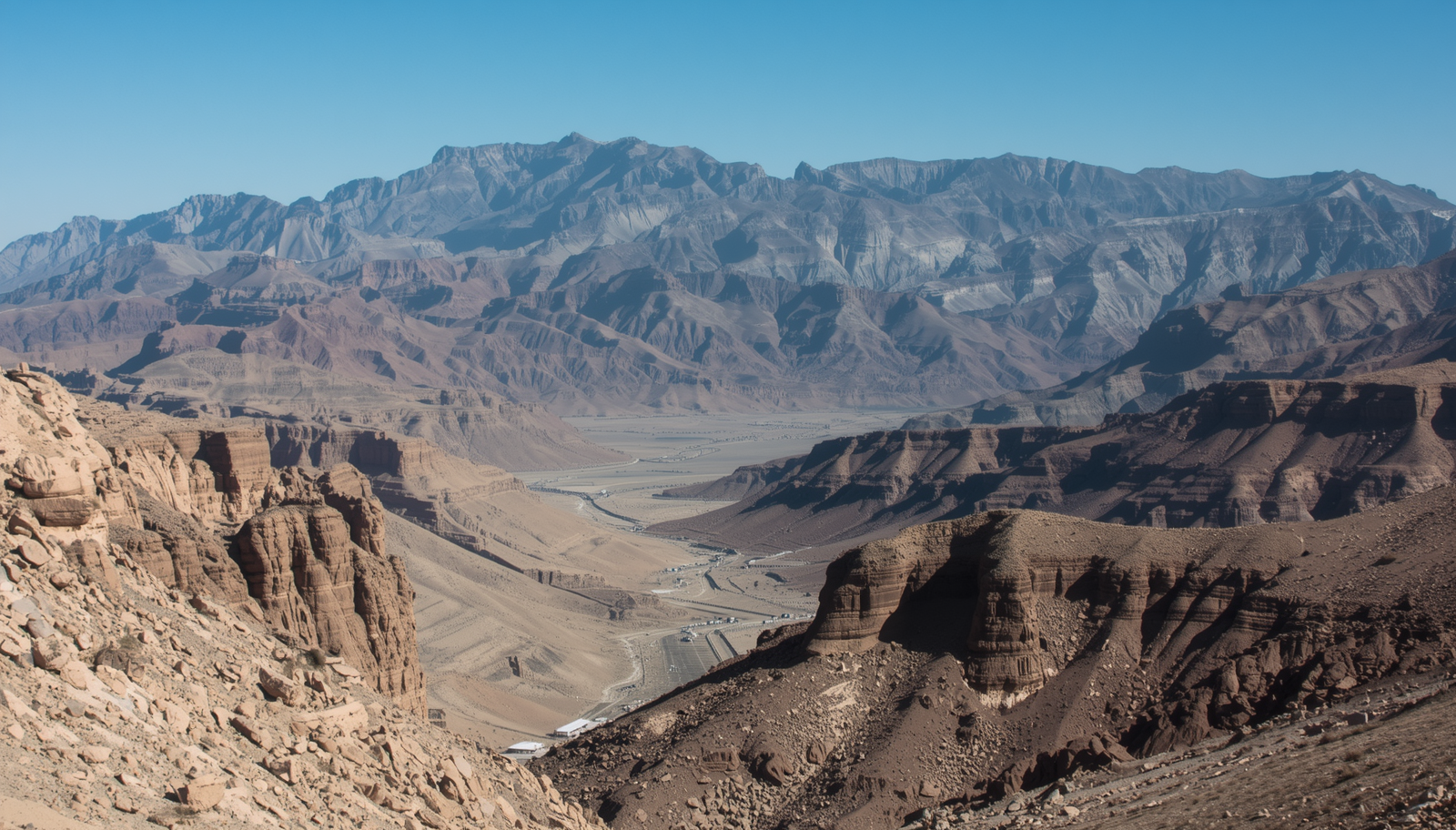
We passed the Qalamoun Mountains, a rugged range in western Syria forming the northeastern part of the Anti‑Lebanon Mountains. They stretch from the Barada River Valley near Damascus northeast toward the Homs countryside, running parallel to Lebanon’s Beqaa Valley. For centuries, these mountains have served as both a natural barrier and a strategic corridor. The landscape is steep and varied, with peaks and deep valleys that have supported ancient settlements and agriculture. Towns such as Maaloula, Yabrud and Saidnaya (also location of Assad’s notorious prison) are scattered throughout the range, with Maaloula particularly notable for its Christian population still speaking Western Neo‑Aramaic, a direct descendant of the language once widely spoken across the region. The slopes have traditionally supported fruit cultivation, including apples, cherries, apricots, and figs.
The Qalamoun region has also been strategically important in modern history. During the Syrian civil war, control of its high ground and mountain passes influenced access between Damascus, Homs, and Lebanon. Historically and culturally, the mountains reflect Syria’s diverse communities, with Christian and Muslim populations living alongside monasteries, churches and mosques, each marking the spiritual life of the area. The combination of dramatic terrain, historic settlements and enduring cultural traditions makes the Qalamoun Mountains both a significant natural feature and a key part of Syria’s historical and contemporary landscape.
Our guide, Ghassan, was extremely knowledgeable and well-mannered. Although he is a Christian, he has a deep understanding of many religions, especially Islam, and he even joined us in prayer a few times, which had us believing he was Muslim for a few days. He shared the history, background, and all relevant details about the places we visited. Ghassan explained that the villages around these mountains have long operated smuggling routes using mules, moving goods between Lebanon and Syria. Lebanon was relatively open while Syria was subject to sanctions for decades. Petrol and fuel would be smuggled into Lebanon, while appliances and other goods would be brought back to Syria.
The national train service from Damascus to Aleppo has recently restarted. It is a very old-fashioned train and takes about eight hours to complete the journey, which is longer than travelling by car.
Driving along Syria’s motorways, I kept noticing the pine trees lining the verges and embankments. At first, they seemed out of place in such a dry, unforgiving landscape, but their presence is deliberate. Pines are among the few trees that can withstand heat, poor soil, and long stretches without rain.
In their early years, they require watering and care, but once established, they largely look after themselves. Their roots reach deep, drawing moisture from far below the surface, which makes them well suited to roadsides where maintenance is difficult and resources are scarce. They also help hold the soil together, softening dust and erosion along the road.
We passed Maaloula, a very old settlement with houses nestled into the mountains. I remembered visiting this area before, but the details no longer came clearly to mind. There are three Christian villages here, the only places in the world where Western Neo‑Aramaic is still spoken, the language of Jesus (peace be upon him). The residents feel a strong sense of pride, believing they have a direct connection to the Prophet. Many of the older houses are carved directly into the rock of the mountains, blending seamlessly with the landscape.
Geologically, this area was once submerged beneath what is sometimes called the Messinian Sea during the Messinian Salinity Crisis, around six million years ago. Over time, the water receded, eventually forming what is now the Mediterranean Sea and leaving behind vast deposits of sediment. This ancient marine environment explains the abundance of fossils embedded in the mountains, remnants of the sea and the creatures that once lived there. The combination of natural history and cultural heritage makes Maaloula and its surroundings extraordinary, a place where layers of time, both human and geological, are visible in the very stones themselves.
We passed by Nabak, which is surrounded by around forty-two villages. There is a well-known service area here, and it felt as though everyone knew about it. It has several shops selling everything from food and snacks to desserts, baklava, tea, and coffee, as well as local products such as its renowned apricot jam. One of the cafés even serves free tea to anyone who stops by. People pause here to freshen up, eat something, pray, and then continue on their journey.
Our hotel booking for the night was in Homs and could not be changed, so we passed through the city as we had decided to visit Hama first. Hama lies about 45–47 km north of Homs, whether measured by road or as a straight-line distance. The plan was to return to Homs later in the afternoon to tour the city. There is more to see in Hama, so we wanted to go there first, complete that visit, and spend more time exploring it before heading back.
Hama: City of Waterwheels and Endurance
We reached Hama just after the Ẓuhr prayer had been performed, entering a city whose name carries both deep history and heavy memory.
Situated in west-central Syria along the Orontes River, Hama is best known for its historic norias (nā‘urāt), the large wooden waterwheels built primarily during the medieval Islamic period to lift water for irrigation. One of Syria’s oldest continuously inhabited urban centres, its roots stretch back to prehistoric settlements. Today, Hama remains an important agricultural and industrial hub within the fertile Ghab Valley and ranks among the country’s larger cities. It has long been known for the piety of its people and for their hospitality, qualities that continue to shape the character of the city.
Yet Hama’s name is inseparable from one of the darkest chapters in modern Middle Eastern history. In February 1982, the Syrian government launched a full-scale assault on the city to crush an uprising led by the Muslim Brotherhood. Heavy artillery, tanks, and widespread shelling were used against residential neighbourhoods. Entire districts, including historic quarters, were flattened. Thousands of civilians were killed, with estimates ranging from 10,000 to 40,000. The destruction was indiscriminate. Families were buried beneath rubble, mosques were damaged, and the social fabric of the city was torn apart. The trauma of that period lingered for decades, and the massacre remains a stark reminder of the extreme measures employed to maintain control.
Alḥamdulillāh, during the more recent uprising and war, Hama was largely spared and did not endure a second wave of devastation.
Masjid al-Nūrī
With this history in mind, our first stop in the city was Masjid al-Nūrī, also known as Jāmi‘ al-Nūrī, one of Hama’s most significant historical mosques and one that had itself borne witness to the events of 1982. Founded around 558/1163–559/1164 by the Zengid ruler Nūr al-Dīn Maḥmūd Zangī, the mosque was endowed as part of the broader Islamic architectural and cultural revival of his era. It stands in the old quarter of the city near the Orontes River and is admired for its restrained yet striking Ayyubid-era design. Built from basalt and limestone, it features a distinctive square minaret with alternating dark and light stone bands.
Although Masjid al-Nūrī suffered significant damage during the assault on Hama, it has since been restored and remains an active place of prayer, as well as a living reminder of the city’s Islamic heritage. Its original carved wooden minbar, an outstanding example of medieval Syrian craftsmanship, is now preserved in the Hama Museum.
Standing on the deep red carpet inside the mosque, the caretaker explained that the building is over nine hundred years old. Much of its stone structure remains original from the time it was built, although much of the interior has been plastered over, covering the original surfaces. One small portion of the original calligraphy is still visible on one of the pillars. It consists only of the final word from Sūrat al-Tawba, verse 23, al-ẓālimūn, meaning “the wrongdoers,” followed by the opening words of verse 24, qul in kāna ābā’ukum, translated as “Say: If your fathers…,” a verse that continues with a powerful warning against placing family, wealth, or worldly attachments above Allāh, His Messenger, and striving in His cause.
As he spoke, the conversation moved beyond architecture to the life of the city itself. He described the longstanding harmony between different religious communities in Hama. Christians have lived here for generations, and relations between communities were traditionally respectful and peaceful. During Ramadan, for example, Christians refrain from eating openly in front of Muslims. He explained that the only group to disrupt this harmony were the Alawites, to whom the former ruling Assad family belonged.
He then recalled the night of the liberation of Hama, just under a year ago, when around four hundred fighters stayed in this mosque. They came from many different backgrounds, including Indians. He mentioned this after learning that two of us were originally Indian.
The caretaker’s name is Samīr Muḥammad al-Ḥallāq. He has served as both the mu’adhdhin and caretaker of this blessed mosque for the past twenty years. The way he spoke, and the pride with which he carried his responsibilities, made it clear that he considers this role a great honour and that he values his service to the mosque, and to the Divine, deeply.
Several prominent families are among the original inhabitants of Hama. One is the Barāzī family, of Kurdish background; another is the Ṭayfūr family, of Turkic origin; and there is the Kaylānī (or Jīlānī) family, of Iraqi Arab roots. These families have lived here for generations, shaping the city’s character and preserving its heritage.
After visiting Masjid al-Nūrī, we walked a short distance to a well-known local eatery, Alo Chicken, for a shawarma. The restaurant sits near the Orontes River, from where one of the large historic norias is visible. From this spot, the residential areas on the opposite bank of the river can also be seen.
The Orontes River, known in Arabic as Al-Nahr al-ʿĀṣī, is one of the most distinctive rivers in Western Asia. Its source lies in Lebanon’s Beqaa Valley, from where it flows northward through Syria and Turkey before turning west to empty into the Mediterranean Sea. This northward course is unusual in the region, where most rivers flow south, and it is reflected in its Arabic name, al-ʿĀṣī, meaning “the rebel.” As the main perennial river of the northern Levant, it has shaped the landscape, agriculture, and settlements, including Homs and Hama, for millennia. During our visit, the river carried little water due to the summer heat, though I recalled it running fuller when I had been here before.
From Alo Chicken, we began exploring the old city. Passing the Espasia restaurant, a converted Ṭayfūr family mansion turned café, we ordered some juice. While there, the cousin of one of my close Syrian friends from Santa Barbara—who now lives in another state in the USA and belongs to the Barāzī family—came to meet me and joined us for the remainder of the tour. As we moved through the streets, we encountered some of the city’s officials, who warmly insisted that we stop for food or at least tea. We politely declined, conscious of time, but the gesture itself was familiar. It was a quiet reminder of the extraordinary hospitality that has long characterised Hama, something I had experienced very personally during my first visit many years ago.
Held Prisoner by Hospitality
That earlier encounter remains vivid in my mind. In 1998, we travelled to Hama on a day trip from Damascus, arriving in the late afternoon with only a few hours to explore before catching one of the last buses back. We were eager to see the city’s historic mosques, its famous norias, the great wooden water wheels rising from the river, and to get a sense of everyday life. At the bus stop, we joined a crowd waiting for a microbus into the town centre. These were the familiar white eleven-seater vans, known locally as meekro or “service” vehicles, operating fixed routes like shared taxis. I boarded with my wife, our young son, and his pushchair.
The driver attempted to charge us extra for the pushchair. This caught us off guard. In Damascus, it was never an issue, as it could easily be tucked behind the driver’s seat. One of the passengers took offence on our behalf. He became visibly angry, declaring that it was an embarrassment, perhaps even using the word haram in that exaggerated sense people use when they want to underline moral outrage. A short but heated exchange followed. He repeatedly challenged the driver, asking why he was trying to charge foreigners who were guests in their city.
Suddenly, the man turned to me and said, “Come on, let’s get off.” We did. Instead of finding another microbus, he hired an entire private taxi for all of us. At the time, a microbus fare would have been no more than two Syrian lira per person. For the six of us, that would have been minimal. He paid around twenty-five lira for the taxi without hesitation.
The taxi did not stop in the town centre. It stopped outside his house.
We followed him in. Syria felt safe in those days and still today, and there was something deeply trustworthy about him. I have never minded a little adventure or the unknown. I also felt a calm reliance upon Allāh, the kind that settles in the heart when events unfold beyond planning yet without fear. He welcomed us as guests. My wife sat with his wife in another room while he called a friend and we talked. When I mentioned that we needed to catch the last bus back to Damascus, he flatly refused the idea. We had only just arrived, he said. We had seen nothing. He even insisted there were no more buses. When I pressed him to check, he did, and admitted that buses were still running. Even then, his hospitality was so sincere and insistent that I asked my wife how she felt. She was comfortable. So we stayed the night, trusting Allāh.
Our host was delighted. He took us to see the norias, the great mosque, and various corners of Hama. He lived near Masjid al-Ḥayāyā, the so-called Snake Mosque, named for the snake motifs carved into some of its stones, possibly remnants from an earlier civilisation. His name was ʿUmar al-Shāmī. The next morning, after a good night’s sleep, he took me through the local market, proudly introducing me to shopkeepers as his guest. He was visibly beaming. He insisted I try desserts from a local sweet shop, where I tasted saḥlab for the first time. Everywhere we went, there was pride: in the city, in its food, and in the simple honour of hosting a stranger.
That experience brought to life the Arab hospitality I had only ever read about. The belief that a guest is a gift, that generosity is a matter of honour, and that once someone enters your home, they become family. I have encountered moments like this elsewhere, but this one has stayed with me. I often wish I could see him again, to thank him, to know whether he is still alive, to visit his family. But travelling with a group means surrendering to schedules you do not control. Still, I carry the memory with gratitude to Allāh, and I pray that He rewards him, blesses his family, and preserves goodness in his descendants.
Grand Mosque of Hama
Continuing through the narrow streets of the old city, we eventually arrived at the Grand Mosque of Hama, Al-Jāmiʿ al-A‘lā ’l-Kabīr. The mosque stands on a site layered with history. Parts of its structure still bear small egg-shaped stone carvings from Roman times, symbols of life and continuity that quietly echo the city’s long and complex past.
The mosque was almost entirely destroyed during the Assad government’s assault on Hama in 1982. At that time, only one wall of the original structure remained standing. It has since been reconstructed, though I still noticed the pock marks in the large stones of the bottom half of the front wall of the prayer area, a visible reminder of the city’s violent past. I remembered my local host on the earlier visit pointing them out to me. It appears that many people in Hama believe these large marked stones were intentionally left visible as a reminder of what happened when the city rose up against the Assads. Whether or not that was the intention, the scars are unmistakable, and standing before them brought the weight of that history sharply back into focus.
Historically, the mosque was renowned for its distinctive wooden minbar (pulpit), an exquisite example of medieval Islamic craftsmanship. Like other celebrated minbars in the region, it was constructed using interlocking wooden pieces fitted together with traditional joinery, without glue or nails—a technique that highlights both skill and durability. The most famous example of this kind of craftsmanship was the Minbar of Nūr al-Dīn in the Al-Aqsa Mosque in Jerusalem, assembled from thousands of interlocking pieces and widely regarded as a masterpiece before its destruction in 1969.
The mosque complex also houses the tombs of two important Ayyubid rulers from the 7/13th century. Al-Muẓaffar ‘Umar, a nephew of Ṣalāḥ al-Dīn (Saladin), was buried here after his death in 587/1191 at the age of about forty-three. Beside him rests his son, Al-Malik al-Manṣūr Muḥammad, who succeeded him as Amīr of Hama. These tombs underscore the city’s significance during the Ayyubid period, when Ṣalāḥ al-Dīn’s extended family ruled the region and left a lasting architectural and historical legacy.
Apparently, Hama has many other historical sites, and it is a beautiful city. Even its name carries a gentle, soothing sound. However, since we needed to reach Homs in good time before Maghrib, we said our salāms to Mr Barāzī, thanked him for his company, and departed. The Barāzī family has many other relatives in the city, and it would have been wonderful to meet some of them, visit the residential quarters, and to meet ʿUmar Shāmī. But we had to continue our journey.
Homs: In the Heart of Khālidiyya
Homs, or Ḥimṣ in early Islamic sources, became one of the major military districts (ajnād) of Bilād al‑Shām after the Muslim conquest in the 7th century. Many of the Prophet’s Companions settled here, giving the city a reputation for piety and steadfastness in classical Islamic writings. It served as an important garrison and administrative centre under the Rashidun and Umayyads, guarding the routes between Damascus, Aleppo, and the coast. The city is closely associated with Khālid ibn al‑Walīd (may Allāh be pleased with him), whose mosque remains one of its defining landmarks. Over the centuries, Homs produced notable scholars and transmitters of hadith, contributing to its standing as a respected centre of early Islamic life.
We reached Homs in time for ʿAṣr and first visited the Mosque of Khālid ibn al‑Walīd (may Allāh be pleased with him). The mosque has been newly rebuilt after being destroyed in the war and is much larger than I remembered from 1998. At that time, the tombs of Khālid ibn al‑Walīd and his son ʿAbd al-Raḥmān ibn Khālid (may Allāh be pleased with them) were housed in a separate, smaller building. Now, they are part of the main mosque complex, with the tombs situated at the back on the right-hand side as one enters. ʿAbd al-Raḥmān was a notable commander in the Arab–Byzantine wars and served as a close aide to Muʿāwiya ibn Abī Sufyān (may Allāh be pleased with him), the first Umayyad caliph.
On the opposite side of these tombs, to the right as you enter, lies another tomb believed to be that of ʿUbaydullāh ibn ʿUmar (147/764), a son of the Companion ʿUmar ibn al-Khaṭṭāb (may Allāh be pleased with them), although details about his burial there are uncertain. The tomb of Khālid ibn al‑Walīd (may Allāh be pleased with him) is enclosed in a glass structure. Interestingly, it features a slightly larger elevated marble structure over the original grave, allowing visitors to see the soil beneath through side cavities. This is the first time I have seen such a design, as most built-up tombs are solid and do not allow a view of the ground underneath.
We performed ʿAṣr and then sat quietly in the mosque to relax, remember Allāh, and take in the serene atmosphere. Worshippers moved in and out, some praying and leaving, others sitting and making du‘as. The mosque has been reconstructed elegantly, with a striking blue carpet covering the floors. During our visit, we noticed a few Uyghurs performing ʿAṣr prayer. They carried guns, and we were told they are part of Syria’s liberating forces.
Outside the mosque, in the surrounding area known as Khālidiyya, named after the Companion buried in the masjid, we observed local life. On a few occasions in the bazaar, people asked whether we were muhājirūn, meaning emigrants, likely referring to foreign fighters and refugees who had come to assist in Syria’s liberation. We explained that we were only zā’irūn, visitors, and did not have the honour of being part of the liberation efforts.
This is the area of the city in front of the mosque from which protests first began in 2013. The government responded with a vicious crackdown. Many people were killed, homes were destroyed, and countless families were forced to flee. Many escaped to Idlib, which at the time was under the control of the Syrian opposition, while others sought refuge abroad. They were forced to migrate and rebuild their lives from nothing in Turkey, Lebanon, Jordan, or European countries such as Germany, Belgium, the UK, and Austria, or else survive in refugee camps. Around 200,000 people were displaced from this area alone. Twelve years later, they have finally regained their freedom. You can see it in people’s faces, as though an enormous weight has been lifted from their heads.
We then began walking through the devastated neighbourhoods. Only a small number of houses were still standing, and even those barely so. A few families have started to return, but the process is slow and difficult. First, they must clear vast mounds of rubble from what remains of their homes, then have the structures assessed to determine whether they are safe to renovate or must be completely rebuilt. The original owners also need significant funds to rebuild, and from what I could see, only around one house in fifty had been renovated and reoccupied. May Allāh facilitate their return, grant them the means to rebuild their lives, and protect them in the future.
We had a booking at the Al Waleed Hotel and Restaurant. It is a clean hotel, though the rooms are quite small. Access to the rooms is through the café, which also serves as the lobby. In the evenings, the space fills with people smoking shisha, and the air becomes thick with smoke. Here, and elsewhere, we noticed that more women were smoking shisha than men, something we were told is a relatively recent development. I do not recall this at all from my earlier visit. In countries like this, there is little public campaigning to discourage such habits or raise awareness about the harms of smoking. In some places, smoking is still viewed as a sign of toughness or masculinity.
Wednesday, 13 August
On the Way to Aleppo
In the morning, we first visited the Bab ‘Umar area. This is a northern suburb of Homs that one passes through when travelling towards Hama and Aleppo. It has also been completely destroyed and was one of the key areas of the uprising. It was here, we were told, that Bashar al-Assad, after surveying the devastation, infamously declared that victory had been achieved. Seeing the area in person, the scale of destruction made that statement feel especially chilling. Yet standing there now, with the Assads removed from power, that claim of “victory” rings empty. What endures instead is the quiet truth that dominion belongs only to Allāh. He grants power and He removes it, and in His wisdom He has lifted oppression from a people who endured with patience. This freedom is not the achievement of men alone, but a gift from God, bestowed after hardship, loss, and long years of steadfastness.
As we continued on the road towards Aleppo, our guide pointed out the direction of Salamiyya, a town in eastern Hama Governorate with a long and unusual history. It was an important centre serving for several decades as a base for the leadership and missionary activity of the pre-Fatimid Ismailis in Syria. In the later medieval period, the Nizari Ismailis, often referred to in European sources as the “Assassins,” established a network of fortified centres across Persia and Syria. Their main stronghold was Alamut in northern Iran, with other important centres such as Masyaf in Syria. While Salamiyya itself was not a fortress stronghold like Alamut or Masyaf, it formed part of the broader Ismaili historical landscape and functioned as a significant settlement linked to their tradition. We were not able to visit Salamiyya, but it lies around 51 kilometres from Homs.
Alamut itself was a notorious mountain fortress in northern Iran, located in the Alborz Mountains near the southern edge of the Caspian Sea. Originally built in the ninth century, it became the principal stronghold of the Nizari Ismailis under the dreaded Ḥasan-i Ṣabbāḥ in the late eleventh century. Its position atop a sheer rock cliff, surrounded by steep valleys and accessed only through carefully controlled routes, made it virtually impregnable. At the height of its power, Alamut also became associated with fear and terror across the Muslim world. The movement’s targeted assassinations deeply unsettled the orthodox Muslim rulers of the time, creating an atmosphere of constant anxiety and insecurity that extended far beyond the fortress itself. Yet, like all forms of oppression, its dominance did not last. Every nightmare has an end, and history bears witness to the fact that no power built on intimidation endures forever.
We then passed through Rastan, where we saw the large ancient dam that was built around three hundred years before ‘Īsā (Jesus) (peace be upon him). The bridge there had been destroyed by Russian forces in an attempt to halt the advance of the liberators towards Damascus, but it is now expected to be restored within the coming months. Rastan is also known as a fishing town, and along the roadside vendors waved large polystyrene fish models to signal the arrival of fresh catches. There is extensive catfish farming in the area, which supports much of the local economy.
Along the way, we also passed Khan Shaykhun, another area deeply involved in the uprising. It had already suffered severe destruction earlier, alongside Hama, during the events of 1982. Khan Shaykhun is traditionally known for its sugar beet plantations and once housed a major sugar factory. Now, however, destruction stretches as far as the eye can see, a stark reminder of how repeatedly this land and its people have been made to bear the weight of history.
The Tomb of ʿUmar ibn ʿAbd al-ʿAzīz, Reviver of the First Century
Our next stop before reaching Aleppo was a place of deep personal significance for me. We stopped at Maʿarrat al-Nuʿman, having only recently learned that the great reviver (mujaddid) of the first Islamic century, the Caliph ʿUmar ibn ʿAbd al-ʿAzīz (may Allāh be pleased with him), is buried in this area. His resting place lies just off the main highway near Seeda. To reach it, one passes through Deir al-Gharbi, another town devastated during the clashes, before continuing towards Deir al-Sharqi, where the caliph is buried.
Along the way, we saw signs of tentative rebuilding. A few people were returning to what remained of their homes. Several children were running about, one of them darting across the road directly in front of our coaster. They looked young enough to have been born only after this entire area had been destroyed. This devastation is the only reality they have ever known.
Seeing this brought Gaza forcefully to mind. If this was the scale of destruction here, one could only imagine what people there are enduring, trying to survive amid the loss of homes, livelihoods, entire families and neighbourhoods. These places felt like ghost towns, with only a thin stream of life slowly re-emerging.
We spent some time at the tomb, and I delivered a short talk about the caliph there for my companions, which we recorded. The visit carried a deep personal weight for me. For over two decades I have spoken and taught about ʿUmar ibn ʿAbd al-ʿAzīz, his character, and his reforms, especially while revising and editing his life story in the book Saviours of Islamic Spirit (available at www.whitethreadpress.com). Yet standing there, before his resting place, felt almost unreal. The grave was modest and unassuming, not cemented or marbled over, and far removed from the centres of power from which he once ruled, and it quietly embodied the very humility and detachment from the world that had defined his life.
The Caliph, often remembered as the “fifth rightly guided caliph,” is revered for a brief but extraordinary reign defined by justice, humility, and a sincere effort to restore the ethical spirit of Islam. Though born into the Umayyad family, his maternal lineage traced back to the second caliph of Islam, ʿUmar ibn al-Khaṭṭāb (may Allāh be pleased with him). He was marked by deep piety and moral seriousness.
When he became caliph in 99/717, he moved swiftly to reverse injustices, return unlawfully seized wealth, reduce oppressive taxation, and hold governors strictly accountable. His court became known not for luxury, but for restraint and responsibility. Despite ruling for little more than two years, his reforms left a lasting imprint on Islamic political thought. He is recognised as the reviver of the first century, remarkable not only for his knowledge and scholarship, but because he possessed the authority to implement what he believed was right.
It came as a surprise to find that his resting place is here, given that he ruled from Damascus. This was likely because he passed away while returning from a journey. I spoke there about his death, which remains one of the most inspiring accounts passed down in our tradition. May Allāh grant us such an ending.
Here is the account of his death as recorded by some of his biographers:
The illness of ʿUmar ibn ʿAbd al-ʿAzīz continued to worsen until he passed away at Khunāysira, near Dayr Samʿān (Saint Simeon Monastery), between Hama and Aleppo. As for the cause of his death, some said it was due to tuberculosis, while others related that a servant had poisoned his food or drink after being paid a thousand dinars. When the sickness overtook him, he realised what had happened and said, “I knew the very day the poison was given to me.” He summoned the servant and asked, “Woe to you, what drove you to this?” The man replied, “A thousand dinars were offered to me.” ʿUmar said, “Bring them.” When the money was brought, he placed it in the public treasury and then told the man, “Go, disappear from people’s sight, lest you perish.”
When ‘Umar was urged to seek treatment, he replied, “By Allāh, even if my cure were as simple as wiping the lobe of my ear, or smelling a perfume brought to me, I would not do it.” He was then reminded of his twelve children and asked whether he wished to leave anything for them, for they were poor. He answered, “My Protector is Allāh, who sent down the Book, and He is the Guardian of the righteous.” He added, “By Allāh, I will not give them what belongs to others. They are of two kinds: if one of them is righteous, then Allāh will care for the righteous; and if he is not, I will not assist him in his disobedience.” In another narration he said, “I do not care in which valley such a one perishes,” and in another, “Shall I leave him what he will use to disobey Allāh, making me a partner in his sins after my death? Never.”
He then called his children, bade them farewell, consoled them with these words, and said, “Go now, may Allāh protect you and grant you good success after me.” It is said that later, one of his sons was able to equip eighty horses for the path of Allāh, while some of the sons of his cousin Caliph Sulaymān ibn ʿAbd al-Malik—despite the vast wealth left to them—were reduced to asking assistance from the children of ʿUmar. For ʿUmar entrusted his children to Allāh, whereas Sulaymān and others entrusted theirs to the fleeting wealth they left behind, which was soon lost in the desires of their heirs.
People once said to ʿUmar ibn ʿAbd al-ʿAzīz: “O Commander of the Faithful, if you were to go to Madinah and Allāh decreed your death there, you would be buried in the fourth grave beside the Messenger of Allāh (Allāh bless him and give him peace), Abu Bakr, and ʿUmar (may Allāh be pleased with them).” He replied, “By Allāh, that Allāh should punish me with every punishment except the Fire—for I have no patience for it—is more beloved to me than that Allāh should know from my heart that I consider myself worthy of that place.”
His illness took hold of him and lasted twenty days. When death approached, he said, “Sit me up.” They sat him up, and he said, “My Lord, I am the one whom You commanded, yet I fell short; You forbade me, yet I disobeyed—three times. But there is no god but Allāh.” Then he lifted his head and fixed his gaze intensely. They said, “Your gaze is so strong, O Commander of the Faithful.” He replied, “I see beings before me who are neither human nor jinn.” And he passed away at that very moment.
In another narration, he said to his family, “Leave me.” They left, and Maslama ibn ʿAbd al-Malik and his sister Fāṭima, ʿUmar’s wife, sat by the door. They heard him say, “Welcome to these faces, faces that are neither of humans nor of jinn.” Then he recited: “That abode of the Hereafter We grant to those who seek neither exaltation on earth nor corruption, and the good end is for the God-fearing” (Qaṣaṣ 28:83). His voice then grew still. When they entered, they found him lying peacefully, his eyes closed, his body turned towards the qibla, his soul returned to its Lord.
Then Abū Bakr ibn Abī Shayba relates, through his chain, from ʿAbd al-ʿAzīz ibn Abī Salama, that when ʿUmar ibn ʿAbd al-ʿAzīz was placed in his grave, a strong wind blew, and a sheet of parchment fell, written in the most beautiful script. They read it, and it said: “In the name of Allāh, the Most Merciful, the Most Compassionate. A declaration from Allāh that ʿUmar ibn ʿAbd al-ʿAzīz is free from the Fire.” They placed it among his shrouds and buried it with him. (See Ibn Kathīr, Al-Bidāya wa ’l-Nihāya, 9:209-210)
We remained there for some time, reflecting on his life and legacy. The tomb complex itself had suffered damage during the war but has now been largely restored, though signs of destruction remain visible. The surrounding area too bears deep scars. Standing there, amidst the ruins and the rebuilding, it felt fitting that the resting place of a man who embodied justice, humility, and trust in Allāh should be surrounded by a land still searching for healing.
Halab: Where History and Blessing Meet
We hit the road again and finally reached the outskirts of Aleppo, where hundreds of pistachio trees came into view. This was my first time in the city, as I had been unable to visit on my previous trip, and I was eager to see whatever remained after the war.
Life in Aleppo began around 7,000 years ago, when the Amorite kingdom of Yamhad established the city. It is considered one of the oldest continuously inhabited cities in history, and its importance endured through the centuries, eventually becoming a key hub along the Silk Road that stretched from China to Europe. Its covered markets are still regarded as the longest in the world. Recognising its exceptional heritage, UNESCO has inscribed Aleppo on the World Heritage List, highlighting its archaeological significance.
Since around 3000 BC, this region has been a centre of trade and commerce, thanks to its fertile land and abundant resources. Often called the food basket of Syria, it produces wheat, cotton, fruit, and the famed golden pistachios, a blessing of Allāh’s provision. The Euphrates River nourishes these plains, flowing from the mountains of eastern Turkey through Syria and into Iraq, sustaining agriculture, settlements, and trade along its banks for millennia. Syria is home to some ten million pistachio trees, and much of Aleppo itself is constructed from striking white carved stone.
The city became renowned for its major industries, including silk weaving, soap production, dyes, leatherwork, wool, dried fruits, and nuts. It also served as a commercial hub for the surrounding agricultural regions, which produced wheat, cotton, barley, vegetables, fruit, nuts, and sesame.
Aleppo (Halab), often described as al‑Shahbā’—“grey” or “ashen”—has earned this name for several reasons. Some say it refers to the distinctive grey-toned Aleppine stone used in many of the city’s traditional buildings. Others trace it’s name to the legendary founder, Ḥalab ibn Mihr, or to the story of the “grey cow” owned by the Prophet Ibrahim (peace be upon him), which he would milk (ḥalaba) daily and share with the Arab tribes camped nearby, as some locals believe and as our guide recounted. Another explanation links the name to the Syriac word ḥalba, meaning “white,” with Arabs later adding al‑Shahbā’ to clarify the meaning. Syriac sources also describe Aleppo as “white” because of the pale, mineral-rich soil, which gave the city’s architecture its bright, chalk-like appearance, similar to the historic cities of Gaziantep and Edessa.
We arrived in Aleppo around Ẓuhr time and checked into the recently renovated Riga Palace Hotel on Bustan Kul Ab Street in the old city, a comfortable and well-appointed hotel, among the best in the area. With a full day ahead, we dropped our luggage in the rooms, prayed, and set out to explore.
Our first stop was the old city and its historic souk. My initial impression of Aleppo was of a bustling, vibrant city that appeared largely intact, at least in the areas around the hotel. There was a palpable energy, a lively mix of commerce and daily life, and one could sense the long-standing rivalry between Damascus and Aleppo in business, trade, manufacturing, and culture.
The Aleppo souk stretches for fifteen kilometres and is one of the oldest covered markets in the world. Scattered along its length are forty-two caravanserais—large inns built to shelter traders, their animals, and their goods. These caravanserais were vital to the functioning of the souk, allowing merchants from distant regions to rest, store merchandise safely, and continue their long trading journeys. Often equipped with courtyards, stables, and storerooms, they made the market more than just a place to buy and sell: they became hubs of social interaction, commerce, and cultural exchange, reflecting the long tradition of hospitality and trade in Islamic cities.
Sadly, 80% of the bazaar was destroyed during the war. In total, it comprises thirty-nine specialised souks, each dedicated to different merchandise—cloth, copper, books and stationery, clothing, and more—unlike Western malls, where goods are mixed under one roof. We saw that reconstruction efforts were underway, but it is a monumental task given that this was one of the largest covered souks in the world. Walking through the remaining sections, I was reminded of the Souk Hamidiyya in Damascus and the historic markets of Marrakesh and Fez in Morocco.
The Aleppo Citadel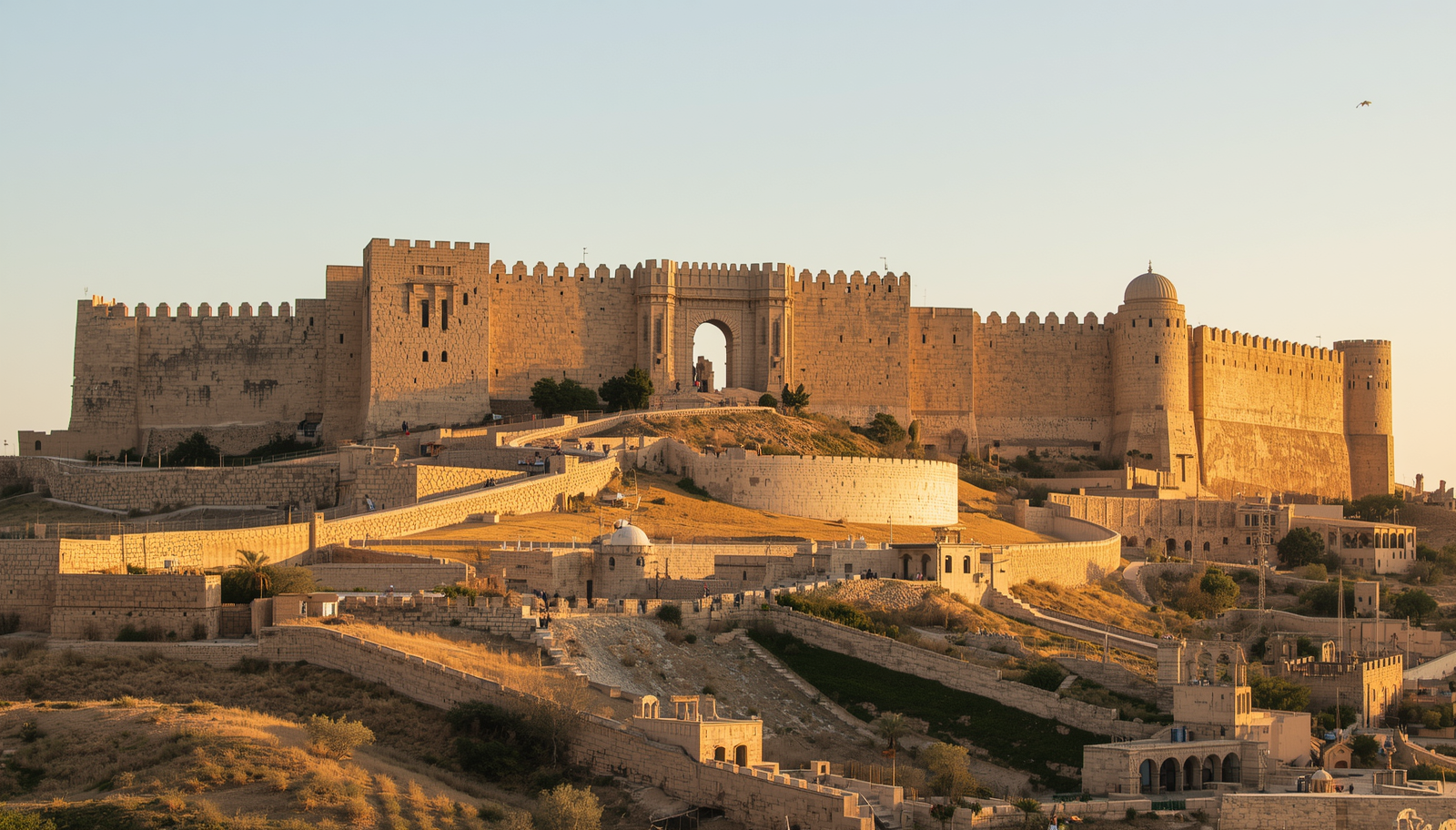
We finally emerged from one of the exits of the souk, and before us rose the looming hill that houses one of Aleppo’s greatest landmarks: the Citadel. Though over a thousand years old, most of its visible architecture today dates to the Mamluk and Ayyubid periods. I had seen it in books and Syrian tourism materials during my previous trip, yet I had never been able to visit. Now, Alḥamdulillāh, I was finally here. The Citadel had been closed to the public for several months due to renovations after sustaining damage during a recent earthquake.
The Citadel of Aleppo is one of the oldest and most imposing fortified structures in the world, standing dramatically above the city’s Old Town. Archaeological evidence shows that the hill has been used since at least the third millennium BCE, with successive civilizations—including the Arameans, Assyrians, Greeks, Romans, Byzantines, Ayyubids, Mamluks, and Ottomans—leaving their mark on the site. Built atop a natural limestone outcrop, it rises roughly 38–50 metres above the surrounding streets, giving it a commanding strategic position. A deep defensive moat surrounds the fortress, in some places twenty-two metres deep and thirty metres wide (though without any water at present), reinforced during the reign of the Ayyubid ruler Al‑Ẓāhir Ghāzī.
Over centuries, the Citadel has served as a military fortress, royal residence, and symbol of Aleppo’s political and urban identity. Its strategic height offers sweeping views toward the plains of Bāb in the east and the slopes of Mount Simeon in the west. Much of the monumental entrance, fortified gateways, throne hall, and defensive towers we see today date to the Ayyubid period, when the fortress was transformed into a formidable medieval stronghold. Extensive conservation efforts in the 2000s stabilised and restored major sections, allowing visitors to appreciate its scale and grandeur. Today, the Citadel forms part of the UNESCO-listed Ancient City of Aleppo, a testament to more than four thousand years of continuous human history. It is widely regarded as one of the largest and most beautiful castles in the world, containing mosques, auditoriums, theatres, doors, paths, and corridors—a city within a city that once housed rulers, soldiers, craftsmen, and worshippers.
Alḥamdulillāh, our guide knew one of the Citadel personnel, and we were granted entry. He was a pleasant Kurdish man and gave us an extraordinary personal tour, including areas usually closed to visitors. Over the course of more than an hour, we explored multiple sections of the fortress. Though we were asked to tip him five dollars, we gave much more in gratitude for the rare access and insight he provided.
Walking through the Citadel feels like stepping into a self-contained stone kingdom. After crossing the steep bridge and entering through the monumental Ayyubid gateway, we moved through a sequence of angled corridors designed to confuse and slow intruders. These bent-axis passages are tall, cool, and dim, with walls pierced by arrow slits and murder holes, a vivid reminder that the fortress was built for survival as much as for ceremony. Symbols such as lions appear at various internal entrances, clearly intended to impress or intimidate visitors of the past, though to modern eyes they seem less striking. Even the main entrance itself is deliberately offset. When you pass into the hollowed-out entrance enclosure, the great doors are not directly in front of you as one might expect, but set into the right-hand wall instead. Had the doors been flush with the outer facing wall, attackers would have had far more space to build momentum with a battering ram. By shifting the doorway inward and to the side, the defenders severely restricted both the length of the approach and the force that could be brought against the gate.
At the summit, the citadel opens into a broad plateau scattered with the remains of palaces, barracks, and storerooms. The most striking structure is the Ayyubid Throne Hall, distinguished by its high vaulted ceilings and alternating black-and-white stonework. The throne was positioned just in front of a large rear window, so that sunlight streaming through it would dazzle visitors as they entered, making it difficult to see the ruler clearly, a subtle blend of ceremony, theatre, and security. From this hall, a secret passage allowed the ruler to escape if necessary. We were also shown a remarkably clever internal and private central observation chamber, from which the ruler could discreetly monitor different sections of the fortress through a series of carefully placed observation windows.
Nearby lie the outlines of residential quarters, where governors and their households once lived, cooked, stored provisions, and administered the affairs of the citadel. Toward the centre stands the citadel’s Friday mosque, now roofless but still clearly marked by its miḥrāb and courtyard, reflecting the citadel’s role not only as a military stronghold but as a functioning community. Beneath the surface lies a network of rock-cut cisterns, engineered to store water during prolonged sieges and demonstrating the advanced planning and ingenuity of the Ayyubids and Mamluks. Our guide dropped a stone into one of these cisterns, and we waited several seconds before hearing the splash, a simple but striking indication of its depth.
Between these structures, open courtyards and terraces once served as training grounds and gathering spaces. From the summit, the views are extraordinary. The old city spreads out in every direction, its mosques, markets, and neighbourhoods forming a dense tapestry below. From different sides of the fortress, one can take in an almost aerial view of the entire city of Aleppo, miles upon miles unfolding into the distance. With the sun out in full force, the city appeared especially striking, bathed in light and texture.
Standing there, it is clear that the Citadel was not merely a defensive stronghold but also the symbolic heart of Aleppo—a place where power, faith, and daily life converged. The grand architecture, strategic design, and enduring history combine to make it an unforgettable testament to human endeavour and resilience.
Other Sites in Aleppo
From the citadel, we headed towards the Grand Umayyad Mosque of Aleppo. Although still under construction, it is largely complete, with only final touches remaining after the extensive damage it sustained during the war. On the way, we stopped at a small shop selling Aleppo olive soap, for which the city is renowned. Our guide had specifically recommended the place, so we bought some soap and a few other items before continuing on to the mosque. He was not one of those guides who only take you to, or oblige you to visit, specific shops where they earn a commission, but instead gave good advice on where to find the best items at the right price. In fact, he would sometimes negotiate prices for us, as locals tend to receive more honest rates. He also bought some soap there himself.
When we arrived at the mosque, we were told that entry was not permitted due to the ongoing restoration work. Alḥamdulillāh, however, after our guide showed an approval letter from the Ministry of Tourism, we were allowed in briefly, on the condition that no photographs were taken. Even in its unfinished state, the mosque was stunning. It is slightly smaller than the Umayyad Mosque of Damascus, which remains more imposing and classical in appearance, but the resemblance is clear. The mosque in Aleppo was built by Sulayman ibn ʿAbd al-Malik, following the completion of the Damascus mosque by his older brother, Al-Walid ibn ʿAbd al-Malik, reflecting the continuity of Umayyad architectural ambition.
The areas surrounding the Citadel bear heavy scars from the war and remain visibly devastated. During the fighting, the liberating forces were positioned in the neighbourhoods around the Citadel, while government forces occupied the Citadel itself, using its height to their advantage. Supplies were reportedly delivered to them by helicopter, as the surrounding districts were hostile and road access was impossible.
We were also told that the layout of the Old City of Jerusalem was influenced by Aleppo, particularly in the organisation and style of its streets. Walking through Aleppo’s old quarters, this felt plausible. In many streets, one can see arched structures bridging buildings from one side of the road to the other, with a residence constructed above the passageway. These were often built when families on opposite sides of the street were closely connected, allowing a third residence to span between them. This architectural feature can also be seen in the old cities of Jerusalem, Fez, and Marrakesh, reinforcing the shared urban traditions of historic Islamic cities.
That evening, we were directed to a local spot famed for serving Aleppo’s cherry-sauce kebabs, a dish everyone insisted we had to try at least once. Curious about this deep red, sweet-and-tangy speciality so closely associated with the city, we went along. The kebabs themselves were tender, and the cherry sauce carried that distinctive Aleppine balance of sourness and sweetness. I quickly realised, however, that it was something of an acquired taste for me. It was decent and certainly palatable, and I was glad to have experienced a dish so rooted in the city’s culinary identity, even if it is not something I would go out of my way to seek again. Still, I thanked Allāh for allowing us to taste it and for the chance to sit in Aleppo, sharing a meal that carries generations of history in its flavour.
Thursday 14 August
The Armenian Quarter
We visited the Armenian Quarter in the morning, as our departure was scheduled for later in the day. Armenians have been present in Aleppo since at least the fourteenth century, with a second significant wave arriving in the early twentieth century. One of the community members who showed us around explained that, even in earlier periods, Christians were permitted to practise their religion freely, but their churches were not allowed to have steeples. Domes, however, were permitted, which is why many of their churches were designed with them.
While speaking with him as he guided us through one of the old churches, the topic of homosexuality came up and how it is viewed within the Armenian Orthodox tradition here. He became visibly and deeply upset and stated unequivocally that it is completely unlawful in their faith. He even used the Arabic word haram (unlawful). He said, “We have a legal system from God, from Allāh, and He prohibits it completely,” adding that this was an agreed-upon position across all Orthodox Armenian churches.
Inside the church, there was an image of the Virgin Mary feeding both Jesus and John (Yahya) (upon them be peace), with a breast exposed. When asked whether this posed any issue within their religious understanding, the priest said it did not. From an Islamic perspective, this would of course be considered sacrilegious, but the contrast itself was revealing of how differently sacred imagery is approached across traditions.
The people of Syria are, in general, very gentle and deeply respectful, and this includes the Christians here. At one point, their guide repeatedly referred to me during the conversation as shaykhanā, meaning “our shaykh” or “our religious leader,” a form of address commonly used by Muslims out of respect for scholars, and one that I did not expect to hear in this context.
Outside one of the larger churches, we noticed armed guards from the new regime stationed at the entrance. We were told that there remains some tension in certain areas due to extremists and other actors, which explains the continued security presence.
Aleppo must be one of the most dynamic and vibrant cities I have visited, a place where the old and the new coexist with remarkable intensity. In its resilience and energy, I think it ranks alongside cities such as Old Delhi and Herat in Afghanistan. Aleppo has been destroyed and rebuilt many times throughout its long history, and even after the most recent devastation, a considerable number of buildings have already been restored. Much work still lies ahead, but the city’s enduring spirit is unmistakable.
Jebeili Olive Soap Factory
We made our way back through the old souk to visit the Jebeili Family olive soap factory, one of the very few remaining soap manufacturers in Aleppo whose roots stretch back to the fourteenth century. According to their own records, the family has been producing soap here since the 1330s. The factory is housed within a Mamluk-era khan, or caravanserai, a structure that itself tells the story of Aleppo’s long commercial history. (https://jebeilifamilysoap.com)
At the beginning of the sixteenth century, Aleppo underwent a notable transformation in its soap industry. Small workshops gradually gave way to larger buildings that had not originally been constructed for soap production. Soap makers adapted existing structures to suit their needs, and the Jebeili Soap Factory stands as a living witness to this period. The building was once the stable of Khan al-Qadi and was later converted into a soap factory. It consists of two floors, each with a clearly defined purpose.
The ground floor is primarily used for storing raw materials. Beneath it are thirty-three underground compartments designed to store oils. There is also a special room dedicated to preparing the anabasis plant, where grinding was traditionally carried out using a millstone turned by animals. The main hall is arranged in parallel rows of arches supported by columns and covered with gabled roofs containing perforated openings that allow air to circulate.
Each part of this floor serves a specific function. The spaces between certain arches are used for straightening the freshly made soft soap, cutting it by hand, and stamping it with the factory’s distinctive seal. Other sections are reserved for stacking cubic soap bars, often arranged in striking tower-like formations. This method allows air to reach every side of each bar. The soap remains in this state for six to nine months, the time required for it to dry fully, during which the space becomes saturated with the scent of laurel.
Two large pots are used in the cooking process, each with a capacity of over 5,000 litres of oil, water, and anabasis. Traditionally, the pots were heated with wood fires to temperatures reaching 200 degrees Celsius, though today wood has largely been replaced by burners due to the scale of production. The remaining areas on the ground floor are used to store finished products once they have been packed into bags, either for sale on the local market or for export outside Syria.
The saponification process depends on an alkaline substance that was historically extracted from the burning of the anabasis plant, which grows across the Syrian Bādiya. Over time, and with increased production, some factories began using auxiliary alkaline products. Aleppo’s soap industry remains closely tied to the olive harvest and its pressing cycle, with the soap-cooking season typically beginning in November and continuing through March or April. Aleppo soap, also known as laurel soap, has been produced here for centuries and is traditionally recognisable by its cubic shape.
Throughout the visit, the staff repeatedly emphasised the importance of ghār as a key ingredient alongside olive oil and lye. Only later did I realise that ghār refers to laurel oil. Since antiquity, laurel has been regarded as a noble plant. In ancient Greek and Roman traditions, its branches crowned emperors and heroes, and its leaves were used to flavour food. Laurel oil was long considered almost magical due to its many benefits. It helps keep the skin fresh, promotes healthy hair, and, in Aleppo soap, provides both a distinctive fragrance and a green hue.
Laurel oil is extracted through distillation, a method used for generations by villagers living in Syria’s mountainous coastal regions between Antioch and Kassab. Interestingly, the price of Aleppo soap is determined not by the olive oil content, but by the percentage of laurel oil it contains. The most basic bars contain no laurel oil at all, while others contain 2, 5, 10, 20, or even 40 percent. The bars with the highest laurel content were priced at around six to seven US dollars each. The day before, when I had seen these prices in a shop, I could not understand why some bars were so expensive while others that looked almost identical sold for about six dollars per kilo, roughly six bars. To the untrained eye, they appear the same, but the laurel content makes all the difference, especially for sensitive skin. The higher the laurel percentage, the greater its benefit.
The factory also produces olive soap blended with other oils, including musk and oud. As we toured the facility, we saw stacks upon stacks of soap at various stages of drying. Over time, the bars turn brown on the outside while remaining green at the core.
Natural Soaps from around the world
Since natural soaps have always fascinated me, here is some information about several traditional soaps from around the world that I have been able to learn about, even though I have not yet had the chance to try all of them myself. Each reflects centuries of local knowledge, ingredients, and bathing traditions, shaped by climate, culture, and daily life. It also demonstrates the various ways they are manufactured.
Nabulsi soap from Palestine is produced primarily from virgin olive oil and an alkaline derived from plant ashes. Light in colour and extremely hard, it lathers slowly but forms a silky foam that cleanses gently without stripping the skin’s natural oils. With no added fragrance and a focus on purity and simplicity, it is well suited for everyday use and sensitive skin.
Marseille soap from France, traditionally known as Savon de Marseille, is made from olive oil, water, and soda ash, sometimes blended with other vegetable oils such as palm or coconut. It has a hard, smooth, slightly waxy texture and produces a creamy lather with a subtle scent. Biodegradable and versatile, it is commonly used not only for bathing but also for washing hair and household cleaning.
African black soap from West Africa is made using ashes from plantain skins, palm leaves, and cocoa pods, combined with shea butter, palm oil, and coconut oil. When dry, it is crumbly and rustic in appearance, but when wet it forms a dense, slightly gritty lather. Rich in natural antioxidants and vitamins, it deeply cleanses while nourishing the skin and is particularly beneficial for oily or acne-prone skin.
Castile soap, originating in Spain and the wider Mediterranean, is made entirely from olive oil, water, and lye, sometimes scented with essential oils. It is firm and smooth with a waxy texture that makes it durable and long-lasting. The lather is mild and creamy, and the soap is prized for its gentleness and versatility, commonly used for bathing, washing hair, and even cleaning fabrics.
Moroccan baladī soap is a dark paste made from fermented olive oil and crushed olives, sometimes enriched with argan oil or herbal extracts. Its slick, gelatinous texture spreads easily on wet skin and is traditionally used in ḥammāms, where I experienced it, alongside coarse exfoliating mitts. It cleanses deeply, softens the skin, and prepares it for the intense scrubbing that follows. In the souks, it is sold from a large mass, with portions scooped out and weighed for you.
Ayurvedic and herbal soaps from India and other regions often combine plant oils such as coconut, sesame, or palm with herbs and spices like neem, turmeric, sandalwood, or rose petals. Their textures vary, some smooth and others slightly grainy from the powdered herbs, producing creamy or foamy lathers with gentle, natural scents. The Mysore sandalwood soap is particularly well known, made from pure sandalwood oil and prized for its fragrance and nourishing properties.
Taken together, traditional soaps are generally denser and longer-lasting than modern commercial bars. Their textures range from paste-like to hard and crumbly, but they tend to feel more natural on the skin, often offering gentle exfoliation and mild moisturisation.
Feeding 500 People for 500 Dollars
Leaving Aleppo, we headed toward a village in the direction of Idlib. We did not have time to visit the city of Idlib itself, even though many had encouraged me to see how people from across the country had established a functioning system of governance there in opposition to the Assad regime. One of our travel companions had arranged to feed 500 people in a surrounding village, and to show how far aid can go, it only cost about 500 US dollars to provide each person a plate of rice and meat. We arrived a little early, prayed, and helped to serve the food, assisting in handing out containers for people to take home. Watching the men, women, and children collect their meals was both humbling and deeply satisfying.
The road to the village was rough, full of potholes, though we were later told there is a better route via Sarakib to reach the main highway. The heatwave persisted, with temperatures climbing to 42 degrees—an unusual spell not seen for decades, perhaps sixty years.
Journey Reflections
On the return journey, we had a reflective session in the coaster, where each of us shared our experiences and thoughts from the trip so far. It struck us just how many towns and villages had been so severely affected. Despite this, what stood out most was the kindness of the people, their warmth, constant smiles, resilience, and remarkable hospitality, even when they themselves had very little. It was a deeply humbling moment and reminded us how much we have to be grateful for.
We recalled an incident in Aleppo when we had gone out for dessert and had an extra portion. We tried to offer it to a tissue seller we passed on the way. He accepted it graciously and then, incredibly, insisted on offering to pay us from his meagre earnings. This small gesture said so much. Syrians possess a strong sense of dignity, character, and decency.
In the bazaars of Homs and Aleppo, I often bought large portions of fruit, bananas, cactus fruit, or other food to distribute to people. Some children would initially hesitate to accept it, but adults nearby would gently encourage them to do so. My brother had brought packets of sweets from the UK, which we handed out to children along the way. Giving charity here was relatively easy, as the currency denominations made it simple to offer small amounts to many people. There were beggars, but far fewer than one might expect in a country scarred by war. We often focused on those who appeared poor but did not ask, quietly giving them 100, 200, 500, or 1,000 lira notes, roughly equivalent to a dollar. They accepted this with grace, though occasionally the smallest notes were not sufficient.
One thing that consistently amazed me, both on this visit and during earlier stays, was the level of cleanliness. People may be poor, yet they remain clean and tidy. Even roadside tea vendors maintained a sense of order and hygiene, much like what one sees in Turkey. This contrasts sharply with many parts of the Asian subcontinent and Egypt, where standards of cleanliness are often much lower. Despite everything Syrians have endured, they have preserved their dignity and personal composure.
The coaster bus itself proved to be a wise choice. Each of us had a row of four seats, allowing us to rest by lying down when needed. The layout had two seats on one side and a single seat on the other, with a folding seat in the aisle that could be lowered to create a full row across. This made the long journey far more comfortable.
Alḥamdulillāh, we made good time, and around ‘Asr we reached the outskirts of Ma‘lula.
Ma‘lula
The word ma‘lula means “entrance.” Syriac is a very ancient language, and our guide Ghassan told us that the word “Syriac” itself means sun, much like sūraj in Hindi or Urdu means the same. The people of this area had converted to Christianity from the Aramaic-speaking communities that once dominated the region.
We entered Ma‘lula, parked our bus, and then started our walk through a narrow natural pass between the mountains. According to local folklore, this dramatic opening was created for Saint Thecla (Mar Taqla), a young woman from Iconium (modern-day Konya) who embraced Christianity against the wishes of her pagan family. Persecuted by her father, she fled to these mountains and, it is said, prayed for protection, at which point the mountain miraculously split open to shelter her. She lived in the caves here, healing the sick, and in time a monastery was built around the grotto, believed to hold her relics.
From an Islamic perspective, being in such a place invites reflection on a shared human instinct: turning to Allāh in moments of fear and persecution. While we do not affirm the miraculous details of this account as religious truth, the act of seeking refuge itself is deeply familiar. The mountains stand as silent signs (āyāt) of Allāh’s power, reminding the believer that true protection is not found in stone or legend, but in reliance upon Allāh alone.
The path through the gorge itself reminded me of a miniature version of Petra in Jordan. Towering rock walls rose sharply on both sides, their surfaces worn smooth in places and jagged in others, as though carved by time rather than tools. The stone closed in in some parts overhead, funnelling light through the narrow opening so that parts of the path lay in shadow while others glowed in warm, reflected hues. As we walked, the walls seemed to lean inward, creating a sense of enclosure and stillness, amplifying every footstep and breath, and making the journey through the passage feel both dramatic and humbling.
The passage leads directly to the monastery near where we had begun the walk, looping back on itself so that, although it felt as though we would have to retrace our steps, we were relieved to find our coaster waiting on the other side, sparing us a return through the narrow gorge. The entire area is calm and quiet, nestled between the mountains. Many houses are built into the cliffs, and the caves where people once lived remain clearly visible, now repurposed for storage and other practical uses. We could also see a mosque in the valley below from the height we were at. The combination of history, legend, and sheer rock scenery gives Ma‘lula a timeless, almost suspended quality.
On the way back to the main highway, as the adhan for Maghrib was called, we stopped at the next village, Ain at-Tina, meaning the Spring of Figs. In the masjid, we noticed many Kurdish men, identifiable by their loose black Kurdish trousers, a quiet reminder of the diverse communities that make up Syria.
Damascus
Alḥamdulillāh, we made it back to Damascus in good time. This time we stayed at the Beit Rummān Boutique Hotel—Bayt al-Rummān, the “House of Pomegranates”—though, amusingly, there were no pomegranates to be seen. It was not far from our first hotel, still within the old part of Damascus, and near the old Jewish quarter, and felt comfortably familiar.
The guide explained that many houses in the old Jewish Quarter (Ḥārat al-Yahūd) remain closed, as much of the Jewish community left Damascus decades ago. Walking through the quarter feels like moving through a place where time has slowed rather than stopped. Heavy wooden doors seal homes whose courtyards have long been surrendered to dust and ivy, while faded stonework and shuttered balconies hint at the families who once lived there. People still pass through the narrow lanes, yet the houses themselves remain closed, giving the streets a quiet, suspended quality.
Decades of emigration, conflict, and legal limbo have left these homes largely untouched, slowly fading but intact. Despite periods of deep political tension and open hostility, they were never seized or repurposed. Their locked doors became an unspoken boundary—part legal restriction, part social caution—leaving the quarter preserved in a way that feels both unusual and quietly haunting.
As it was time for ʿIshāʾ, we entered one of the smaller masjids near the hotel. The imām was already in the final rakʿa of the ṣalāt, and we joined him. After he completed the prayer and we stood to make up what we had missed, the worshippers moved away from the front row. From the corner of my eye, I noticed the imām seated on a chair. He then began performing his sunna prayers while remaining seated, indicating the rukūʿ and sujūd by gestures of the head. This immediately created a doubt in my prayer, as according to fiqh, one who is physically able to perform rukūʿ and sujūd cannot validly pray behind someone who is excused and praying by gesture alone.
However, this was Damascus, and the ʿulamāʾ here are usually well-learned, since the classical texts are taught widely. The imām was an older, dignified-looking person who appeared to have studied extensively. After completing my farḍ ṣalāt, I approached the imām to ask him. I said that a person performing the two cannot pray behind someone praying with gestures. He reassured me that his farḍ ṣalāt had been performed with proper rukūʿ and sujūd. He had only gestured for them in his sunna prayers. I said Alḥamdulillāh, which meant our farḍ ṣalāt was complete behind him. May Allāh bless him.
Friday 15 August
Damascus Tour
We finally began our tour of Damascus this morning, a journey I had anticipated for nearly three decades. Our first stop was the cemetery commonly referred to as Bāb al-Ṣaghīr, located just outside the walls of the old city and regarded as one of the most historically and religiously significant burial grounds in Damascus. Its name derives from “the Small Gate” (Al-Bāb al-Ṣaghīr), and the cemetery has been in continuous use since the earliest centuries of Islam, expanding gradually as the city itself grew.
Walking through its quiet rows of tombs, one is immediately struck by the atmosphere of devotion and historical depth that permeates the site. Numerous graves are traditionally attributed to members of the Prophet Muḥammad’s family and his Companions, though the precise historical details vary across sources and traditions. Among those venerated here are Umm Kulthūm bint ʿAlī, daughter of ʿAlī ibn Abī Ṭālib and Fāṭima (may Allāh be pleased with them) and granddaughter of the Prophet (Allāh bless him and give him peace); Sukayna bint al-Ḥusayn, closely associated with the tragedy of Karbalāʾ; and Asmāʾ bint ʿUmays, a prominent Companion and the wife of several leading figures of the early Muslim community (may Allāh be pleased with them).
Deeper within the cemetery are shrines connected to the martyrs of Karbalāʾ, particularly those slain in 61/680. According to certain accounts, the severed heads of some of the martyrs were brought to Damascus after the battle. In addition to these early figures, the cemetery contains the graves of many later scholars.
Moving among the weathered stones and modest tombs, the cumulative weight of centuries of devotion is palpable. Despite repeated wars and upheavals, Bāb al-Ṣaghīr has remained a focal point for visitors, offering a serene space that connects contemporary Damascus with its earliest Muslim past and invites reflection on faith and history.
Bilāl ibn Rabāḥ and Muʿāwiya ibn Abī Sufyān (may Allāh be pleased with them)
We then visited the tombs of the Companions Bilāl ibn Rabāḥ, the Prophet’s first muʾadhdhin, and Muʿāwiya ibn Abī Sufyān (may Allāh be pleased with them). The latter’s tomb is noticeably less well maintained than many others. During an earlier visit, however, I had been directed to a sealed area behind the qibla wall of the Umayyad Mosque and told that this was the burial place of Muʿāwiya (may Allāh be pleased with him).
This recollection took me back to my stay in Damascus in 1998. On one occasion, while sitting in the Umayyad Mosque awaiting a lesson with Shaykh ʿAbd al-Razzāq al-Ḥalabī (may Allāh have mercy on him), I was approached by several men in shalwār kamīz (Pakistani looking attire) who appeared to be visitors. They spoke Persian and asked whether I knew the location of the tomb of Muʿāwiya (may Allāh be pleased with him). Until that moment, I had never given the matter much thought, despite having visited the resting places of many Companions and later luminaries in Damascus. Their dress distinguished them from the large groups of Iranian pilgrims commonly seen in the mosque, and they explained that they were Sunnīs from Iran.
Together, we set out in search of the tomb, a journey that led us behind the qibla wall of the Umayyad Mosque. Many people were reluctant to guide us, but eventually the location was indicated to us behind a particular wall in a restricted area.
On this visit, when I asked one of the local attendants about the grave I had been shown previously, I was informed that it was most likely the tomb of Muʿāwiya ibn Yazīd, the grandson of the Companion Muʿāwiya ibn Abī Sufyān (may Allāh be pleased with him), who bears the same name and is buried in that location.
Ibn ʿĀbidīn al-Shami
I then asked to visit the tomb of the great Ḥanafī jurist whose works we study extensively in our iftāʾ programme and upon which contemporary fatwā-writing still heavily relies. Ḥanafī muftīs consult his writings almost daily. Ibn ʿĀbidīn (1161/1784–1252/1836) was the pre-eminent Ḥanafī jurist of the late Ottoman period and the foremost legal authority of Damascus. His full name was Muḥammad Amīn ibn ʿUmar ibn ʿAbd al-ʿAzīz, though he is universally known as Ibn ʿĀbidīn al-Shāmī. He was renowned for his mastery of jurisprudence and his exceptional command of the Ḥanafī legal tradition.
His magnum opus, Radd al-Muḥtār ʿalā ’l-Durr al-Mukhtār, is regarded as one of the final authoritative references of the Ḥanafi school, synthesising centuries of juristic discourse with remarkable precision and clarity. Through this work, he effectively became the last great codifier of classical Ḥanafī fiqh, and his work continue to function as standard reference points for Hanafi jurists worldwide. His tomb was pointed out to us, marked by a metal arched structure that distinguishes it from the surrounding graves. Standing there was a sobering reminder that even the most enduring legal legacies ultimately rest beneath the earth, while their knowledge continues to guide generations long after their authors have departed.
Ibn ʿAsākir
We then passed by the tomb of Ibn ʿAsākir, located separately from the main cemetery in a distinct and elevated enclosure, surrounded by railings. Ibn ʿAsākir (498/1105–571/1176) was one of the towering scholars of the medieval Islamic world, renowned as a ḥadīth master, historian, and defender of Sunni orthodoxy. Born in Damascus, his full name was ʿAlī ibn al-Ḥasan ibn Hibat Allāh ibn ʿAsākir, and he became the city’s most celebrated scholar of his era.
He travelled extensively throughout the Islamic world—Baghdad, Nishapur, Isfahan, Merv, and beyond—studying under more than 1,300 teachers, a testament to his extraordinary dedication to ḥadīth transmission. His monumental work, Tārīkh Madīnat Dimashq, spanning dozens of volumes, remains one of the most comprehensive biographical and historical encyclopaedias in Islamic scholarship. A leading authority of the Shāfiʿī school and a staunch proponent of Ashʿarī theology, Ibn ʿAsākir played a central role in shaping the intellectual and religious life of Damascus for generations.
Ibn Qayyim al-Jawziyya
Near one of the other entrances of the cemetery lies the tomb of Ibn Qayyim al-Jawziyya. Ibn al-Qayyim (691/1292–751/1350), born Muḥammad ibn Abī Bakr ibn Ayyūb in Damascus, was among the most influential Ḥanbalī scholars of his time, celebrated for his penetrating legal analysis, spiritual insight, and prolific authorship. He was most closely associated with Shaykh Ibn Taymiyya, whose ideas he adopted, refined, and defended with great vigour. His commitment to aberrant positions in theology (in following his teacher) placed him at the centre of intense scholarly controversy during his lifetime, leading at times to imprisonment and sustained opposition. Despite this, his scholarship, especially in other areas such as the sīra and taṣawwuf, earned enduring respect across the Islamic tradition. His major works Zād al-Maʿād, Iʿlām al-Muwaqqiʿīn, and Madārij al-Sālikīn reflect a rare synthesis of legal rigor, spiritual depth, and literary eloquence. Over time, he came to be recognised not merely as a student of Ibn Taymiyya, but as a major independent scholar whose influence continues to shape Islamic thought. I remember visiting the tomb of Ibn Taymiyya on my earlier visit, who is buried alongside Ibn Kathīr, the great mufassir, in the grounds of what is now Damascus University.
Caliphs ʿAbd al-Malik ibn Marwān and his son Al-Walīd ibn ʿAbd al-Malik
We also visited the tombs of the Caliphs ʿAbd al-Malik ibn Marwān and his son Al-Walīd ibn ʿAbd al-Malik. ʿAbd al-Malik (r. 66/685–86/705) was the fifth Umayyad caliph and one of the most consequential state-builders in early Islamic history. His reign marked the consolidation of Umayyad authority following years of civil strife, transforming the caliphate into a stable and centralised empire. He implemented far-reaching administrative reforms, including the standardisation of coinage, and the strengthening of imperial governance. His era also witnessed the construction of the Dome of the Rock in Jerusalem, a landmark of Islamic architectural and theological expression.
Al-Walīd ibn ʿAbd al-Malik (r. 86/705–96/715), his son and successor, ruled during the height of Umayyad territorial expansion and administrative maturity. Under his leadership, Muslim armies advanced into Transoxiana, Sindh, and the Iberian Peninsula, extending the caliphate’s reach from the Atlantic to the borders of China. He is particularly remembered for his monumental architectural projects, including the expansion of the Prophet’s Mosque in Madina and the construction of the Great Umayyad Mosque of Damascus, both enduring symbols of early Islamic civilisation.
All of these towering figures have departed from this world after leaving indelible marks upon it. Their graves serve as quiet reminders that power, knowledge, and achievement ultimately give way to the same earthly end. We, too, will soon follow. I pray that Allāh accepts us for some service to His dīn and His creation, and that, in turn, others may one day remember us with sincere prayers.
Ṣalāḥ al-Dīn al-Ayyūbī
We then visited the grave of Ṣalāḥ al-Dīn, located behind the Umayyad Mosque and therefore not within the Bāb al-Ṣaghīr cemetery. Ṣalāḥ al-Dīn Yūsuf ibn Ayyūb (531/1137–589/1193) stands among the most luminous figures of medieval Islamic history—a statesman, military commander, and moral exemplar whose reputation transcended civilisations. Born in Tikrit, Iraq, and shaped within the cultural and intellectual milieu of Syria and Egypt, he rose from the service of Nūr al-Dīn Zangī to become the founder of the Ayyūbid dynasty and the unifier of Egypt and Syria.
His most celebrated achievement came in 583/1187, when he reclaimed Jerusalem after nearly nine decades of Crusader rule. Yet it was not victory alone that defined him, but the chivalry, restraint, and magnanimity with which he treated his adversaries. Even chroniclers of Latin Christendom recorded his justice, mercy, and nobility of character. His rule combined military brilliance with a deep commitment to learning, piety, and public welfare. He strengthened institutions of law and scholarship, supported Sufi lodges, and cultivated a political order grounded in discipline and moral purpose. When he died in Damascus, he left behind an empire, yet almost no personal wealth, a powerful testament to the sincerity of his service.
Across the centuries, Ṣalāḥ al-Dīn endures as a symbol of principled leadership, courage tempered by compassion, and the possibility of honour even amid the harshest of conflicts. At all such places, I am moved to pray that Allāh accepts me and my family as well for some share in noble service and meaningful accomplishment as he chose these luminaries.
Also buried here, in this place of honour beside the great warrior, is the recent Syrian scholar and martyr Shaykh Ramaḍān al-Būṭī. Shaykh Ramaḍān al-Būṭī (1347/1929–1434/2013) was one of the most prominent Sunni scholars of the modern era, known for his deep erudition, traditionalist orientation, and commanding public presence in the religious life of Syria. Born in a Kurdish village and raised in Damascus, he became a leading professor at the University of Damascus, teaching generations of students in theology, law, and spirituality. His works—most notably Fiqh al-Sīra, Kubrā ’l-Yaqīniyyāt al-Kawniyya, al-Lā Madhhabiyya—earned him widespread recognition for their intellectual rigour, clarity of argument, and defence of classical Sunni orthodoxy. He was widely regarded as a scholar of profound moral seriousness, deeply committed to preserving the continuity of the Islamic scholarly tradition amid modern upheavals.
Although Shaykh Būṭī’s apparent support for the Assad regime was deeply controversial and divided opinion, he was killed in 1434/2013 while teaching in a mosque in Damascus—an event that shocked the Muslim world and marked the loss of one of the last great representatives of the Levant’s traditional juristic scholarship. May Allāh forgive him and have mercy on him.
Sultan Baybars
In the surrounding vicinity are also the tombs of several other major rulers, further reinforcing the area’s association with a formative period of Islamic political and military history. Among the most prominent is Al-Malik al-Ẓāhir Rukn al-Dīn Baybars al-Bunduqdārī, one of the most consequential rulers of the Mamluk Sultanate, who served as Sultan of Egypt and Syria from 658/1260 until his death in 676/1277.
Originally of Kipchak Turkic origin, Baybars was captured at a young age and sold into slavery, eventually entering the elite Mamluk military corps—slave soldiers who converted to Islam and formed the backbone of medieval Islamic armies. Through exceptional discipline, intelligence, and military skill, he rose rapidly through the ranks. He first distinguished himself in campaigns against the Crusaders and then played a decisive role at the Battle of ʿAyn Jālūt in 658/1260, where the Mamluks inflicted the first major defeat upon the Mongols, halting their westward advance into the Levant. This victory marked a turning point in Middle Eastern history and secured Baybars’ place among Islam’s great military leaders.
After ascending to the sultanate, Baybars consolidated Mamluk control over Egypt and Syria, systematically dismantled Crusader strongholds, including the fall of Antioch, and strengthened the region’s defensive and administrative structures. Alongside his military campaigns, he actively patronised Islamic institutions, commissioning mosques, madrasas, and public works, and restoring religious and legal order across his territories. I was especially struck by the sheer scale of his great mosque in Cairo when I visited it, which left a strong impression on me.
Baybars died in Damascus in 676/1277, reportedly from poison intended for someone else, and was buried there. The funerary complex built in his name, commonly known as the Ẓāhiriyya, serves both as his tomb and as a notable example of Mamluk architecture. The site also housed the famous Syrian manuscript library, known as the Ẓāhiriyya.
The Sayyida Ruqayya Shrine
From there we proceeded to the Sayyida Ruqayya Shrine, located in the narrow streets behind the Umayyad Mosque, just south of its main southern wall. Set within a dedicated building on a frequently crowded thoroughfare, the shrine is easily identified by the steady flow of visitors moving toward it.
Sayyida Ruqayya is traditionally identified as a young daughter of Sayyidunā Ḥusayn (may Allāh be pleased with them), the grandson of the Prophet Muḥammad (Allāh bless him and give him peace). Upon entering the shrine, visitors are immediately confronted by an interior renowned for its extreme visual opulence. The chamber is conceived as an immersive, almost celestial space: its walls and dome are entirely clad in dense mirror mosaics, gilded tilework, and fragments of coloured glass, producing a radiant, jewel-like effect in which light reflects endlessly in every direction. At the centre stands an ornate silver tomb enclosure, often draped with richly embroidered fabrics, completing a scene of highly emotive devotion. Personally, I found the aesthetic excessive and overdone.
The shrine’s visual and devotional character stands in marked contrast to the surrounding Sunni mosques and madrasas of the old city. Sunnī religious architecture in Damascus typically privileges open courtyards, expansive prayer halls, and restrained stonework accented by calligraphy and proportion. By contrast, the Sayyida Ruqayya Shrine centres on an intensely emotional, enclosed interior, oriented toward the veneration of a specific sacred figure rather than communal ritual space.
It is also noteworthy that during the Assad years, this area was controlled by a Shi‘ite committee. Following the fall of the Assad regime, all Shi‘a banners, memorabilia, and sectarian symbols that had been installed in and around the shrine were removed.
The shrine nonetheless maintains very clean facilities, and we prepared there for the Friday prayer.
The Umayyad Mosque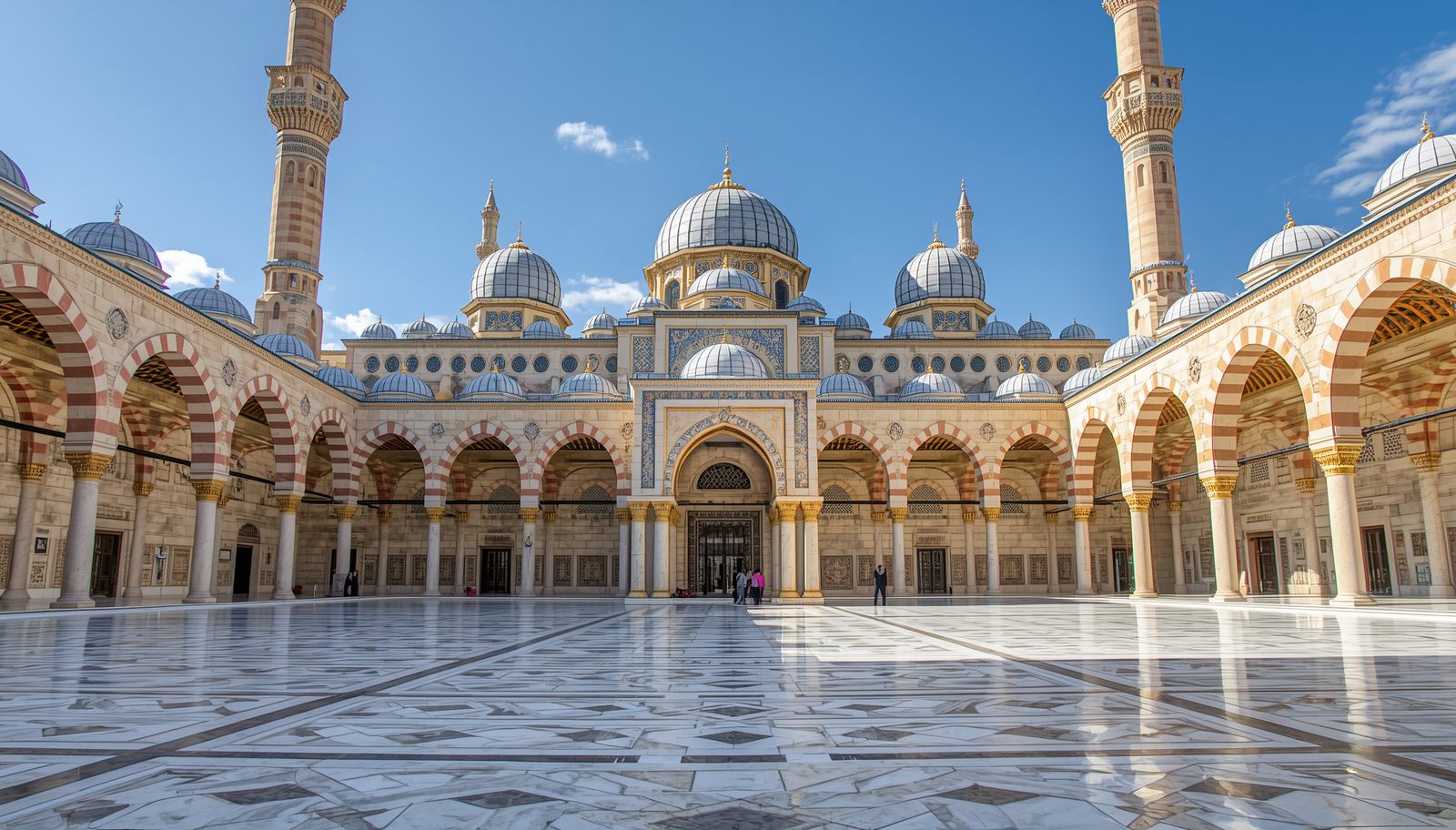
Finally, we made our way swiftly to the Umayyad Mosque (Masjid Banī Umayya) for the Jumuʿa prayer—a moment I had long been waiting for.
Stepping toward the Umayyad Mosque, the first thing that strikes you is not the mosque itself but the ancient Roman columns of the Temple of Jupiter that still stand outside its southern wall. They rise unexpectedly from the modern street—massive, weathered shafts that once formed part of the grand colonnade of Roman Damascus. Passing between them feels like walking through a doorway carved by an older civilisation, a reminder that this site had been sacred for thousands of years before the Umayyads transformed it into one of Islam’s greatest mosques.
Once inside the courtyard, the space opens into a vast expanse of polished marble and sunlight. The marble underfoot reflects the sky, so that for a moment you are walking between two heavens, the real one above and its pale echo below. The Dome of the Treasury, perched on delicate columns, looks almost too ornate to be real, a surviving fragment of the early Islamic world’s fascination with Byzantine craftsmanship. Around you, families sit in the shade of the colonnades and children chase one another across the stones, though a respectful atmosphere is maintained. The mosaics along the western and northern walls shimmer with gold and green, depicting imagined landscapes of trees, pavilions, and flowing rivers, a vision of paradise rendered by Byzantine craftsmen commissioned by the early Umayyads. Dating back to the reign of Caliph Walīd ibn ʿAbd al-Malik, these extraordinary mosaics have survived centuries, despite partial damage during the Mongol invasions. Their intricate detail, subtle layering of vegetal motifs, and harmonious blend of artistic influences, from Byzantine to early Islamic, convey the grandeur, craftsmanship, and spiritual aspiration of Damascus at the height of its early Islamic civilisation.
Above rise the mosque’s three minarets, each distinct in form and history. On the north is the Minaret of the Bride (Mi’dhanat al-‘Arūs), the oldest, with its square base and elegant proportions. The Minaret of Qaytbay on the west is more ornate, crowned with late-Mamluk stonework and positioned at the back of the mosque. On the eastern side stands the tall White Minaret of Jesus (Mi’dhanat ‘Īsā), slender and bright against the sky, associated with the return of the Prophet Jesus (peace be upon him) and foretold by the Prophet ﷺ before it was even built. Each minaret speaks its own architectural language, yet together they form a harmonious expression of the mosque’s layered history.
As we moved toward the prayer hall, the scale becomes more intimate but no less impressive. The triple-arched entrance leads into a long, cool interior, where the scent of perfume mixes with the faint trace of incense. I remembered the familiar hum of subdued voices in prayer. The hall stretches out in calm symmetry: rows of columns, hanging lamps, and the soft glow of filtered light. At the centre lies the Maqām of Yaḥyā (John the Baptist) (peace be upon him), a small domed shrine said to contain his head. The walls are lined with intricate tilework, each section different from the next: Ottoman blues, Mamluk geometric patterns, and delicate vegetal motifs that seem to grow from the stone itself. The variety is astonishing—centuries of artistic styles layered together without ever feeling disjointed.
Upon our arrival, most likely due to the way we were dressed—and myself wearing a white tuban—we were warmly welcomed at the gate and led to the muʾadhdhin’s room, where the several callers to prayer were seated, waiting for the adhān. We were introduced as guests from the United Kingdom, and I was presented, probably by our guide, as a muftī from London and a scholar. Out of courtesy and respect, they hosted us in this private space. I mentioned that I had studied in this blessed mosque nearly three decades earlier and inquired about some of the scholars from that period. I have always known the people of Damascus to become genuinely excited and appreciative when they hear that someone has studied here and lived in the city.
As the time for the adhan approached, we were escorted to the front of the mosque, in front of the congregation that had gathered and patiently awaited the call to prayer, near the miḥrāb and seated close to the imām. The adhān was then called in the distinctive Damascene style, delivered collectively by the several muʾadhdhīns in unison—a practice that remains unique to this mosque and a few others in the region. It was truly wonderful to be back in this great masjid, one of the most inspiring I have ever visited, and a place I had longed to return to for many years.
The imām then emerged in his traditional robe and white turban and ascended the pulpit to deliver the khuṭba (sermon) in Arabic, in which he outlined fifteen practical points for the future of the new Syria. Many of these emphasised cooperation, communal responsibility, and collective effort toward social renewal. After the ṣalāt, we were invited into the imām’s large reception chamber near the main entrance of the mosque. It is a grand and richly decorated hall, adorned with marble and intricate designs. I do not recall entering this space during my earlier stay, and its scale and elegance left a strong impression. A corresponding hall lies opposite it, forming part of the right wing of the mosque within the arcade, beyond which are administrative offices.
We were then taken to the Zāwiya Ghazāliyya, literally the “Ghazālī Lodge” or “Ghazālī’s Retreat,” named after Imām Abū Ḥāmid al-Ghazālī, who resided there during a period of spiritual retreat while in Damascus. Standing in that space was deeply moving. Having previously visited the Golden Gate (Bāb al-Raḥma) at Al-Masjid al-Aqṣā in Jerusalem, where Imām Ghazālī is also reported to have spent time in seclusion, I felt a similar and powerful sense of continuity. These spaces are sanctified not by architecture alone but by the presence and devotion of great souls. They serve as living memorials and quiet witnesses to inner struggles, reflection, and the pursuit of nearness to Allāh.
After exiting the chamber, I lingered in the courtyard, not wanting to leave, my gaze drawn toward the eastern White Minaret. I tried to picture the descent of the Prophet ʿĪsā (upon him be peace), supported by two angels, his head glistening as though freshly bathed. I imagined the mosque filled with worshippers, Muslims and Christians alike, awaiting the Mahdī (may Allāh be pleased with him), to lead the prayer, an event that will mark one of the great signs of the Day of Judgement. In that moment, I felt the layers of time folding together: the living present, the centuries of devotion and scholarship that had passed in this sacred space, and the promise of what is yet to come. The imagination alone could not capture the full majesty, yet standing there, I sensed the weight of history and the continuity of faith, as if the mosque itself were holding its breath, waiting for that extraordinary event. May Allāh protect us from the chaos and confusions of the end of times.
This mosque has never ceased to inspire and captivate me. One feels both the weight of history and a deep spiritual presence within its walls. It is a place that has witnessed centuries of worship, learning, conquest, and renewal, from its Umayyad foundation until the time when Sayyidunā ʿĪsā (peace be upon him), will descend here once again.
Zabadani and Bloudan
After departing the mosque, we set off toward Zabadani and Bloudan, leaving behind the dense streets of Damascus as the road gradually climbed into the mountains. Almost immediately, the air grew cooler, carrying the scent of pine and damp earth, and the constant noise of the city softened into long stretches of quiet, broken only by the hum of the engine and the mild clanging of the glass windows.
Zabadani lies in a fertile valley, long celebrated for its orchards, streams, and fresh mountain produce. As we passed through, glimpses of greenery appeared between the hills, gentle reminders of why generations of Damascenes come here to escape the summer heat. Despite the visible scars left by recent years, there remained a lingering calm to the place—a sense of endurance shaped by the enclosing mountains and the slower rhythm of rural life.
Further uphill, Bloudan opened onto a broad plateau, and the views suddenly widened. Valleys dropped away below us in layered shades of green and grey, while the air grew sharper and cleaner with every turn. Bloudan has long been known for its grand hotels and mountain villas, serving as a retreat where visitors once gathered to enjoy cool evenings and expansive vistas. Standing there, with the breeze cutting through the afternoon warmth, it was easy to understand its enduring appeal. The cooler air, distant horizons, and quiet presence of nature formed a gentle contrast to the intensity of Damascus, revealing another facet of Syria that lingers long after one leaves.
On the way, we stopped at what is said to be the grave of Hābīl, the son of Ādam (peace be upon him). Standing there, I found myself quietly questioning the attribution. Based on traditional descriptions of humanity in that primordial era, I had imagined a much longer grave. Sayyidunā Ādam (upon him be peace) is reported in prophetic narrations to have been sixty cubits (approximately twenty-eight to thirty metres) tall which naturally shaped my expectations. Still, such matters ultimately belong to the realm of the unseen, and Allāh knows best.
From this spot, the view opened out across the entirety of Wadī Barada, the valley stretching wide and green below us. The air felt noticeably cooler here. Although the temperature remained around 36 degrees, a steady breeze moved through the hills, softening the heat and making it surprisingly pleasant.
Zabadani is a well-known resort town and is especially busy on Fridays, which function as the weekend in many Muslim countries. As a result, it was lively when we arrived, filled with families and groups escaping the city. Damascus does not offer this kind of scenery, and people naturally gravitate here, drawn by the open views, cooler air, and sense of space the mountains provide.
We ate at a restaurant called Maṭʿam Bawwābat Abī Zād, perched on the edge of a hill and overlooking the valley below. As we sat there taking in the view, we met some Muslims from Bihar, India, who work for one of the companies operating in Syria. The food was good, and the setting reminded me of a restaurant we had visited in Jablanika, Bosnia, not too long ago.
We then visited a man-made cave known as Maghārat Mūsā. Visitors are taken on a short boat ride inside, and there is also a designated place for prayer. As a constructed site, it was modest and not particularly remarkable.
In another nearby place, we noticed many people filling containers with water. Vendors sold empty drums for this purpose, as the water here is believed to be exceptionally pure, emerging directly from a natural source. We filled a few bottles ourselves; the water was cool, refreshing, and distinctly natural.
After walking through a street lined with small shops, we made our way back to Damascus, bringing the mountain interlude to a close.
A Visit to the Ḥammām
That evening, we visited the Ḥammām al-Malik al-Ẓāhir, a historic bathhouse dating back to 375/985. Upon arrival, an attendant assisted us in changing and securely tying a towel around each visitor, a practice that immediately conveyed the traditional etiquette of the ḥammām.
The cost was modest, around seven US dollars, or approximately 70,000 Syrian pounds, and notably included the full bathing and scrubbing service. The process involved the use of a special olive-based soap, generously applied to the body, followed by a vigorous scrub using coarse cloth mitts. While the exfoliation was somewhat underwhelming compared to my experiences in Istanbul and Morocco, those ḥammāms typically charge separately for such services, whereas here everything was included in the basic fee.
Visitors retain the towel throughout and attend to certain areas themselves. The ḥammām also contained a steam room, adding to the therapeutic aspect of the visit. After showering, the attendant wrapped us in multiple towels, including one around the head, after which we rested quietly to the side, enjoying tea or juice.
Although there are several ḥammāms in Damascus, we were recommended this one specifically because of its historical significance. The atmosphere was modest and unpretentious, and at the late hour of our visit there were only a handful of other patrons present.
Saturday 16 August
Nawa and Hauran
Today our itinerary took us to the south of the country. Our first stop was Nawa, a historic town in southern Syria located roughly two hours (85–100 km) south of Damascus. The wider region forms part of the fertile Hauran (Ḥawrān) plain, known for its rich basaltic soils, with pockets of the red “terra rossa” earth found toward the Golan foothills.
The land here is exceptionally productive, we are told. Crops such as tomatoes, okra, and potatoes are widely cultivated, aided by the ease of accessing groundwater at only a few metres below the surface. Geologically, the region is marked by the presence of over one hundred extinct volcanoes. Phosphate is extracted from this volcanic landscape and mixed with oil refined in Homs to produce tarmac, a factor that helps explain the generally good condition of Syrian roads.
Much of the black stone used in Syrian architecture originates from this volcanic rock and is often paired with white limestone. This distinctive black-and-white construction style is known in Arabic as ablaq. During the Ottoman period, an additional yellowish layer of calcite stone was sometimes introduced, producing a visually striking effect.
Nawa itself has expanded considerably since my first visit twenty-eight years ago. At that time, the village was far smaller and the cemetery lay beyond the inhabited area, with little activity or disturbance. Today, urban expansion has reached and in some places passed the cemetery. Imām Nawawī’s grave has now been developed into a substantial walled enclosure. Previously, there had been only a low surrounding wall, whereas now large black-stone walls and a shaded structure cover the site.
Around 2015, ISIS attempted to destroy the grave and detonated explosives that also destroyed the tree symbolically growing from its centre. I recall clearly from my earlier visit that the grave of Imām Nawawī was distinctive precisely because it was not built up with marble or stone, unlike many other tombs of renowned scholars in Syria, which have often been encased in cement. It remains unbuilt even now, though the site has since been enclosed within a walled structure. After the attack, the tree was replaced with a transplanted olive tree said to be around seven hundred years old.
The attendant at the site was exceptionally courteous and welcoming. I sat by the grave, spoke briefly to my companions about the life of Imām Nawawī, and read several ḥādīths from his Riyāḍ al-Ṣāliḥīn. On my previous visit with my wife, we had read passages from both the beginning and the conclusion of that work, along with selections from his Kitāb al-Adhkār.
A short distance away stands the mosque named after Imām Nawawī, which has now become quite large. While performing wuḍū’ there, I met a boy of around ten years old. I asked him whether he had memorised any part of the Qur’ān. He replied that he worked and therefore could not memorise it. When I asked where he worked, he explained that he assisted his father installing windows, in addition to attending school. I encouraged him to devote some time to reading and memorising the Qur’ān as well. He agreed, and I gave him a small amount of money.
After performing Ẓuhr prayer at the mosque, we continued our journey towards Bosra. Along the way, we passed through an area known as Shaykh Miskin, which appeared truly miskīn (poor) in condition, having once again been severely affected by the ravages of war.
The Black-Stone City of Bosra and the ‘Umarī Mosque
We reached the ruins of Bosra, where our guide began explaining the different parts of the ancient Roman city. Right from the outer gate, two touts latched onto us, trying to sell old coins. One of them stayed with us for nearly fifteen minutes. In the end, I bought two coins, one Roman and the other Ottoman, for far less than his original asking price. Later, someone told me that the Roman coin was genuine, while the Ottoman one was fake. A friend from the UK even messaged me, warning me to be careful of fake coin sellers in Bosra, but by then it was too late.
Bosra is a remarkable town in southern Syria, close to the Jordanian border, renowned for its Roman, Byzantine, and Islamic heritage. Once the capital of the Roman province of Arabia, it flourished as a major centre along the caravan routes, and its former prosperity is still visible in the extensive ruins spread throughout the town.
Bosra is known for its early Christian churches and Islamic architecture, including mosques from the Umayyad period, reflecting its role as a cultural and religious crossroads. The old town, with its stone houses and narrow alleys, still bears traces of the many civilisations that passed through—Romans, Byzantines, Crusaders, and Mamluks.
Today, Bosra feels like a living museum: a quiet and atmospheric place where black basalt buildings blend into the surrounding landscape, and where almost every street and arch carries centuries of history. What makes it especially evocative is the freedom to walk among the ruins, imagining the passage of time across generations.
The Romans usually built with white calcite stone, but Bosra is one of the very few Roman settlements constructed almost entirely from black basalt, a volcanic rock drawn from the surrounding region. We were told that the famous Crusader fortress Crac des Chevaliers, closer to Homs, was also built using basalt, and that prolonged fire could weaken the stone by driving out its internal moisture, making it brittle.
However, while basalt is indeed a tough volcanic rock, it is not among the hardest stones, and Crac des Chevaliers itself is in fact primarily a limestone fortress rather than a basalt one. Its formidable strength lay not only in its materials but in its massive Crusader masonry, layered defences, and commanding position.
When Sultan Al-Malik al-Ẓāhir Baybars besieged the fortress in 670/1271, the fall of Crac des Chevaliers was achieved through skilful siegecraft rather than fire alone. Baybars employed mining and heavy bombardment to collapse part of the outer defences and is reported to have secured the final surrender through a forged letter, purportedly from the Crusaders’ own Grand Master, instructing the garrison to yield. The capture of the fortress thus stands as a triumph of strategy, intelligence, and persistence rather than the weakening of stone by fire.
We then arrived at the ʿUmarī Mosque (Jāmiʿ al-ʿUmarī), situated within the ruined city. The mosque was originally founded by Caliph ʿUmar ibn al-Khaṭṭāb (may Allāh be pleased with him) following the Muslim conquest of Syria in 15/636, and it was later completed in 103/721 during the caliphate of Yazīd II. A plaque at the entrance records a major renovation in 506/1113. It is regarded as one of the earliest mosques, not only in Syria but in the wider Islamic world.
Historically, the mosque functioned as a vital rest stop for travellers. Arab caravans moving along the major trade routes of Syria, as well as pilgrims journeying to Mecca, would stop here to rest. The central courtyard served multiple purposes, acting as a marketplace by day and a sleeping space by night. This courtyard was enclosed by arcades on the eastern and western sides, which provided shelter and structure to the complex.
We entered the mosque after the Ẓuhr congregation had concluded and found two young children lingering inside on their own. After completing our prayer, I asked them to recite some Qur’ān. It emerged that they were the imām’s children, and one of them had already memorised two parts (ajzāʾ) of the Qur’ān. I gave them a small amount of money and encouraged them to continue with their memorisation, as ḥifẓ requires consistent support, motivation, and reinforcement.
We then climbed the external stone steps to the roof, where we were rewarded with a sweeping view over the surrounding ruins and the wider landscape beyond.
From there, we passed through the Nabataean Gate, which dates to around the 2nd century BCE. This gateway once marked the entrance to the Nabataean quarter of ancient Bosra, long before the Roman annexation of the region. Along the roadside lay numerous excavated artefacts—column fragments and inscribed stones—simply resting in the open, without visible protection or security. It was striking how exposed these remnants were, vulnerable to removal or damage, despite their historical value. Anyone could arrive in a truck and carry something away it seemed.
We then came to a building that claims to mark the spot where the Prophet (Allah bless him and give him peace) is said to have stopped with his uncle’s caravan and encountered the monk known as Baḥīrā. A white painted sign outside identified the site as Dayr al-Rāhib Buḥayrā.
I shared photographs of this location with Prince Ghazi bin Muḥammad of Jordan, who has identified a historically more plausible site a few hundred kilometres away in the Bosra region of northern Jordan, a place I have visited on two occasions. The Prince also noted that the monk was not known as “Rāhib Buḥayrā” in a personal sense, but rather as the monk of the buḥayra, meaning a small lake. There was, and still is during the winter months, an oasis at that location.
Furthermore, the Jordanian desert site lies along the Roman road constructed by Emperor Septimius Severus through the Arabian desert, a major route used by caravans. Remnants of this road can still be seen near the site today.
The traditional account also mentions a tree under which the Prophet (Allah bless him and give him peace) rested. No such tree exists at this location in the city of Bosra. By contrast, at the Jordanian Bosra site there stands a lone tree, with no others for miles around. In addition, as Prince Ghāzī has observed, the Bosra city location appears “too posh” and refined to have been the dwelling of a hermit monk. And Allāh knows best.
Our guide had called ahead to one of the small restaurants, and they had prepared food for us. He had asked them to cook a simple meal of vegetables, okra in particular, with small pieces of meat, along with rice and bread. It turned out that one of the coin sellers we had encountered earlier also worked there. The café owner kindly showed us how to distinguish genuine coins from fake ones by scraping them lightly against a stone: if the metal remained the same throughout, the coin was original; if a different metal appeared beneath the surface, it was a forgery.
Bosra’s most unforgettable sight is its Roman theatre, nearly 1,800 years old, and carved almost entirely from local black basalt. This was our next stop. Built in the second century CE during the height of Roman power, and later enclosed within a citadel by Muslim rulers to protect the road to Damascus, the theatre has an almost magical, fortress-like presence. It originally seated around 15,000 people, making it one of the largest and best-preserved Roman theatres in the world. Even today, its acoustics are astonishingly clear: a voice from the stage carries effortlessly to the highest rows without amplification.
During our visit, we persuaded Dr Farrukh to go down to the stage. He obliged and began singing a nasheed in praise of the Prophet ﷺ. He has a fine voice for Urdu naʿts, and we remained at the very top while he stood alone on the vast stage below. The theatre, originally built for Roman performances and later adapted for fortifications, now carried the echo of spiritual praise instead of dramatic spectacle. The contrast between its centuries-old purpose and the devotion filling it today was striking—stone and silence transformed into a vessel for Prophetic remembrance and reverence. Though it still hosts cultural events at times, in that moment it became a living bridge between history and faith.
Back in Damascus
We returned to Damascus, and on the way to Souk Hamidiyya we stopped at a masjid to perform our salat. It was located on one of the upper floors of a large, old building just before the Souk and the Umayyad Mosque. The masjid is called Masjid Tinqiz, or the Tinqiziyya, and is a Mamluk-era mosque and madrasa built in 728/1328 by Sayf al‑Dīn Tinqiz al‑Nāṣirī, the powerful Mamluk governor of Syria under Sultan Nāṣir Muḥammad. Situated beside the Umayyad Mosque in Old Damascus, it exemplifies Syrian Mamluk architecture with its ablaq stonework, carved façades, and refined geometric decoration. The complex originally served as a madrasa, housing teaching halls and student rooms, and later became the main Sharī‘a court of Damascus during the Ottoman period. Today, the mosque itself occupies one of the upper floors, while the lower levels reflect its long history as both an educational and judicial centre in the heart of the old city.
We noticed they were just concluding a ḥifẓ completion ceremony. We tried to find the students who had completed their memorisation and were able to locate only one, as most had dispersed. We gave him a gift of some money and quickly visited the teachers, who insisted we have tea with them, but we were pressed for time and had to decline.
We then entered Souk Hamidiyya. Souk Hamidiyya draws you in almost without warning as you approach from the shadow of the Damascus Citadel, where the fortified walls give way to the market’s long, covered entrance. The moment you step beneath the high iron canopy, the atmosphere shifts: sunlight filters through the tiny holes peppering the roof (scars from old gunfire) casting thin, shifting beams across the moving crowd. The soundscape settles into a steady rhythm: vendors calling out prices with the confidence of generations, the rustle of fabrics being unfurled, the metallic clink of a craftsman shaping brass, and the low, constant hum of bargaining that rises and falls like a tide. Although Hamidiyya is the grandest and most famous of the markets, it is far from alone; a whole network of side‑streets branches off from it, each one a souk in its own right—lanes dedicated to spices, perfumes, silks, leather, sweets, and traditional remedies. These smaller arteries weave outward into parallel markets such as Sūq al‑Buzūriyya, Sūq al‑Ḥarīr, Sūq al‑Saghīr, and the long, historic Sūq Midḥat Pāshā, creating a dense commercial grid that has served Damascus for centuries. Returning to the main corridor, the souk stretches ahead in a straight, gently sloping line, its tightly packed shops spilling colours and scents into the walkway—spices, leather, perfumes, roasted nuts, embroidered fabrics, and the unmistakable sweetness drifting from Bakdash’s pistachio ice cream. As you walk, the space gradually narrows and brightens, and the market seems to funnel you forward until, almost suddenly, you emerge into the open air beneath the towering Roman columns of the Temple of Jupiter, their weathered stone marking the dramatic threshold between the bustling artery of the souk and the sacred calm of the Umayyad Mosque beyond.
Souk Hamidiyya doesn’t end so much as it delivers you into something larger: the open courtyard of the Umayyad Mosque, where the noise of the market dissolves into marble, sky, and silence. That transition, from the sensory rush of the souk to the calm expanse of the mosque, is one of the most unforgettable moments in Damascus, a reminder of how commerce and devotion have always lived side by side in this ancient city.
Walking through this bazaar was once an everyday journey for me when I was studying there, the familiar route I took to reach the Umayyad Mosque. I still remember a particular vendor near the end on the right, selling garments and repeating the same rhythmic call all day long; I used to wonder whether he murmured those same words in his sleep. Now, instead of those human voices, I heard recorded messages advertising products playing from small speakers. I looked for that old vendor out of curiosity and nostalgia, but he was nowhere to be seen; another small reminder of how even the most timeless places change quietly over the years.
We prayed in the Masjid and then on the way back to the hotel, we stopped at a small bakery to buy more of the special biscuits our guide had brought along, which everyone had grown fond of. That one-kilogram box had lasted the entire trip. They were barāziq (برازق), traditional Syrian sesame biscuits originating in Damascus, dating back to the late Ottoman period, when the city was a major trading hub for spices, sesame, sugar, and nuts. Thin and crisp with a rich, nutty flavour, they are coated on one side with toasted sesame seeds and often dipped on the other in finely chopped pistachios. The lightly sweet dough is subtly flavoured with aniseed or fennel, sometimes with a hint of maḥlab (St. Lucie cherry), giving them gentle aromatic warmth rather than overpowering sweetness. As is customary in many sweet shops, bakeries, and even fruit, nut, and herb stalls, the shopkeeper invited us to taste them first, along with several other biscuits.
When he learned that we wanted to take the biscuits out of the country, he advised us instead to buy barāziq made with pure ghee (saman ḥayawānī) from the Al-Wisam Sweet Shop, explaining that his own were made with vegetable ghee (samān nabātī). We were struck by his honesty; rather than pressing us to buy from him, he guided us elsewhere for better quality. The moment brought back memories of Damascus and other places where such sincerity still exists, reminding us that many people act with integrity and goodwill. May Allāh bless him and those like him, and may He make us among the honest and sincere.
Staying in the old city had its limitations, as the Umayyad Mosque was a ten to fifteen-minute walk from some of the better boutique hotels, and taxis could not reach this part of the city due to the narrow roads. We were told there are no quality hotels near the Masjid itself; the available options were more rundown. We did not have time to explore them, as everyone has their own perspective. We were given a few options, and someone suggested the Dama Rose Hotel, one of the few larger five-star hotels.
Sunday 17 August
We transferred to the Dama Rose Hotel in the late morning, from where it was easier to catch taxis to different parts of the city. One of my friends from the UK had put me in touch with a Syrian acquaintance who had previously lived in the UK. He came to pick us up from the hotel, and we went to eat at Al-Fārūq Shawarma in Al-Maliki. Interestingly, the Shias had historically objected to the name, as it is attributed to the second caliph, ʿUmar ibn al-Khaṭṭāb (may Allāh be pleased with him), and used to trouble the owner during the days of the previous regime. Those days were behind him now. The food was clean, and the meat tasted very good.
He drove us through some other parts of Damascus as we talked, giving us a perspective on the new Syria from someone who had left during the old regime and had now returned. He finally dropped us at the foot of Mount Qasioun. The moment had arrived for me to visit my old neighbourhood. As we ascended the lower part of the hill, memories began flooding back—this had been my daily path home when I had lived here. Entering the bazaar, one of the vendors, seeing we were non-natives, asked if we intended to visit the shrine of Shaykh Dāghistānī. Many came for that purpose, though we had not planned to this time.
Shaykh ʿAbdullāh al-Fāʾiz ad-Dāghistānī (1891–1973) was a prominent sufi master of the Naqshbandī‑Ḥaqqānī order who spent much of his life in Damascus. Born in Dagestan into a family of physicians, he exhibited an early spiritual inclination and later migrated with his family to the Ottoman Empire to escape political repression in Russia. After periods in Aleppo and Homs, he settled in Damascus, where he established a zāwiya and became widely known as a spiritual guide. A devoted student purchased a house and nearby mosque on Mount Qasioun for him, which became the centre of his teaching. His influence spread throughout the Naqshbandī network, and many sought him for guidance and solace. He died in Damascus in 1973, and his tomb and small mausoleum remain a site of visitation for followers.
Shaykh Muḥyī al‑Dīn Ibn ʿArabī
We first headed to the Shaykh Muḥyī al‑Dīn Ibn ʿArabī Mosque, located in the district that now bears his name. Shaykh Ibn ʿArabī (1165–1240) was one of the most influential sufis in Islamic history, widely known as Al-Shaykh al‑Akbar (“the Greatest Master”). Born in Murcia in Andalus, he travelled extensively across the Islamic world—North Africa, Anatolia, the Hijaz, and the Levant—before settling in Damascus, where he spent the final years of his life.
Ibn ʿArabī is best known for his writings on waḥdat al‑wujūd (the “unity of being”), his mystical poetry, and his philosophical treatises, all of which profoundly shaped later sufi thought. His ideas inspired generations of scholars and spiritual orders, though they also sparked debate and, at times, more extreme interpretations by later followers. In the 10/16th–11/17th centuries, Shaykh Aḥmad Sirhindī offered a corrective framework known as waḥdat al‑shuhūd (“unity of witnessing”), engaging cautiously yet deeply with the earlier tradition.
The mosque and mausoleum sit at the heart of the Shaykh Muḥyī al‑Dīn district, a neighbourhood that grew around Ibn ʿArabī’s resting place and still carries his name. The complex includes his tomb, a prayer hall, and a courtyard framed by old Damascene houses, creating a contemplative atmosphere despite being part of the busy northern edge of the Old City. Even today, the neighbourhood retains a sense of spiritual continuity, with small shops, zawiyas, and traditional homes clustered around the mausoleum.
From here we walked through the market towards Jāmiʿ al‑Hanābila. As we passed through the narrow alleys, I reflected on my earlier ascent of Mount Qasioun and my walk through the bazaar: the path home in 1998, the familiar streets now changed yet still resonant, and the way the city’s memory seemed to linger in every corner, connecting past and present. It was in a gully opposite the side entrance of the mosque that I had lived with my wife and son in 1998.
Jāmiʿ al‑Hanābila
Jāmiʿ al‑Hanābila is one of Damascus’s historic mosques, dating back to the early Ayyubid period in the 7/13th century (circa 598/1202–610/1213). It was founded for followers of the Ḥanbalī school and served as a centre for Ḥanbalī scholars and students in the city. The area surrounding Jāmiʿ al‑Hanābila became known as the Ḥanbalī Quarter, a district that took shape during the Ayyubid era after many Ḥanbalī scholars and families relocated from Jerusalem following its reconquest by Ṣalāḥ al‑Dīn. The Ayyubid rulers supported these communities by establishing a dedicated neighbourhood with its own congregational mosque, madrasas, and residences. Over time, the quarter became the intellectual centre of the Ḥanbalī school in Damascus, long associated with families such as the Ibn Qudāmas. Its lanes, study circles, and small mosques once sustained a vibrant Ḥanbalī tradition, though formal teaching there has largely disappeared. In recent generations, the imams have typically been Ḥanafī or Shāfiʿī, reflecting the scarcity of classically trained Ḥanbalī scholars in general. Yet a modest revival may be emerging: a maqraʾa was recently held there for the recitation of Imām Aḥmad ibn Ḥanbal’s thulāthiyyāt—his hadiths with three‑tier transmission chains to the Prophet (Allah bless him and give him peace).
The mosque’s design is modest yet elegant, modelled in miniature on the great Umayyad Mosque with a courtyard, hypostyle prayer hall, and central dome. Inside, the prayer hall is divided into aisles supported by stone arches and columns, lit by high windows and adorned with traditional geometric decoration. A tall minaret rises beside the courtyard, marking its presence in the neighbourhood skyline. We prayed ʿAṣr there and had a brief conversation with the imām. Nearly three decades later, the imām was a new face, likely now in his fifties, continuing the mosque’s long tradition of guiding the local community.
After leaving the masjid, I set out to find the building and flat where we had once lived, longing to reconnect with a fragment of the life we had known. The streets felt both familiar and strange—the same narrow lanes, the same pattern of steps, yet every face was new, every shop a stranger. I climbed two or three staircases of the surrounding buildings, peered at doors and windows, and even knocked on what I thought had been our apartment, but there was no answer. The door remained closed, and with it, the last tangible link to a past life. Finally, I asked someone in the street, who looked at me curiously as I wandered, about the family who had lived above us, mentioning one of the children’s names. They had long since moved, and there was no news of my landlord’s brother or his family. After nearly thirty years and more than a decade of brutal war, so much had changed. I prayed for their safety and that Allāh reward them for the kindness they had shown us during our stay. In that quiet moment, I also remembered countless others who had helped us along our journeys and offered a silent prayer for them too—the least I could do.
The absence of familiar voices was a sting, a reminder that the Damascus I had carried in my memory no longer existed in full. Yet, the buildings and streets themselves had endured, bearing witness to history, memory, and resilience. In their steadfast presence, I felt a subtle comfort: even when people move on, even when decades and conflict reshape a city, the essence of a place persists.
From there, we walked toward the Rukn al-Dīn area and reached the Mujamma‘ Abi ’l-Nūr, the seminary once run by Shaykh Aḥmad Kaftārū, who was the grant Muftī of Syria at the time, where many foreign students had studied, and where I had delivered a few informal lessons myself. The seminary had grown since my last visit.
Uber did not operate here, but we had Yalla Go downloaded, so we called a taxi. The driver arrived quickly, and as we wound through the streets of Damascus, I reflected on the visit, I felt the delicate tension between memory and reality. Returning to an area once so intimately known, only to encounter its transformation and the absence of familiar faces, reminded me that life and time move relentlessly forward. May Allāh make the rest of our life better than the earlier part of our life.
Shaykh Muḥammad Jumu‘a
When we arrived back at the Umayyad Mosque, I had hoped that the usual daily lesson would begin after Maghrib. Unfortunately, Shaykh Fawāz al-Nimr, now the teacher at the mosque, was away on a trip, so there would be no lesson of the Ḥāshiyat Ibn ʿĀbidīn today. This was disappointing. I inquired about his colleague Shaykh Muḥammad Jumu‘a, who along with Shaykh Fawāz had been the foremost students of our teacher Shaykh ‘Abd al-Razzāq al-Ḥalalbī who taught here for several decades. Shaykh Fawāz had now taken over. I was told that Shaykh Muḥammad Jumu‘a would be at the Masjid al-Barda‘iyya, located behind the Umayyad Mosque. He was a scholar I would consult when I had some questions about some of the fiqhī texts I was studying and had also been invited to his home and he had come to mine for a meal. Before leaving, I asked to see the room at the front right of the mosque where I had once read Qur’ān to Shaykh ʿAbd al-Razzāq al-Ḥalabī; they allowed me a quick glimpse, which brought back many memories.
We navigated the narrow, dim streets, most shops already closed. Eventually, we found the mosque, but the door was locked. A group of children were lingering nearby, and one of them asked if they could help. He knocked persistently, pounding on one of the doors until it finally opened.
Inside, I was directed to a room across the courtyard. There he was, seated with his feet outstretched on a couch, looking much older and weaker than I remembered. It took me a moment to recognize him; he had lost considerable weight, yet his face retained the same serious, quiet, and sombre expression I recalled from my student days. He was teaching a small group of three or four students, going over a section of Radd al-Muḥtar on the prostration for expiating a mistake (sajdat al-sahw), speaking in a low, measured tone. His son kindly served us water and tea, and we made sure not to disturb the lesson.
When he concluded, I sat beside him and reintroduced myself as one of his students from around thirty years ago. Even though I had not formally studied with him, I still consider scholars whose guidance I benefit from, even in small but significant ways, as my teachers. He smiled and, using the word adkham (more built) rather than asman (fat), asked if I had once been “more built” than I appeared now, a nuanced observation, more about stature than weight. I confirmed that I had indeed lost some weight since then. He asked if everything was well and explained that he had been very ill, suffering from diabetes which caused him considerable pain in his feet. This was why he no longer taught at the Umayyad Mosque. He continues to serve as the imām here, teaching as much as he can during the week and returning home to the outskirts of Damascus on weekends.
I reflected on the remarkable dedication of these teachers. They would guide students through enormous, advanced texts, like the multi-volume Radd al-Muḥtar, which would take Shaykh ʿAbd al-Razzāq around seven years to complete, often to only a handful of students, and frequently without any financial compensation. Yet they did so with pride, patience, and an unwavering commitment to preserving and transmitting knowledge.
I asked if I could present a gift to him, and he said it would be best after Ṣalāt al-‘Ishā’. While he prepared for prayer, we spoke briefly with another shaykh nearby. After the prayer, he invited me to give the gift; he also offered dinner, but I declined. Giving him the gift, I felt a deep sense of gratitude and reverence. Though decades had passed and the city around us had changed, sitting there with my teacher, reconnecting after so many years, I felt the enduring bond of knowledge, respect, and spiritual continuity. It was interesting to see him at this remote masjid rather than at the Grand Umayyad Mosque, but the setting suited his demeanour—always humble, low-key, and away from the limelight. May Allāh relieve his suffering, grant him well-being, and give him strength to continue his teaching.
Monday 18 August
Dār al-Ḥadīth al-Ashrafiyya
Our first stop on this day was Dār al-Ḥadīth al-Ashrafiyya, the historic hadith academy tucked just behind the Umayyad Mosque. Founded in the early twelfth century during the Ayyubid period, it was established for the teaching of hadith, fiqh and theology, and over the centuries became one of Damascus’s most important centres of learning. The building itself is beautiful in its restraint: a quiet courtyard surrounded by arcades, with classrooms and prayer spaces opening onto it, decorated with finely carved stone and subtle geometric detail.
What I had expected to be a short visit stretched into more than two hours. We first met the current Shaykh of the Ashrafiyya, Shaykh ʿUmar Dhī ’l-Nūn, who was generous with his time. He spoke at length about the history of the institute and then took us to another of its branches, where many younger students are housed while memorising the Qur’ān.
As we walked through the original complex, it was easy to imagine generations of great scholars sitting in these very spaces, teaching and memorising hadith, nurturing students who would later carry this knowledge far beyond Damascus. There was a deep sense of calm there, coupled with the weight of continuity, as if the place itself still breathed learning and devotion. One of the conditions for the Shaykh al-Ḥadīth of this institution was that he be the foremost hadith scholar of his time, and that legacy is reflected in the calibre of those who taught here. Among them were figures such as Ibn al-Salāḥ, Abū Shāma, Nawawī, Ibn al-Wakīl, Zamalkānī, Mizzī, Ibn Kathīr, Taqī al-Dīn al-Subkī, Ibn al-Athīr and Dhahabī—names that still define the study of hadith centuries later.
We were served nabīdh, the sunna drink made by soaking dates in water, though this one had a beautiful distinct and unfamiliar note. When I asked about it, the attendant explained that they had added zuhurāt, a natural neroli essence commonly used in Syrian sweets. Later, we found it in a shop in the souk. It is remarkably potent, and even a drop or two transforms the flavour of nabīdh.
Along one of the passage walls was a list of all the Shaykhs who had led the institute throughout its long history. Many of the names mentioned above were there, but I was surprised to also see Ibn Ḥajar al-ʿAsqalānī, as he was in Cairo and is buried there. When I mentioned this, the Shaykh explained that Ibn Ḥajar had spent around six months in Damascus and had been appointed to this noble position during that time. Near the entrance to the mosque, another wall outlines the story of the Ashrafiyya itself, quietly tracing the rise, endurance, and legacy of the institution.
Shaykh ʿUmar spoke candidly about how the original endowment had once been much larger, extending into adjoining buildings. Years of neglect meant that parts were lost, claimed by others, and are now extremely difficult to recover, even by purchase, as property prices in the area are very high. Signs of this loss are still visible: the prayer niche is not centred in the mosque as one would expect, and some decorative elements abruptly stop, clearly intended to continue into what is now a separate structure.
Before leaving, I went into the mosque again with my companions and read the famous continuous chain hadith of mercy (musalsal bi ’l-raḥma). When the Shaykh asked what we did, I explained that I hoped to draw blessing from reciting a hadith in a place where scholars like Ibn al-Ṣalāḥ, Nawawī, Mizzī, and Ibn Ḥajar al-ʿAsqalānī had once sat and taught. May Allāh grant us acceptance, draw us closer to Him as He drew them close, and allow us too to serve the hadiths of His Prophet (Allah bless him and give him peace) with sincerity.
We then went to Halbouni, just beyond the Hejaz Railway Station. This area has long been the heart of Damascus’s book trade, a hub for publishers and bookstores, and it immediately took me back to my earlier days when I would spend long hours moving between its famous bookstores. I visited Dār Ibn Kathīr, Dār al-Bayrūtī and a few others this time. I learned that the owner of Dār al-Bayrūtī, who had always been kind and helpful, had been based in Turkey for many years, running their branch there. I managed to purchase several of the books I had been looking for.
On the way back towards the Umayyad Mosque, we passed by the old Hejaz Railway Station. The Station in central Damascus, opened in 1907 near Marjeh Square, is one of the city’s most striking Ottoman‑era landmarks and a reminder of the empire’s final push toward modernisation. Built in a blend of Ottoman and European styles, it features a carved stone façade, arched windows, and a distinctive clock tower, all meant to project imperial confidence at the dawn of the 20th century. As the northern terminus of the Hejaz Railway, it linked Damascus with Medina by 1909, dramatically shortening the pilgrimage route and allowing the Ottomans to move troops quickly across their Arabian provinces. The line declined after World War I, when sections were damaged or destroyed, and by the early 1920s the station had lost its original function. Today, it survives as a beautifully preserved monument and small museum, offering a glimpse into the technological ambitions and political anxieties of the empire’s final decades.
From here we started walking towards the old part of the city. This was an area I had once walked through almost daily, travelling from the microbus station in Baramika towards the Umayyad Mosque. Very little had changed. The familiarity of it all stirred memories of routine days, simple journeys and a life that once felt entirely ordinary yet now seemed distant.
Just before entering Souk Hamidiyya, the Damascus Citadel stands to the left. It is a massive medieval fortress whose origins go back to the 11th century. Rebuilt on a grand scale by the Ayyubids in the early 1200s, it served as a royal residence, military headquarters and a symbol of power for successive dynasties, from the Seljuks and Ayyubids to the Mamluks and Ottomans. Its thick basalt walls, imposing towers and internal courtyards still speak of centuries of defence, authority and political intrigue. It was also here that Hafiz Ibn Taymiyya was imprisoned during his lifetime. I would have loved to visit the citadel from inside, but we did not have enough time to arrange it, and access probably requires special permission.
Just outside the northern walls of the Old City, near the citadel, stands the striking bronze monument of Ṣalāḥ al-Dīn al-Ayyībī. It is a modern tribute to a figure who reshaped the history of the region. The statue depicts the moment following the Battle of Hattin in 583/1187, which paved the way for the recapture of Jerusalem after nearly a century of Crusader rule. Ṣalāḥ al-Dīn is shown mounted on horseback, calm yet commanding, while defeated Crusader leaders lie beneath the horse’s hooves, most notably Guy de Lusignan, the King of Jerusalem, and Raynald de Châtillon, whose attacks on pilgrims had provoked Ṣalāḥ al-Dīn and ultimately led to his execution. The symbolism is unmistakable, a visual retelling of the collapse of Crusader dominance and the restoration of Jerusalem to Muslim rule.
When we passed it, a group of older teenagers were climbing over the monument, even onto the horse itself. The scene felt jarring, even if there were no barriers to prevent it. More striking still is the monument’s very existence. Islamic law is clear in its prohibition of three-dimensional human sculptures, seeing them as a pathway to idolatry and something firmly rejected by the early scholars of Islam. In that sense, the statue feels less like an expression of Islamic heritage and more like a modern nationalist symbol, rooted in contemporary political memory rather than religious tradition.
Tuesday 19 August
Today was our departure day. Upon arriving at the airport, we waited in line for the initial security check, where bags are scanned—a procedure common in many third world countries. After checking in, we had to scan them again to access the airside area. While waiting in line to go through the detectors, the person behind me asked me to wipe my shoes. Looking down at this strange request in astonishment, I noticed a mat bearing Bashar al‑Assad’s face that everyone had to walk over before entering security.
Once through, we passed a few gift shops selling Syrian items. I managed to purchase some gifts at reasonable prices, as the sales people were still willing to negotiate, even though it was an airport. The airport itself has been developed since my last visit. Though still relatively small, it appeared well organised and clean. Alḥamdulillāh, our journey home was smooth, without any hitches.
Closing Reflections
Alḥamdulillāh, Allāh granted me the chance to visit Sham after so many years of longing, and He made it a journey rich in meaning, learning, and inspiration. It is remarkable how much we were able to see in just a few days—how much history we absorbed, how many lessons we gathered, and how deeply the experience settled into the heart. I am profoundly grateful to my brother and all my travel companions for being such wonderful company throughout, and especially to Dr. Farrukh, a dear friend since the days we performed Hajj together, whose encouragement was the main reason this trip finally happened. I am also deeply thankful to our tour operators and to our guide, whose knowledge, patience, and care shaped the entire experience and allowed us to see Sham with both our eyes and our hearts. May Allāh bless them all, and bless everyone who helped make this journey possible. And may Allāh grant the people of Syria the peace, stability, and security they have long yearned for, and restore to them the tranquillity that this blessed land has known for centuries.
Additional Travel Notes
The exchange rate at money changers is much lower than the online rates shown on currency converters like XE. For example, if the online rate shows 1,300 Syrian pounds per dollar, the street rate may be closer to 1,060. Locals explained that the online rates are largely inaccurate; the street rate reflects reality.
Most stores have money-counting machines, as customers carry wads of cash in high denominations. Without these machines, staff would spend the entire day counting money. Recently, new notes with lower denominations have been introduced to help mitigate inflation.
There is no pork available in Syria; even Christians avoid it, much like in Ethiopia.
Hotel Wi‑Fi is generally unsuitable for serious work. A Syrian Telecom SIM card works better but is about four times more expensive for foreigners than for locals. Many Western websites remain blocked and require a VPN.
You no longer see pictures of the leader everywhere—those familiar smiling or stern portraits that once watched you from shop walls, street corners, and government buildings have quietly vanished. A few people tried putting up photos of the current president, but they were told to remove them. I’ve never fully understood the fascination with displaying leaders’ portraits so prominently in many Arab countries; it has always struck me as a curious blend of tradition, political culture, and public ritual.
Most toilets in mosques, restaurants, and other public spaces are low-pan style.
Interestingly, taxis no longer play music. In earlier times, it was almost impossible to find a taxi without music, so the current quiet is a noticeable—and surprisingly welcome—change.
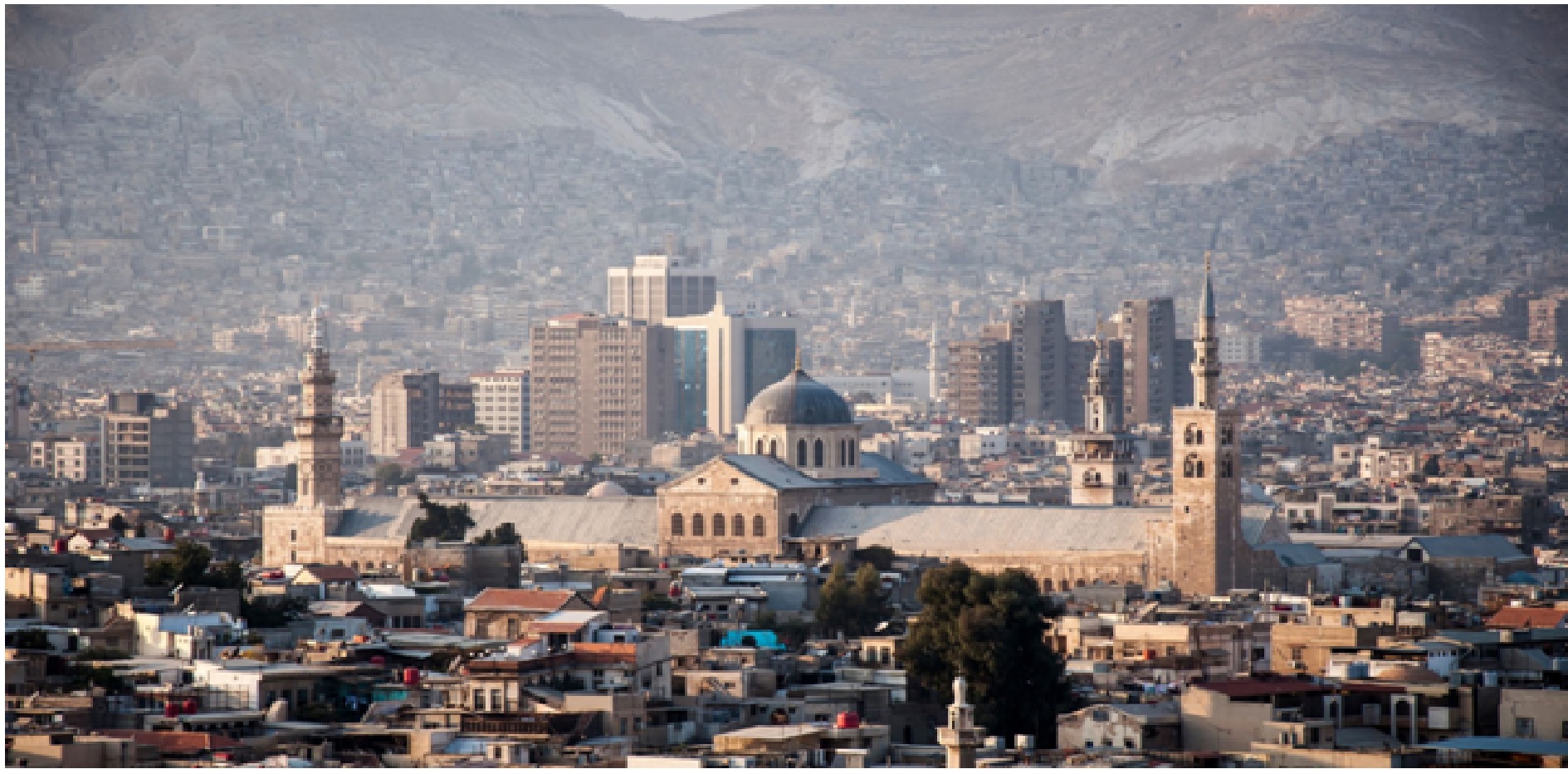
How Places Got Their Names
Sham, Yemen, and the Levant
The name Shām (الشام) is an ancient Semitic geographical term referring to Greater Syria, and its origin lies in the directional system used by early Semitic peoples, who oriented themselves facing east, toward the rising sun. In this system, the right‑hand side corresponds to the south, and the left‑hand side corresponds to the north. Because of this, the Semitic root y-m-n meaning “right” came to designate the southern region, giving rise to the name Yaman (Yemen), while the root sh-ʾ-m meaning “left” designated the northern region, producing the name Shām for the lands of Syria and its surroundings. The term Levant, by contrast, is of European origin, derived from the medieval French levant, meaning “rising,” a reference to the rising sun in the east. European traders and geographers used it to describe the eastern Mediterranean coast, essentially the same region known locally as Shām, and the word later became a standard Western label for that broader eastern Mediterranean world.
Dimashq and Damascus.
The name Damascus, known in Arabic as Dimashq, is one of the oldest continuously recorded place‑names in the world, with roots deep in the ancient Semitic languages of the Near East. Its earliest known form appears in Akkadian texts as Dimašqa or Dimashqu, a name that also shows up in Ugaritic, Aramaic, Syriac and Hebrew with very similar spellings, indicating that it predates both Arabic and Aramaic and belongs to an older Semitic stratum. Scholars generally connect the name to a root meaning “well‑watered land,” which fits the city’s geography as an oasis fed by the Barada River, though another interpretation links it to a root meaning “to hasten,” possibly referring to its position on ancient trade routes. When the Greeks encountered the city, they adapted the Semitic name into Damaskos, which the Romans later passed on as Damascus, while Arabic preserved the older form almost unchanged as Dimashq. Together, these linguistic layers show how the city’s name has travelled through thousands of years of cultural contact while retaining its ancient Semitic core.
Kafr, Ain, Tall, Jabal, and Deir: How Syria’s Place‑Names Reflect Landscape and History
Across Syria, many towns and villages carry names that reflect the region’s deep linguistic and cultural history. One of the most common prefixes is Kafr (also written Kfar, Kafar or Kefr), a term rooted in Aramaic and Syriac that simply means “village” or “rural settlement.” It appears in places such as Kafr Susa, Kafr Batna and Kafr Nabl, usually indicating an older agricultural community that once sat on the outskirts of a larger city. Another widespread prefix is Ain (or ‘Ayn/Ein), meaning “spring,” used for towns built around natural water sources; examples include Ain Tarma and Ain al‑Fijeh, both known for their historic springs.
You also find many Syrian towns beginning with Tell or Tal, a word meaning “hill” or “mound.” These often refer to archaeological tells—artificial hills formed by layers of ancient settlement—such as Tell Rifaat or Talbiseh. In more mountainous areas, the prefix Jabal (“mountain”) appears, marking places connected to prominent highlands like Jabal Qasioun overlooking Damascus. Another historically significant prefix is Deir, meaning “monastery,” which points to the presence of early Christian monastic communities; towns such as Deir Atiyah and Deir Mar Musa preserve this heritage in their names.
Other prefixes reflect Syria’s long history of trade and fortification. Khan, meaning “caravanserai” or “inn,” marks towns that once served as stops for merchants and travellers along regional trade routes, as seen in Khan Shaykhun or Khan Arnabeh. Meanwhile, Qasr (“castle” or “fort”) identifies places associated with historical fortifications, such as Qasr Ibn Wardan. In older urban centres, especially Damascus, the prefix Bab (“gate”) appears in neighbourhood names like Bab Touma and Bab Sharqi, each referring to one of the city’s ancient gates. Together, these naming patterns reveal how geography, religion, agriculture and trade have shaped Syrian settlement over thousands of years, leaving a linguistic map of the country’s layered past.
Abdur-Rahman Mangera
Whitethread Institute
Written on
6 February 2026